Bao Zhengyuan, Cui Can, Chow Simon Kwoon-Ho, Qin Ling, Wong Ronald Man Yeung, Cheung Wing-Hoi
Department of Orthopaedics and Traumatology, Prince of Wales Hospital, The Chinese University of Hong Kong, Hong Kong, China.
The CUHK-ACC Space Medicine Centre on Health Maintenance of Musculoskeletal System, The Chinese University of Hong Kong Shenzhen Research Institute, Shenzhen, China.
Front Aging Neurosci. 2020 Dec 10;12:597811. doi: 10.3389/fnagi.2020.597811. eCollection 2020.
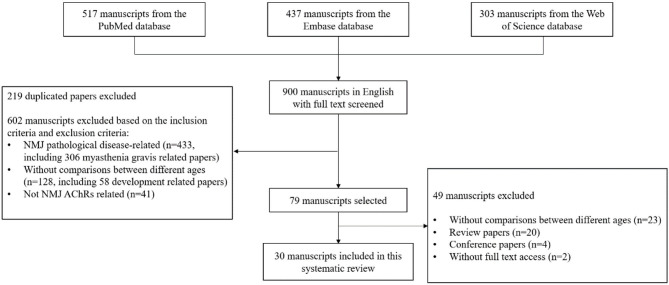
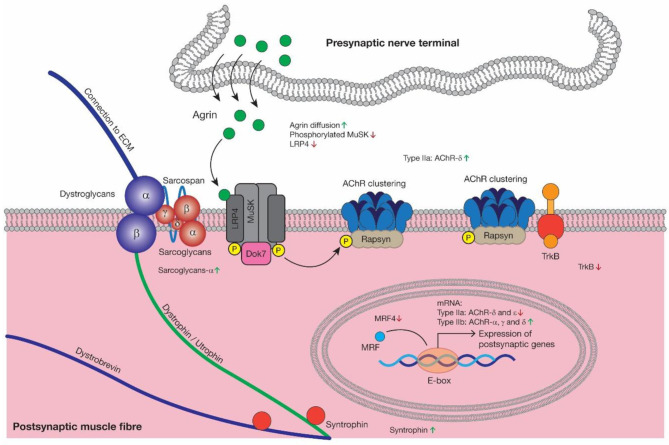
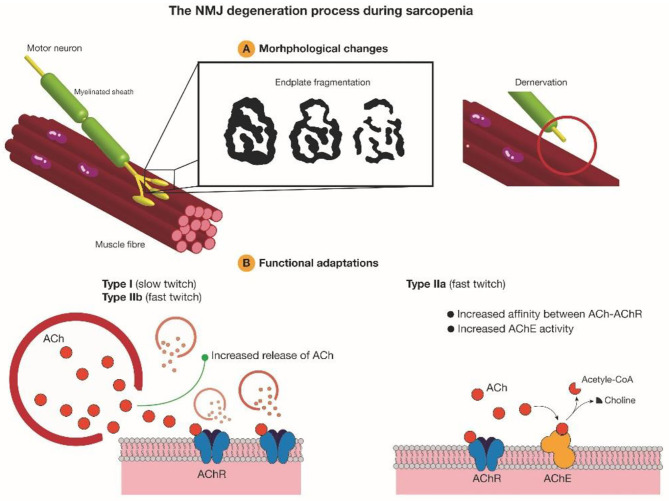
Sarcopenia is an aging process with a decline of skeletal muscle mass and function, which is a challenging public health problem with reduced quality of life in patients. The endplate, the post-synaptic part of the neuromuscular junction (NMJ), occupies 0.1% of the myofiber surface area only, but is composed of millions of acetylcholine receptors (AChRs) that are efficient in binding to acetylcholine (ACh) and triggering skeletal muscle contraction. This systematic review aims to examine aging-associated alterations of post-synaptic AChRs, including morphology, function and related gene expression. A systematic literature search was conducted in PubMed, Embase and Web of Science with relevant keywords by two independent reviewers. Original pre-clinical and clinical studies regarding AChRs changes during aging with available full text and written in English were included. Information was extracted from the included studies for further review. In total, 30 articles were included. Various parameters assessing AChRs alterations by radioassay, immunofluorescence, electrophysiology and mechanical test were reported. Endplate fragmentation and denervation were common in old skeletal muscles during aging. To ensure efficient NMJ transmission and force generation, type I or IIb muscle fibers tended to have increased ACh quanta releasing after electrical stimulations, while type IIa muscle fibers tended to have stronger binding between ACh and AChRs, but the overall function of AChRs was reduced during aging. Alterations of AChRs area depended on muscle type, species and the progress of muscle atrophy and type I muscles fibers tended to demonstrate enlarging AChRs areas. Myogenic regulator factors (MRFs) can regulate the expression of AChRs subunits, while decreased MRF4 may lead to expression changes of AChRs subunits during aging. Sarcoglycan-α can delay low-density lipoprotein receptor-related protein 4 (LRP4) degradation. This protein was increased in old muscles but still cannot suppress the degradation of LRP4. Investigating the role of these AChRs-related genes in the process of aging may provide a potential target to treat sarcopenia.
肌肉减少症是一种骨骼肌质量和功能下降的衰老过程,是一个具有挑战性的公共卫生问题,会降低患者的生活质量。终板是神经肌肉接头(NMJ)的突触后部分,仅占肌纤维表面积的0.1%,但由数百万个乙酰胆碱受体(AChRs)组成,这些受体能有效地结合乙酰胆碱(ACh)并触发骨骼肌收缩。本系统评价旨在研究突触后AChRs与衰老相关的改变,包括形态、功能及相关基因表达。两名独立评价者通过相关关键词在PubMed、Embase和Web of Science中进行了系统的文献检索。纳入了关于衰老过程中AChRs变化的原始临床前和临床研究,要求有全文且为英文撰写。从纳入的研究中提取信息进行进一步审查。共纳入30篇文章。报告了通过放射分析、免疫荧光、电生理学和机械测试评估AChRs改变的各种参数。衰老过程中,终板碎片化和去神经支配在老年骨骼肌中很常见。为确保有效的NMJ传递和力量产生,I型或IIb型肌纤维在电刺激后倾向于增加ACh量子释放,而IIa型肌纤维倾向于使ACh与AChRs之间的结合更强,但衰老过程中AChRs的整体功能降低。AChRs面积的改变取决于肌肉类型、物种以及肌肉萎缩的进程,I型肌纤维倾向于表现出AChRs面积增大。生肌调节因子(MRFs)可调节AChRs亚基的表达,而衰老过程中MRF4减少可能导致AChRs亚基的表达变化。肌聚糖-α可延缓低密度脂蛋白受体相关蛋白4(LRP4)的降解。该蛋白在老年肌肉中增加,但仍无法抑制LRP4的降解。研究这些与AChRs相关基因在衰老过程中的作用可能为治疗肌肉减少症提供潜在靶点。