ElLithy May Hassan, Salah Hager, Abdelghani Lamyaa Samir, Assar Walid, Corbally Martin
Head Pharmaceutical Quality Services Department, King Hamad University Hospital, Bahrain, Founder of QuaMay (for Hospital Quality Improvement & Patient Safety Consultation, Training, and Education services), UAE.
Pharmaceutical Services Department, Research Coordinator -AMS Pharmacist, King Hamad University Hospital, Bahrain.
Saudi Pharm J. 2023 Sep;31(9):101726. doi: 10.1016/j.jsps.2023.101726. Epub 2023 Aug 5.
The benchmarking for medication incidents rate is not regarded as a recognized key performance measure or indicator in national or international organizations. The absence of benchmarking the medication incidents results in the loss of a self-governing perception of how well we performed compared to other peers.
This 600-bed tertiary, Joint Commission International (JCI) accredited hospital retrospective analysis looked at all medication management-related events from January-2018 to December-2021. The study design follows descriptive, cross-sectional, retrospective prevalence research.
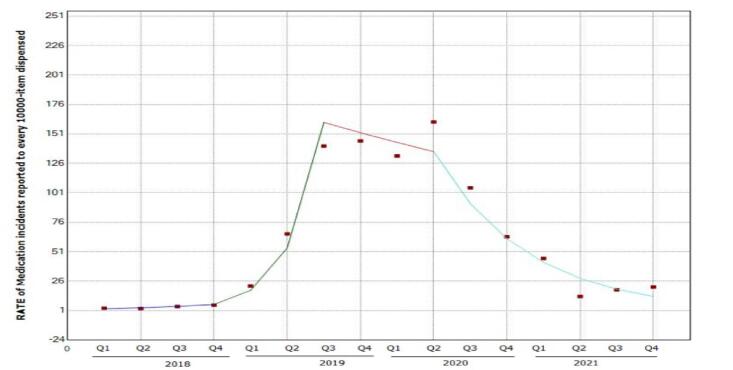
The rate of medication incidents that resulted in harm declined from Q3-2019 to Q4-2021. A significant increase in Pharmacy interventions/clarifications was recorded. Additionally, a significant increase in incidents reported with no-harm coupled with a significant reduction in incidences of serious events from 2019 to 2020. Finally, no-harm events were significantly reduced from 2020 to 2021.
The Pharmacy's study analyzed every medication incident documented from 2019 to 2021. 99.7% of reported incidents were classified as no-harm (near misses). There was an exponential decrease from Q1-2020 to Q1-202. A significant increase in incidents fell in the category of (near misses) with no-harm and a significant reduction in serious events. Pharmacy interventions/clarifications saw a massive increase and impact from Q3-2018 to Q2-2019, compared to the same period in 2018. By preventing medical incidents, benchmarking, and analyzing incidents and the reporting system, the use of information technology could dramatically reduce the rate of drug incidents.
This study found that benchmarking medication incidents is valuable, as it can help identify areas where improvements can be made, implement strategies to improve safety, and track progress over time. The benchmark was recommended to be below 100 incidents for every 10,000 prescriptions/orders processed, and for E-I categories, below one incident for every 10,000 prescriptions/orders processed. This will help develop a worldwide standard with an absolved culture with non-punitive consequences.
用药事件发生率的基准在国家或国际组织中不被视为公认的关键绩效指标。缺乏用药事件的基准导致无法自我评估与其他同行相比我们的表现如何。
这项对一家拥有600张床位的三级国际联合委员会(JCI)认证医院的回顾性分析,研究了2018年1月至2021年12月期间所有与用药管理相关的事件。该研究设计遵循描述性、横断面、回顾性患病率研究。
导致伤害的用药事件发生率从2019年第三季度降至2021年第四季度。记录到药房干预/澄清显著增加。此外,无害报告事件显著增加,且2019年至2020年严重事件发生率显著降低。最后,2020年至2021年无害事件显著减少。
药房的研究分析了2019年至2021年记录的每一起用药事件。报告事件中有99.7%被归类为无害(险些失误)。从2020年第一季度到2022年第一季度呈指数下降。无害的(险些失误)类事件显著增加,严重事件显著减少。与2018年同期相比,2018年第三季度到2019年第二季度药房干预/澄清大幅增加并产生了影响。通过预防医疗事件、设定基准、分析事件和报告系统,信息技术的使用可以显著降低药品事件发生率。
本研究发现,对用药事件进行基准设定很有价值,因为它有助于确定可改进的领域,实施提高安全性的策略,并跟踪一段时间内的进展。建议每处理10000张处方/医嘱的基准低于100起事件,对于E-I类别,每处理10000张处方/医嘱低于1起事件。这将有助于制定一个具有免罚文化的全球标准。