Gherscovici Ezequiel D, Mayer John M
Research & Development, Healthy Buildings LLC, Malibu, USA.
Cureus. 2023 Aug 22;15(8):e43945. doi: 10.7759/cureus.43945. eCollection 2023 Aug.
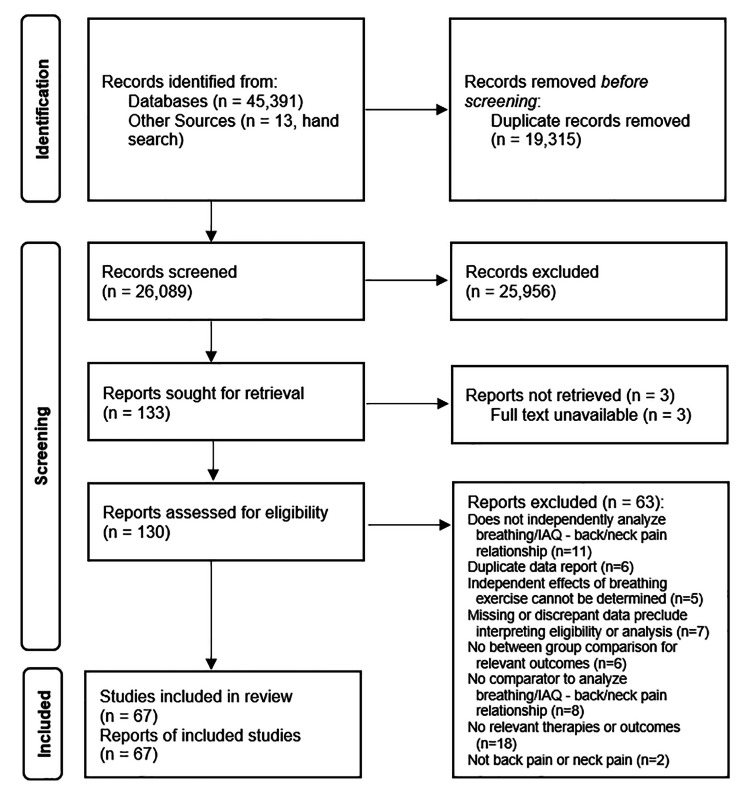
Back pain and neck pain are important public health concerns and are among the most common and disabling conditions globally. However, the relationships among indoor air quality (IAQ), breathing parameters (pulmonary function, respiratory disorders), and back pain and neck pain have not been adequately assessed. The purpose of this study was to systematically review the literature about the impact of IAQ and breathing parameters on back pain and neck pain (PROSPERO ID: CRD42022380515). CINAHL, EMBASE, PEDRo, and PubMed databases were searched through January 19, 2023. Inclusion criteria for study eligibility were observational studies (except case reports) or randomized controlled trials (RCTs), published in peer-reviewed journals in the English language, human research, original research, examined the relationships between IAQ, or breathing parameters with back pain or neck pain. Review procedures were conducted and reported according to PRISMA recommendations. Empirical evidence statements were developed for observational studies, and grades of evidence statements were developed for RCTs. Sixty-seven eligible studies were found (54 observational studies and 13 RCTs) that enrolled 345,832 participants. None of the studies assessed the combined impact of IAQ and breathing parameters on back pain or neck pain. No level 1 studies were found, which precludes making strong statements about causality and strong recommendations about the efficacy of IAQ and breathing exercise interventions for reducing pain and disability related to back pain and neck pain. Evidence indicates that poor IAQ and respiratory disorders are related to an increased risk of back pain and neck pain. Conflicting evidence exists about the association between pulmonary function with back pain and neck pain. Evidence for breathing exercise interventions was mixed with numerous limitations. This review provides preliminary evidence on the relationships of IAQ and breathing parameters with back pain and neck pain, which can be used to guide future research and clinical implementation efforts. Assuming positive findings in subsequent research, a wide range of stakeholders involved with this complex human-building-environment interface can be equipped to address IAQ and breathing parameters, along with other established risk factors to help those suffering from back pain and neck pain.
背痛和颈痛是重要的公共卫生问题,也是全球最常见且使人致残的病症之一。然而,室内空气质量(IAQ)、呼吸参数(肺功能、呼吸系统疾病)与背痛和颈痛之间的关系尚未得到充分评估。本研究的目的是系统回顾有关IAQ和呼吸参数对背痛和颈痛影响的文献(国际前瞻性系统评价注册编号:CRD42022380515)。检索了截至2023年1月19日的CINAHL、EMBASE、PEDRo和PubMed数据库。研究纳入标准为发表于同行评审英文期刊的观察性研究(病例报告除外)或随机对照试验(RCT)、人体研究、原创研究,且研究探讨了IAQ或呼吸参数与背痛或颈痛之间的关系。根据系统评价和Meta分析的首选报告项目(PRISMA)建议进行并报告了综述程序。为观察性研究制定了实证证据陈述,为RCT制定了证据陈述等级。共发现67项符合条件的研究(54项观察性研究和13项RCT),涉及345,832名参与者。没有一项研究评估IAQ和呼吸参数对背痛或颈痛的综合影响。未发现一级研究,这使得无法就因果关系做出有力陈述,也无法就IAQ和呼吸锻炼干预措施对减轻与背痛和颈痛相关的疼痛及残疾的疗效提出强有力的建议。有证据表明,不良的IAQ和呼吸系统疾病与背痛和颈痛风险增加有关。关于肺功能与背痛和颈痛之间的关联,存在相互矛盾的证据。呼吸锻炼干预措施的证据好坏参半,且存在诸多局限性。本综述提供了关于IAQ和呼吸参数与背痛和颈痛关系的初步证据,可用于指导未来的研究和临床实践工作。假设后续研究有积极结果,那么涉及这个复杂的人与建筑环境界面的众多利益相关者就能够着手解决IAQ和呼吸参数问题,以及其他已确定的风险因素,以帮助那些患有背痛和颈痛的人。