Department of Mining Engineering, NITK Surathkal, Mangaluru, India.
Sci Rep. 2023 Aug 28;13(1):14055. doi: 10.1038/s41598-023-40507-9.
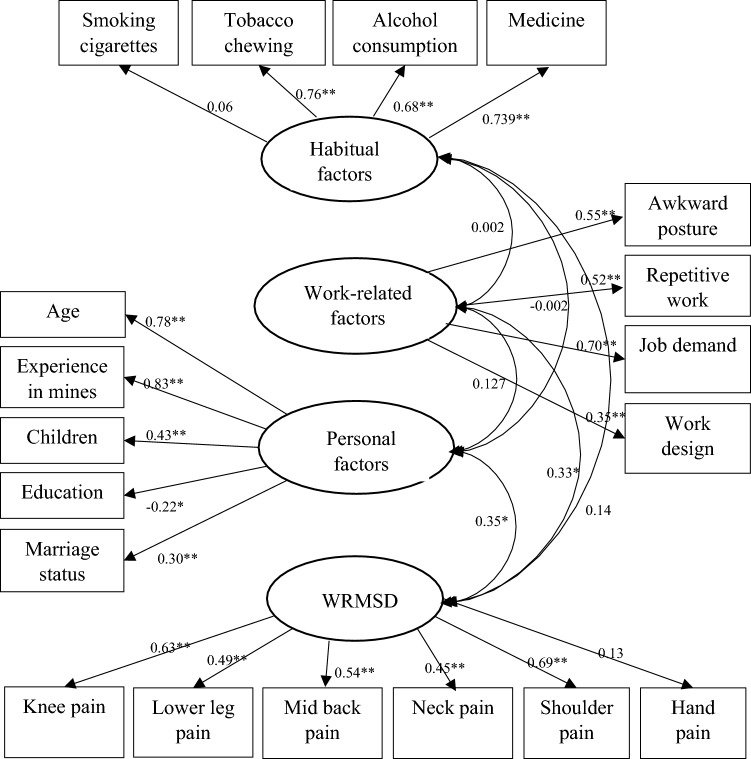
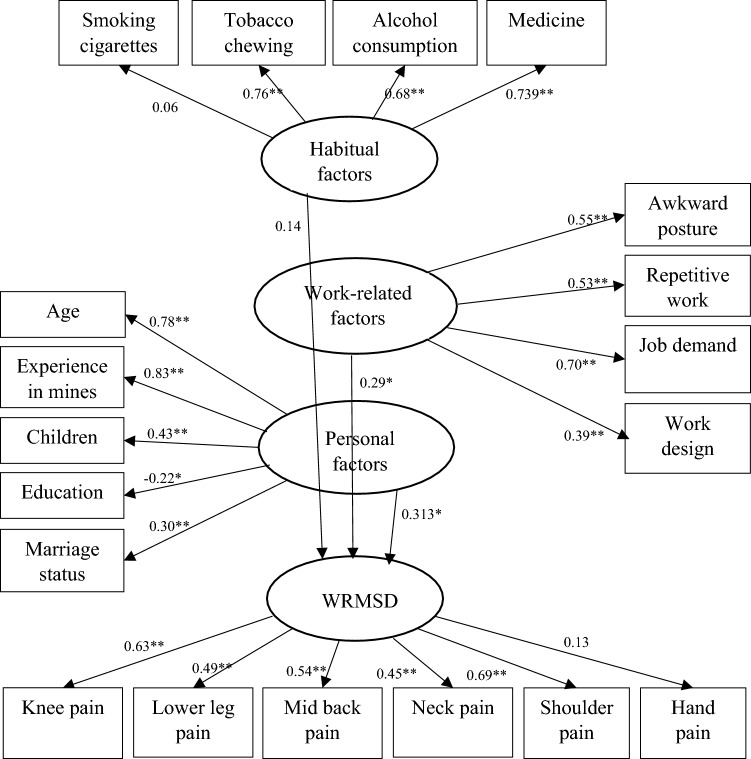
The aim of this study is to investigate the impact of personal factors, habitual factors, and work-related factors on work-related musculoskeletal disorders (WRMSDs) among dumper operators. In total, 248 dumper operators working in an iron ore mine were considered for this study. A questionnaire was developed and administered to collect dumper operators' personal, habitual, and work-related data. The reliability of the questionnaire was cross-checked by Cronbach alpha and the test-retest method. The values of Cronbach alpha for all latent variables were above 0.7, and the correlation coefficient of the questionnaire items at Time 1 and Time 2 was above 0.82. After verifying the validity (i.e., convergent and divergent) of the questionnaire data, the relationship between the factors under consideration was examined by structural equation modeling (SEM). The SEM demonstrated a moderate fit, with [Formula: see text] value of 1.386, comparative fit index (CFI) of 0.86, goodness-of-fit index (GFI) of 0.72, adjusted goodness-of-fit index (AGFI) of 0.69, Tucker-Lewis Index (TLI) of 0.83, normed fit index (NFI) of 0.71 and root mean square error of approximation (RMSEA) of 0.051. The SEM analysis revealed a positive relationship between WRMSDs and personal factors (with path coefficient = 0.313 and p < 0.05) as well as work-related factors (with path coefficient = 0.296 and p < 0.05). However, the relationship between WRMSDs and habitual factors was not statistically significant (with path coefficient = 0.142 and p > 0.05). Overall, this study provides valuable insights into the factors that influence the prevalence of WRMSDs among dumper operators. The findings highlight the significance of personal and work-related factors by which one can make a positive decision to prevent and reduce the incidence of WRMSDs among dumper operators.
本研究旨在探讨个人因素、习惯性因素和与工作相关的因素对自卸车司机与工作相关的肌肉骨骼疾病(WRMSD)的影响。共有 248 名在铁矿石矿山工作的自卸车司机参与了这项研究。设计了一份问卷,以收集自卸车司机的个人、习惯性和与工作相关的数据。通过 Cronbach alpha 检验和重测法检验了问卷的可靠性。所有潜在变量的 Cronbach alpha 值均高于 0.7,问卷项目在时间 1 和时间 2 的相关系数均高于 0.82。在验证问卷数据的有效性(即收敛性和发散性)后,通过结构方程模型(SEM)检验了所考虑因素之间的关系。SEM 显示出中等的拟合度,[Formula: see text]值为 1.386,比较拟合指数(CFI)为 0.86,拟合优度指数(GFI)为 0.72,调整拟合优度指数(AGFI)为 0.69,Tucker-Lewis 指数(TLI)为 0.83,归一化拟合指数(NFI)为 0.71,近似均方根误差(RMSEA)为 0.051。SEM 分析表明,WRMSD 与个人因素(路径系数=0.313,p<0.05)和与工作相关的因素(路径系数=0.296,p<0.05)呈正相关。然而,WRMSD 与习惯性因素之间的关系不具有统计学意义(路径系数=0.142,p>0.05)。总的来说,本研究提供了有关影响自卸车司机 WRMSD 患病率的因素的有价值的见解。研究结果强调了个人因素和与工作相关因素的重要性,人们可以通过这些因素做出积极的决策,以预防和减少自卸车司机的 WRMSD 发生率。