Schippers Philipp, Gercek Erol, Wunderlich Felix, Wollstädter Jochen, Afghanyar Yama, Arand Charlotte, Drees Philipp, Eckhard Lukas
Zentrum f. Orthopädie und Unfallchirurgie, Universitätsmedizin Mainz, Langenbeckstr. 1, 55131, Mainz, Deutschland.
Unfallchirurgie (Heidelb). 2024 Mar;127(3):221-227. doi: 10.1007/s00113-023-01359-0. Epub 2023 Aug 29.
Proximal femoral fractures represent the most frequent fracture entity in Germany accounting for more than 20% of all fractures. According to a decision of the Federal Joint Committee from 2019, proximal femoral fractures also have to be surgically treated within 24 h. In order to quantify a subjectively perceived increase in workload in trauma surgery at a supraregional trauma center, a retrospective analysis of the number of surgically treated proximal femoral fractures was performed. Proximal femoral fractures were chosen due to their high incidence and homogeneous treatment.
Using ICD-10 codes, all surgically treated proximal femoral fractures from 2016 to 2022, including the patient's zip code, were retrieved from the database of the trauma center.
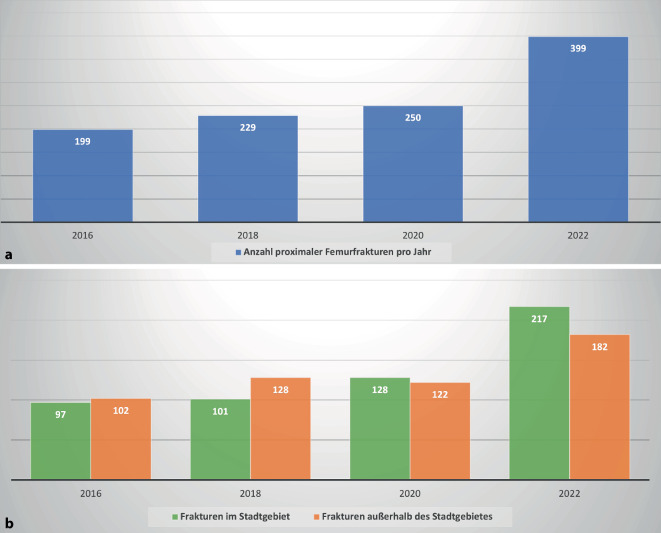
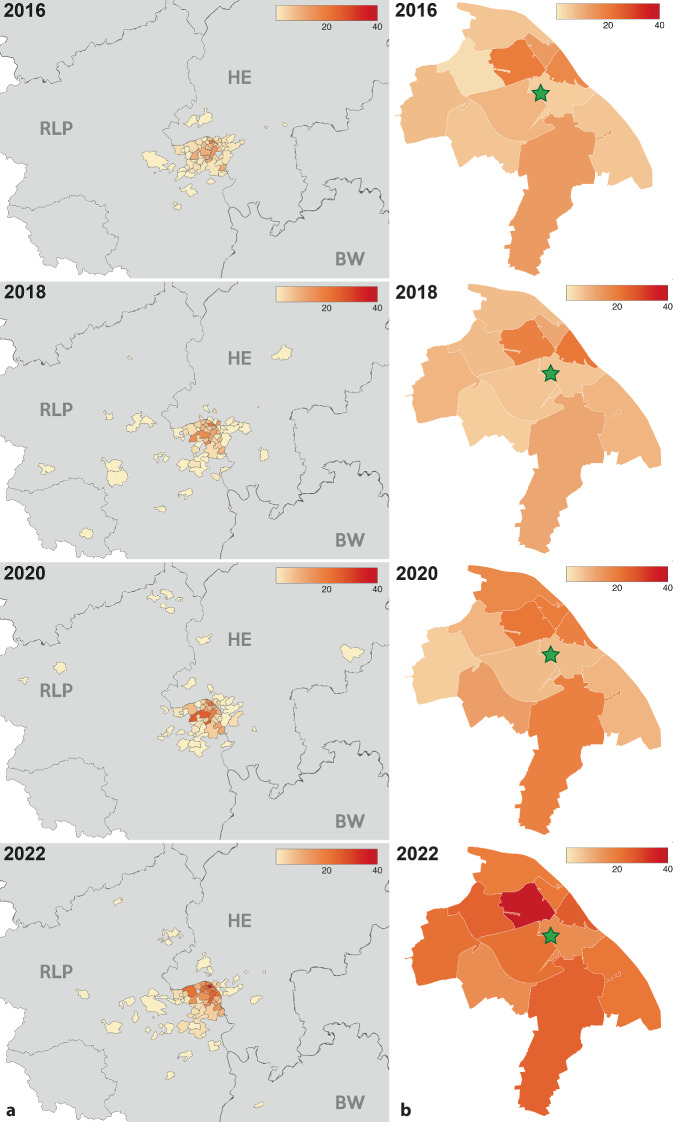
The number of surgically treated proximal femoral fractures doubled from 2016 to 2022. The highest increase (60%) was recorded from 2020 to 2022. Heat maps show an increase in the catchment area radius as well.
When compared (inter)nationally, a disproportionate increase in the amount of surgically treated proximal femoral fractures was recorded at the trauma center studied. The increase of the catchment area radius and the number of patients treated in the urban area show that less and less hospitals participate in emergency treatment. Possible explanations are a lack of resources aggravated by the recent COVID-19 pandemic and a lack of qualified personnel, interface problems between the federal states or the strict requirements of the Federal Joint Committee in the treatment of proximal femoral fractures. It must be assumed that there is a clearly increased workload for all professions involved in the trauma center investigated, although the infrastructure has remained unchanged.
股骨近端骨折是德国最常见的骨折类型,占所有骨折的20%以上。根据联邦联合委员会2019年的一项决定,股骨近端骨折也必须在24小时内进行手术治疗。为了量化一个地区创伤中心创伤外科主观感受到的工作量增加情况,对手术治疗的股骨近端骨折数量进行了回顾性分析。选择股骨近端骨折是因为其发病率高且治疗方式统一。
使用国际疾病分类第10版(ICD - 10)编码,从创伤中心数据库中检索出2016年至2022年所有接受手术治疗的股骨近端骨折病例,包括患者的邮政编码。
2016年至2022年,手术治疗的股骨近端骨折数量翻倍。2020年至2022年增幅最大(60%)。热图显示集水区半径也有所增加。
与国际(国内)相比,在所研究的创伤中心,手术治疗的股骨近端骨折数量出现了不成比例的增加。集水区半径的增加和市区治疗患者数量的增加表明,参与急诊治疗的医院越来越少。可能的原因是近期新冠疫情加剧了资源短缺、缺乏合格人员、联邦州之间的接口问题或联邦联合委员会对股骨近端骨折治疗的严格要求。必须假定,尽管基础设施保持不变,但在所调查的创伤中心,所有相关专业的工作量都明显增加。