Department of Medicine, Memorial Sloan Kettering Cancer Center, New York, New York.
Department of Medicine, Weill Cornell Medicine, New York, New York.
Clin Cancer Res. 2023 Nov 14;29(22):4660-4668. doi: 10.1158/1078-0432.CCR-23-1078.
Tumor genomic profiling is increasingly used to guide treatment strategy in patients with cancer. We integrated tumor genomic, clinical demographic, and treatment response data to assess how prospective tumor-normal sequencing impacted treatment selection in patients with cervical cancer.
Cervical cancers were prospectively analyzed using the MSK-IMPACT (Memorial Sloan Kettering Cancer Center - Integrated Mutation Profiling of Actionable Cancer Targets) next-generation sequencing panel. Clinical data, including histology, stage at diagnosis, treatment history, clinical trial enrollment and outcomes, date of last follow-up, and survival status were obtained from medical records.
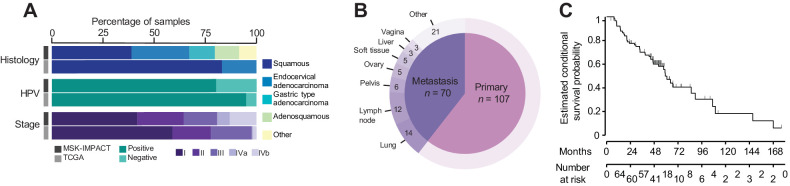
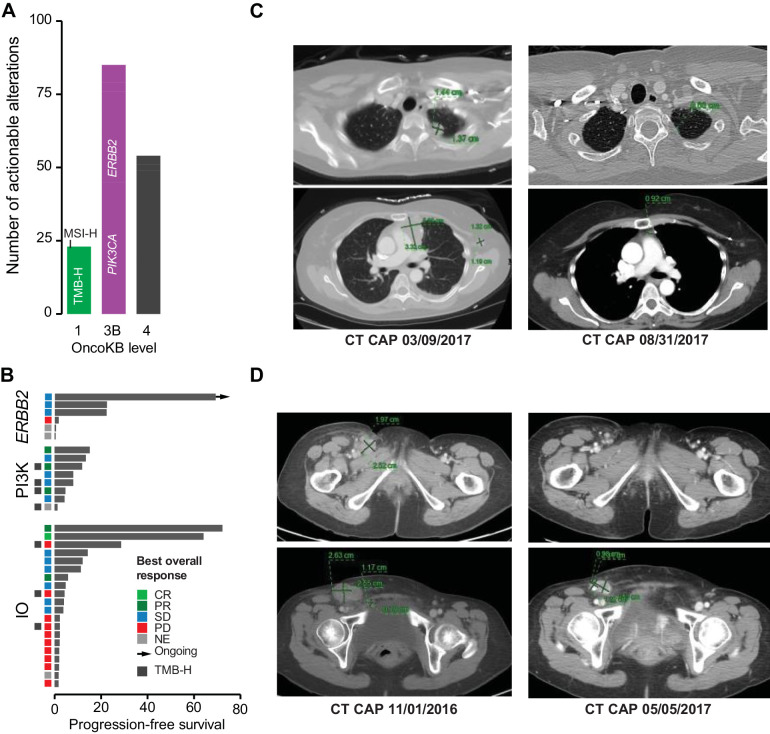
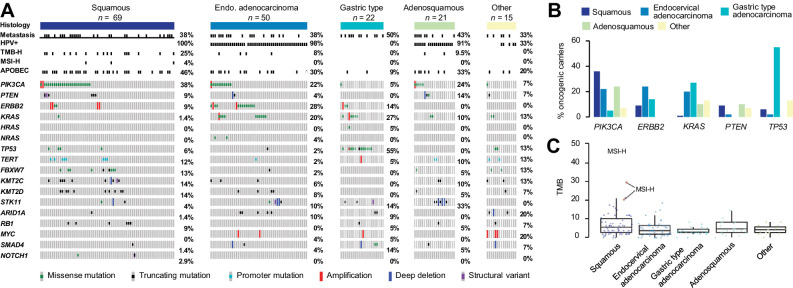
A total of 177 patients with cervical cancer (squamous, 69; endocervical adenocarcinoma, 50; gastric type, 22; adenosquamous, 21; and other, 15) underwent MSK-IMPACT testing. The most prevalent genomic alterations were somatic mutations or amplifications in PIK3CA (25%), ERBB2 (12%), KMT2C (10%), and KMT2D (9%). Furthermore, 13% of patients had high tumor mutational burden (TMB >10 mut/Mb), 3 of which were also microsatellite instability-high (MSI-H). Thirty-seven percent of cases had at least one potentially actionable alteration designated as a level 3B mutational event according to the FDA-recognized OncoKB tumor mutation database and treatment classification system. A total of 30 patients (17%) were enrolled on a therapeutic clinical trial, including 18 (10%) who were matched with a study based on their MSK-IMPACT results. Twenty patients (11%) participated in an immune checkpoint inhibition study for metastatic disease; 2 remain progression free at >5 years follow-up.
Tumor genomic profiling can facilitate the selection of targeted/immunotherapies, as well as clinical trial enrollment, for patients with cervical cancer.
肿瘤基因组分析越来越多地用于指导癌症患者的治疗策略。我们整合了肿瘤基因组、临床人口统计学和治疗反应数据,以评估前瞻性肿瘤-正常测序如何影响宫颈癌患者的治疗选择。
使用 MSK-IMPACT(纪念斯隆凯特琳癌症中心-综合行动癌症靶点突变分析)下一代测序面板对宫颈癌进行前瞻性分析。从病历中获得了临床数据,包括组织学、诊断时的分期、治疗史、临床试验入组和结果、末次随访日期和生存状况。
共 177 例宫颈癌患者(鳞状细胞癌 69 例、子宫内膜腺癌 50 例、胃型腺癌 22 例、腺鳞癌 21 例和其他类型 15 例)接受了 MSK-IMPACT 检测。最常见的基因组改变是 PIK3CA(25%)、ERBB2(12%)、KMT2C(10%)和 KMT2D(9%)的体细胞突变或扩增。此外,13%的患者有高肿瘤突变负荷(TMB>10 mut/Mb),其中 3 例还为微卫星不稳定高(MSI-H)。根据 FDA 认可的 OncoKB 肿瘤突变数据库和治疗分类系统,37%的病例至少有一个被指定为 3B 级突变事件的潜在可操作改变。共有 30 名患者(17%)参加了治疗性临床试验,其中 18 名(10%)根据 MSK-IMPACT 结果与一项研究匹配。20 名患者(11%)参加了转移性疾病的免疫检查点抑制研究;2 名患者在 >5 年的随访中仍无疾病进展。
肿瘤基因组分析可以为宫颈癌患者选择靶向/免疫治疗以及临床试验入组提供便利。