Institute of Epidemiology and Medical Biometry, Ulm University, Ulm, Germany.
Division of Clinical Epidemiology and Aging Research, German Cancer Research Center (DKFZ), Heidelberg, Germany.
BMC Cardiovasc Disord. 2023 Aug 29;23(1):428. doi: 10.1186/s12872-023-03469-4.
This study aimed to describe the characteristics and mortality of two cohorts of patients with chronic coronary syndrome (CCS) recruited with identical study designs in the same rehabilitation clinics but approximately 10 years apart.
The KAROLA cohorts included patients with CCS participating in an inpatient cardiac rehabilitation programme in Germany (KAROLA-I: years 1999/2000, KAROLA-II: 2009-2011). Blood samples and information on sociodemographic factors, lifestyle, and medical treatment were collected at baseline, at the end of rehabilitation, and after one year of follow-up. A biomarker-based risk model (ABC-CHD model) and Cox regression analysis were used to evaluate cardiovascular (CV) and non-CV mortality risk.
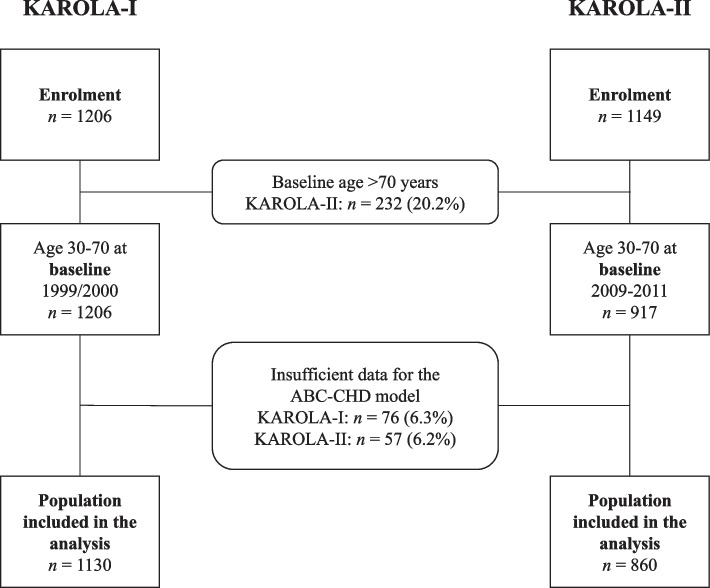
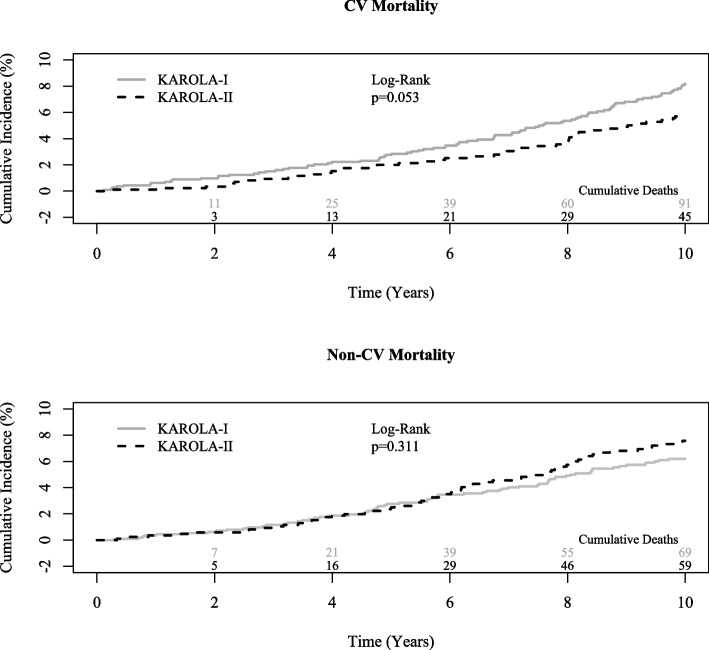
We included 1130 patients from KAROLA-I (mean age 58.7 years, 84.4% men) and 860 from KAROLA-II (mean age 60.4 years, 83.4% men). Patients in the KAROLA-I cohort had significantly higher concentrations of CV biomarkers and fewer patients were taking CV medications, except for statins. The biomarker-based ABC-CHD model provided a higher estimate of CV death risk for patients in the KAROLA-I cohort (median 3-year risk, 3.8%) than for patients in the KAROLA-II cohort (median 3-year risk, 2.7%, p-value for difference < 0.001). After 10 years of follow-up, 91 (8.1%) patients in KAROLA-I and 45 (5.2%) in KAROLA-II had died from a CV event.
Advances in disease management over the past 20 years may have led to modest improvements in pharmacological treatment during cardiac rehabilitation and long-term outpatient care for patients with CCS. However, modifiable risk factors such as obesity have increased in the more recent cohort and should be targeted to further improve the prognosis of these patients.
本研究旨在描述两个慢性冠状动脉综合征(CCS)患者队列的特征和死亡率,这些患者是在同一家康复诊所、采用相同的研究设计招募的,但时间相隔约 10 年。
KAROLA 队列纳入了在德国接受住院心脏康复计划的 CCS 患者(KAROLA-I:1999/2000 年,KAROLA-II:2009-2011 年)。在基线、康复结束时和随访 1 年后采集血样和社会人口因素、生活方式和医疗信息。采用生物标志物为基础的风险模型(ABC-CHD 模型)和 Cox 回归分析评估心血管(CV)和非 CV 死亡率风险。
我们纳入了 KAROLA-I 队列中的 1130 例患者(平均年龄 58.7 岁,84.4%为男性)和 KAROLA-II 队列中的 860 例患者(平均年龄 60.4 岁,83.4%为男性)。KAROLA-I 队列的患者 CV 生物标志物浓度显著升高,除他汀类药物外,接受 CV 药物治疗的患者也较少。基于生物标志物的 ABC-CHD 模型对 KAROLA-I 队列患者的 CV 死亡风险评估更高(中位 3 年风险 3.8%),高于 KAROLA-II 队列患者(中位 3 年风险 2.7%,p 值<0.001)。随访 10 年后,KAROLA-I 队列中有 91 例(8.1%)患者和 KAROLA-II 队列中有 45 例(5.2%)患者因 CV 事件死亡。
过去 20 年来,疾病管理的进步可能导致 CCS 患者在心脏康复和长期门诊治疗期间的药物治疗略有改善。然而,在最近的队列中,可改变的危险因素(如肥胖)有所增加,应针对这些因素进一步改善这些患者的预后。