Department of Psychiatry, Hallym University College of Medicine, Chuncheon, Gangwon, 24252, Republic of Korea.
Department of Neuropsychiatry, Hallym University Dongtan Sacred Heart Hospital, 7 Keunjaebong-Gil, Hwaseong, Gyeonggi, 18450, Republic of Korea.
Alzheimers Res Ther. 2023 Aug 29;15(1):143. doi: 10.1186/s13195-023-01293-8.
Little is known about the associations of midlife- and late life-initiated walking with Alzheimer's disease (AD)-related cognitive decline in humans. We aimed to investigate whether high-intensity, prolonged, midlife-initiated walking is associated with changes in AD-related cognitive decline in physically capable older adults.
We studied 188 physically capable participants aged 65-90 years without dementia who underwent comprehensive clinical assessment, including of their walking modality (i.e., intensity, duration, midlife- or late life-onset), memory- or non-memory and total cognitive performance, and blood or nutritional biomarkers.
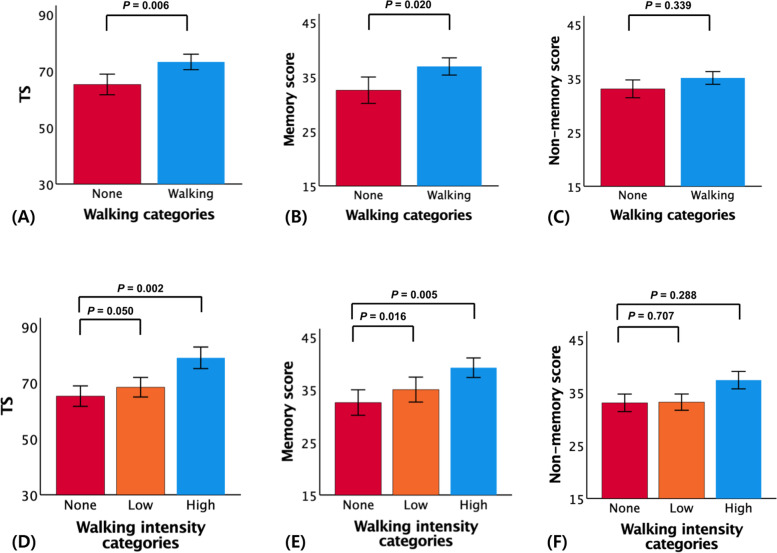
The walking group showed better episodic memory (B = 2.852, SE = 1.214, β = 0.144, p = 0.020), but not non-memory cognition, than the non-walking group. High-intensity walking starting in midlife was significantly associated with better episodic memory (B = 9.360, SE = 3.314, β = 0.446, p = 0.005) compared to the non-walking group. In contrast, there were no differences in cognition according to walking duration, regardless of the onset time. The walking group also showed a similar association with overall cognition.
Among physically capable older adults without dementia, walking, particularly at high intensity and starting in midlife, is associated with improved episodic memory, an AD-related cognitive domain. Further attention should be paid to the role of walking in terms of AD prevention.
关于中年和晚年开始的步行与人类阿尔茨海默病(AD)相关认知能力下降的关联知之甚少。我们旨在研究高强度、长时间、中年开始的步行是否与身体能力较强的老年人 AD 相关认知能力下降的变化有关。
我们研究了 188 名身体能力较强的 65-90 岁无痴呆症参与者,他们接受了全面的临床评估,包括他们的步行方式(即强度、持续时间、中年或晚年开始)、记忆或非记忆和总认知表现,以及血液或营养生物标志物。
与非步行组相比,步行组的情景记忆(B=2.852,SE=1.214,β=0.144,p=0.020)更好,但非记忆认知能力却没有。与非步行组相比,中年开始的高强度步行与更好的情景记忆(B=9.360,SE=3.314,β=0.446,p=0.005)显著相关。相比之下,无论起始时间如何,步行时间与认知能力均无差异。步行组在整体认知方面也表现出类似的关联。
在没有痴呆症的身体能力较强的老年人中,步行,特别是高强度和中年开始的步行,与改善情景记忆有关,情景记忆是 AD 相关的认知领域。应进一步关注步行在预防 AD 方面的作用。