Department of Neonatology, Cerrahpasa Faculty of Medicine, Istanbul University-Cerrahpasa, Kocamustafapasa, Fatih, Istanbul, 34098, Turkey.
Department of Pediatric Endocrinology, Cerrahpasa Faculty of Medicine, Istanbul University-Cerrahpasa, Kocamustafapasa, Fatih, Istanbul, 34098, Turkey.
Ital J Pediatr. 2023 Aug 29;49(1):105. doi: 10.1186/s13052-023-01516-6.
Transient hypothyroxinemia of prematurity (THOP) is defined as a low level of circulating thyroxine (T4), despite low or normal thyroid-stimulating hormone (TSH) levels.
We aimed to evaluate the incidence of THOP, the clinical and laboratory findings of preterm infants with this condition and the levothyroxine (L-T4) treatment.
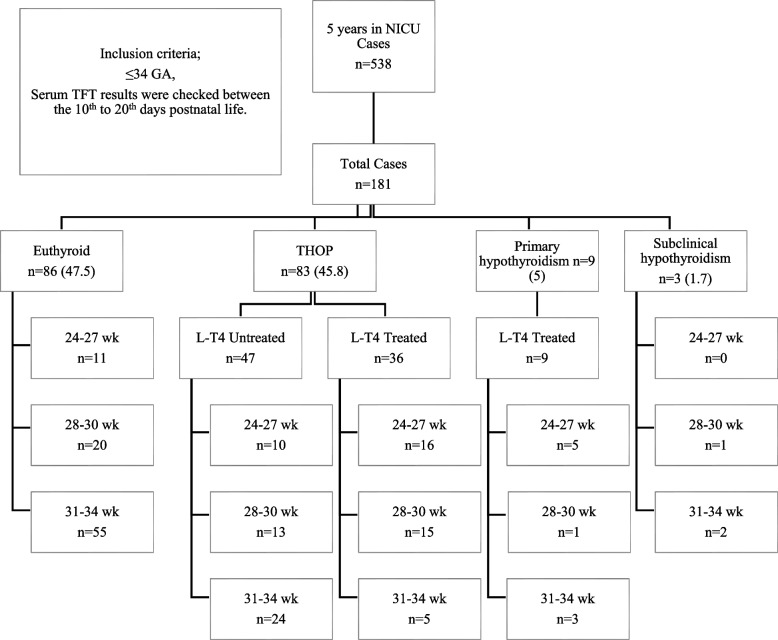
Preterm infants (n = 181) delivered at 24-34 weeks of gestation were evaluated by their thyroid function tests that were performed between the 10 and 20 days of postnatal life and interpreted according to the gestational age (GA) references. Clinical and laboratory characteristics of the patients with THOP and normal thyroid function tests were compared. Patients with THOP and treated with L-T4 were compared with the ones who were not regarding laboratory, and clinical characteristics.
Incidence of hypothyroxinemia of prematurity was 45.8% (n = 83). Euthyroidism, primary hypothyroidism, and subclinical hypothyroidism were diagnosed in 47.5% (n = 86), 5% (n = 9) and 1.7% (n = 3) of the patients, respectively. Mean birth weight (BW) and GA were significantly lower in the hypothyroxinemia group than in the euthyroid group (p < 0.001). L-T4 was started in 43% (n = 36) of the patients with THOP. Treatment initiation rate was 44.4% (n = 16) in 24-27 wk, 41.6% (n = 15) in 28-30 wk, and 13.8% (n = 5) in 31-34 wk. As the GA increased, the incidence of THOP and the rate of treatment initiation decreased (p < 0.001). The lowest free thyroxine (FT4) cut-off value was 0.72 ng/dl in the treated group. In addition, incidences of vancomycin + amikacin, caffeine, dopamine treatments, RDS, IVH, BPD, central catheter, FFP transfusion, and ventilator support were higher in the treated group (P < 0.05).
This study revealed that prevalence of THOP increased as the GA and BW decreased. As the GA decreased, THOP patients requiring L-T4 treatment increased. Additionally, association with comorbid diseases increased the requirement of treatment.
早产儿短暂性甲状腺功能减退症(THOP)定义为尽管促甲状腺激素(TSH)水平低或正常,但循环甲状腺素(T4)水平低。
我们旨在评估 THOP 的发生率、患有这种疾病的早产儿的临床和实验室发现以及左旋甲状腺素(L-T4)的治疗情况。
评估了 24-34 周龄分娩的 181 例早产儿的甲状腺功能检查,这些检查是在出生后 10-20 天进行的,并根据胎龄(GA)参考值进行解释。比较了 THOP 患者和甲状腺功能正常患者的临床和实验室特征。比较了接受 L-T4 治疗的 THOP 患者和未接受治疗的患者的实验室和临床特征。
早产儿甲状腺功能减退症的发生率为 45.8%(n=83)。分别诊断出甲状腺功能正常、原发性甲状腺功能减退症和亚临床甲状腺功能减退症 47.5%(n=86)、5%(n=9)和 1.7%(n=3)的患者。甲状腺功能减退症组的平均出生体重(BW)和 GA 明显低于甲状腺功能正常组(p<0.001)。L-T4 开始用于 43%(n=36)的 THOP 患者。THOP 患者的治疗开始率为 24-27 周时为 44.4%(n=16),28-30 周时为 41.6%(n=15),31-34 周时为 13.8%(n=5)。随着 GA 的增加,THOP 的发生率和治疗开始率降低(p<0.001)。治疗组的游离甲状腺素(FT4)最低截断值为 0.72ng/dl。此外,治疗组万古霉素+阿米卡星、咖啡因、多巴胺治疗、RDS、IVH、BPD、中央导管、FFP 输血和呼吸机支持的发生率更高(P<0.05)。
本研究表明,随着 GA 和 BW 的降低,THOP 的患病率增加。随着 GA 的降低,需要 L-T4 治疗的 THOP 患者增加。此外,合并症的存在增加了治疗的需求。