Department of Pediatrics, Doernbecher Children's Hospital, Oregon Health & Sciences University, Portland, OR, United States.
Front Endocrinol (Lausanne). 2021 Jun 15;12:666207. doi: 10.3389/fendo.2021.666207. eCollection 2021.
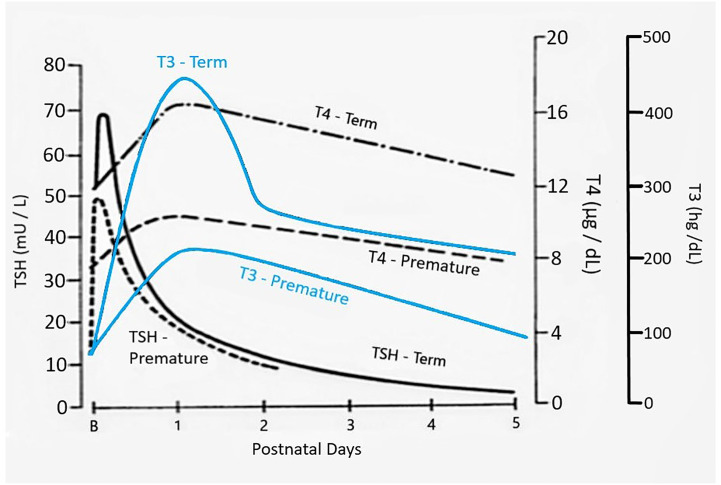
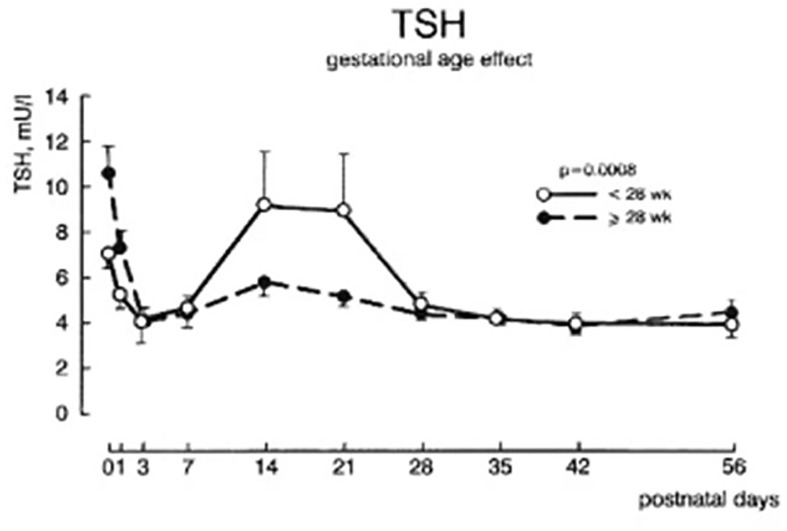
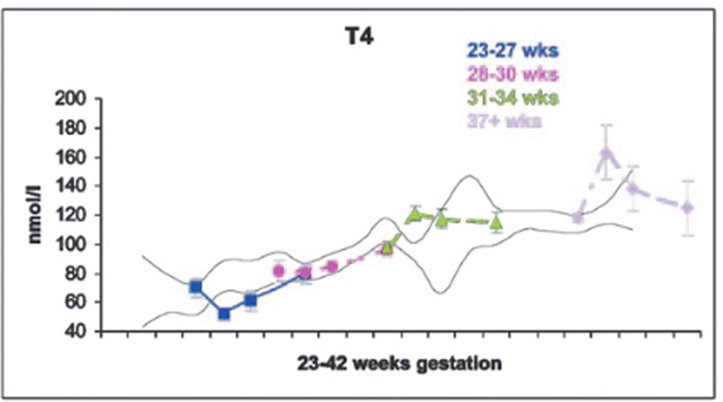
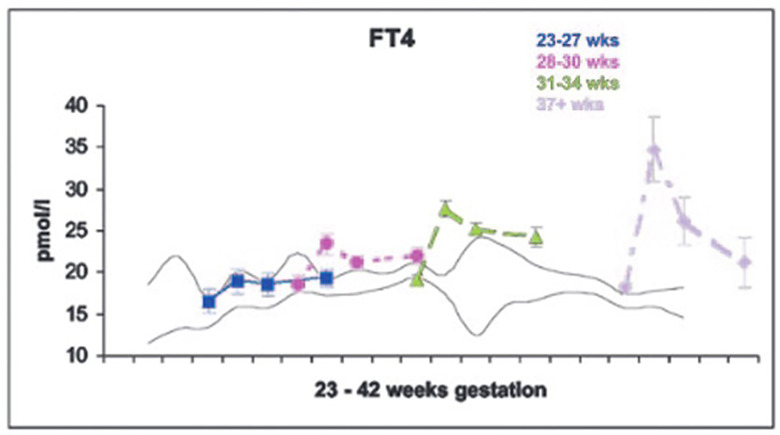
Maternal thyroid hormone crosses the placenta to the fetus beginning in the first trimester, likely playing an important role in fetal development. The fetal thyroid gland begins to produce thyroid hormone in the second trimester, with fetal serum T4 levels gradually rising to term. Full maturation of the hypothalamic-pituitary-thyroid (HPT) axis does not occur until term gestation or the early neonatal period. Postnatal thyroid function in preterm babies is qualitatively similar to term infants, but the TSH surge is reduced, with a corresponding decrease in the rise in T4 and T3 levels. Serum T4 levels are reduced in proportion to the degree of prematurity, representing both loss of the maternal contribution and immaturity of the HPT axis. Other factors, such as neonatal drugs, e.g., dopamine, and non-thyroidal illness syndrome (NTIS) related to co-morbidities contribute to the "hypothyroxinemia of prematurity". Iodine, both deficiency and excess, may impact thyroid function in infants born preterm. Overall, the incidence of permanent congenital hypothyroidism in preterm infants appears to be similar to term infants. However, in newborn screening (NBS) that employ a total T4-reflex TSH test approach, a higher proportion of preterm babies will have a T4 below the cutoff, associated with a non-elevated TSH level. In NBS programs with a primary TSH test combined with serial testing, there is a relatively high incidence of "delayed TSH elevation" in preterm neonates. On follow-up, the majority of these cases have transient hypothyroidism. Preterm/LBW infants have many clinical manifestations that might be ascribed to hypothyroidism. The question then arises whether the hypothyroxinemia of prematurity, with thyroid function tests compatible with either non-thyroidal illness syndrome or central hypothyroidism, is a physiologic or pathologic process. In particular, does hypothyroxinemia contribute to the neurodevelopmental impairment common to preterm infants? Results from multiple studies are mixed, with some randomized controlled trials in the most preterm infants born <28 weeks gestation appearing to show benefit. This review will summarize fetal and neonatal thyroid physiology, thyroid disorders specific to preterm/LBW infants and their impact on NBS for congenital hypothyroidism, examine treatment studies, and finish with comments on unresolved questions and areas of controversy.
母体甲状腺激素在妊娠早期穿过胎盘进入胎儿,可能在胎儿发育中发挥重要作用。胎儿甲状腺在妊娠中期开始产生甲状腺激素,胎儿血清 T4 水平逐渐升高至足月。下丘脑-垂体-甲状腺(HPT)轴的完全成熟直到足月妊娠或新生儿早期才会发生。早产儿出生后的甲状腺功能与足月儿相似,但 TSH 激增减少,T4 和 T3 水平相应升高。血清 T4 水平与早产儿的程度成比例降低,既代表了母体贡献的丧失,也代表了 HPT 轴的不成熟。其他因素,如新生儿药物,如多巴胺,以及与合并症相关的非甲状腺疾病综合征(NTIS),也会导致“早产儿甲状腺功能减退症”。碘无论是缺乏还是过量,都可能影响早产儿的甲状腺功能。总的来说,早产儿永久性先天性甲状腺功能减退症的发生率似乎与足月儿相似。然而,在采用总 T4-反射 TSH 测试方法的新生儿筛查(NBS)中,更多的早产儿 T4 会低于截止值,同时 TSH 水平没有升高。在以 TSH 测试为主并结合连续测试的 NBS 项目中,早产儿的“TSH 延迟升高”发病率相对较高。在随访中,这些病例中的大多数都有短暂性甲状腺功能减退症。早产儿/低体重儿有许多临床表现可能归因于甲状腺功能减退症。那么问题来了,与非甲状腺疾病综合征或中枢性甲状腺功能减退症相符的甲状腺功能检查的早产儿甲状腺功能减退症,是一种生理或病理过程。特别是,甲状腺功能减退症是否会导致早产儿常见的神经发育障碍?多项研究的结果喜忧参半,一些针对出生时胎龄<28 周的早产儿的随机对照试验似乎显示出了益处。本综述将总结胎儿和新生儿甲状腺生理学、早产儿/低体重儿特有的甲状腺疾病及其对先天性甲状腺功能减退症 NBS 的影响,检查治疗研究,并以未解决的问题和争议领域的评论结束。