Instituto Universitário de Lisboa (ISCTE-IUL), Lisboa, Portugal.
Business Research Unit - BRU (UNIDE-IUL), Avenida das Forças Armadas, 1649-026, Lisboa, Lisboa, Portugal.
BMC Psychol. 2023 Aug 29;11(1):251. doi: 10.1186/s40359-023-01295-z.
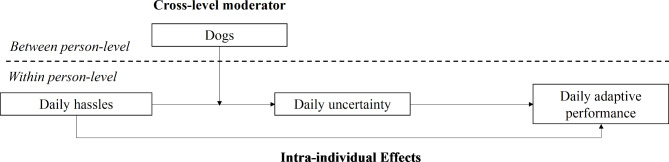
This study relied on the integrative model of uncertainty tolerance to delineate an argument proposing that daily hassles trigger uncertainty, and this influences adaptive performance. Furthermore, relying on the "furr-recovery method" -where interactions with dogs allow dog owners to recover from negative situations or job demands - this study tested whether having a dog would moderate the relationship between daily hassles and uncertainty.
To test this proposed model, daily data during ten working days was gathered with a sample of white-collar workers who were teleworking (N = 233 × 10 = 2,330).
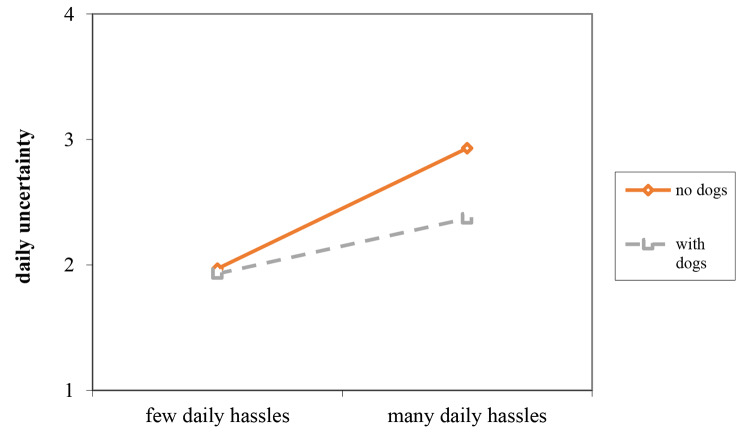
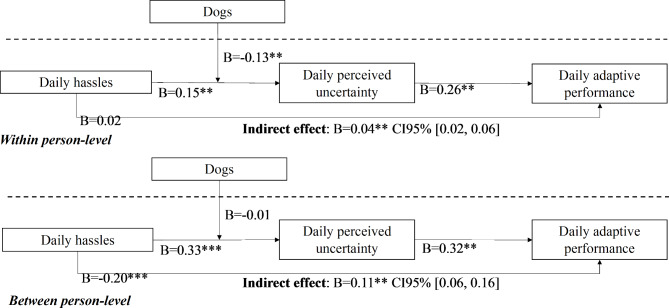
Multilevel results showed that daily hassles influenced adaptive performance via perceived uncertainty. However, the relationship between daily hassles and uncertainty was conditional on the ownership of a dog, in such a way that the relationship became weaker for those who had dogs. That is, those who did not have dogs had increased levels of uncertainty after daily hassles when compared to those who had dogs.
Managers may consider the adoption of pet-friendly work practices (for instance, telework - working from home allow employees to work nearby and interact with their dogs during worktime) as dogs appear to have a beneficial effect to help employees effectively cope with daily hassles and reduce their uncertain reactions.
This study advances knowledge regarding the pawing-effect (the reduced uncertainty to daily hassles on dog owners) on employees' uncertainty to daily hassles and opens new venues for research regarding their role in work-related outcomes. Further, future research could examine how human-dog interactions or the quality of their relationship may benefit owners and explore the benefits of bringing dogs to work periodically.
本研究依据不确定性容忍的综合模型,提出论点,即日常琐事会引发不确定性,而这种不确定性会影响适应性表现。此外,基于“fur-recovery 方法”——与狗的互动可以让狗主人从负面情况或工作要求中恢复过来——本研究测试了是否拥有一只狗会调节日常琐事和不确定性之间的关系。
为了检验这一模型,我们在一个白领远程办公者(n=233×10=2330)样本中,在十个工作日内收集了日常数据。
多层次结果表明,日常琐事通过感知不确定性影响适应性表现。然而,日常琐事和不确定性之间的关系取决于是否拥有一只狗,对于拥有狗的人来说,这种关系会减弱。也就是说,与拥有狗的人相比,没有狗的人在日常琐事之后会感到更高水平的不确定性。
管理者可能会考虑采取宠物友好型工作实践(例如远程办公——在家工作允许员工在工作时间在附近工作并与他们的狗互动),因为狗似乎对帮助员工有效应对日常琐事和减少他们不确定的反应有有益的影响。
本研究增进了对犬主的 pawing-effect(对日常琐事的不确定性减少)的了解,为员工对日常琐事的不确定性以及为研究其在工作相关结果中的作用开辟了新的途径。此外,未来的研究可以考察人与狗的互动或他们关系的质量如何使主人受益,并探索定期带狗上班的好处。