Trunjaruen Attachai, Luecha Prathan, Taratima Worasitikulya
Department of Biology, Faculty of Science, Khon Kaen University, Khon Kaen 40002, Thailand.
Department of Pharmacognosy and Toxicology, Faculty of Pharmaceutical Science, Khon Kaen University, Khon Kaen 40002, Thailand.
Scientifica (Cairo). 2023 Aug 21;2023:2983812. doi: 10.1155/2023/2983812. eCollection 2023.
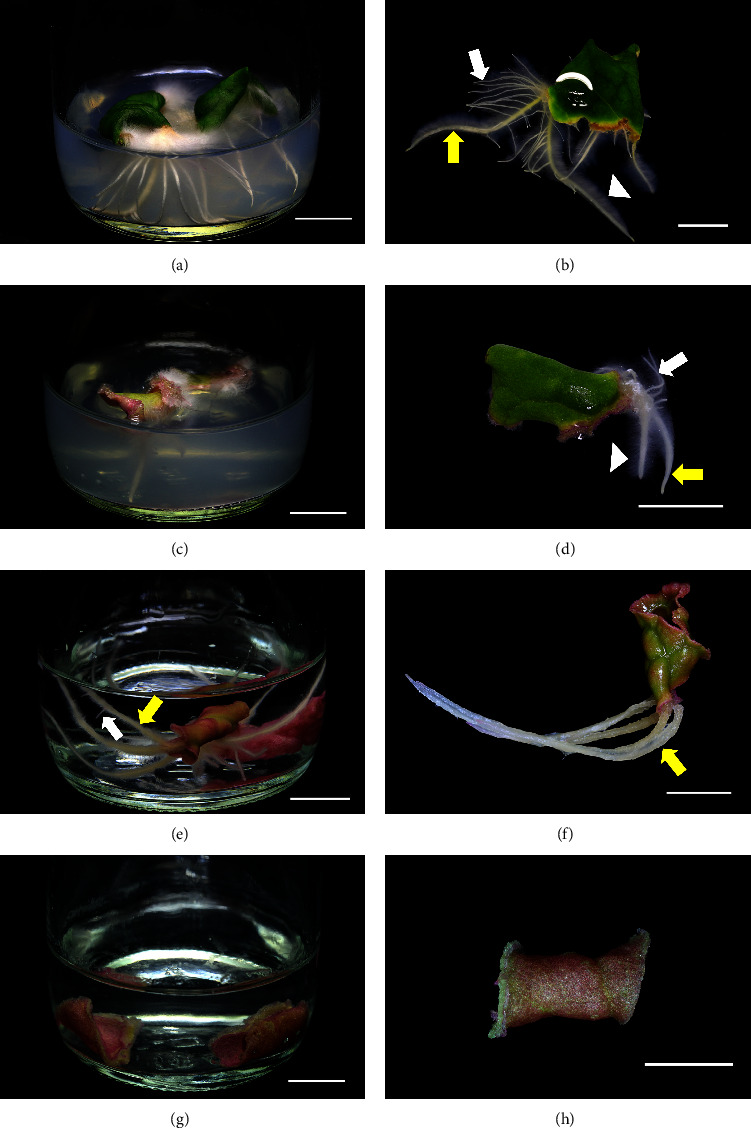
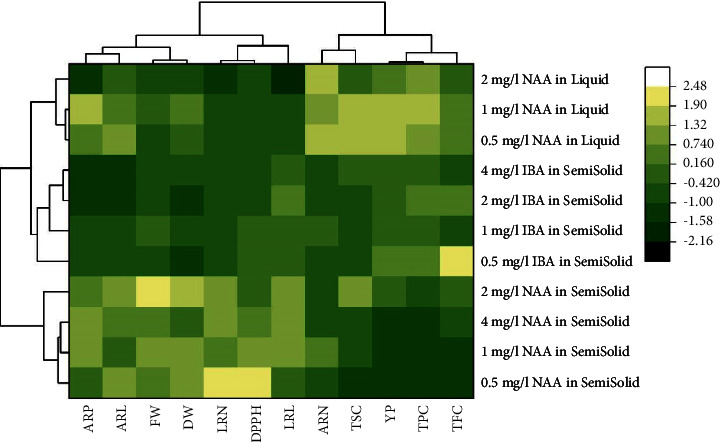
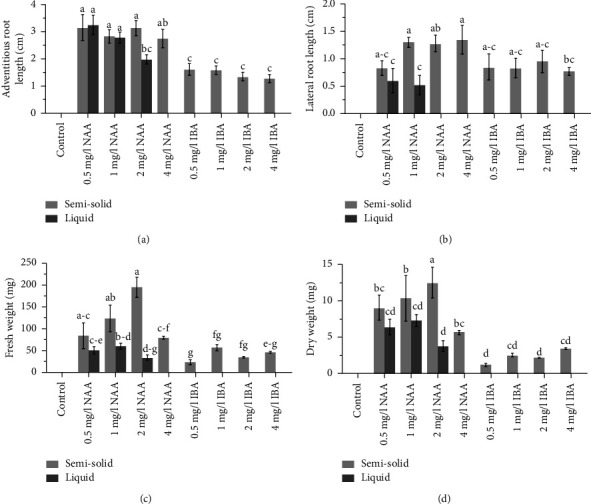
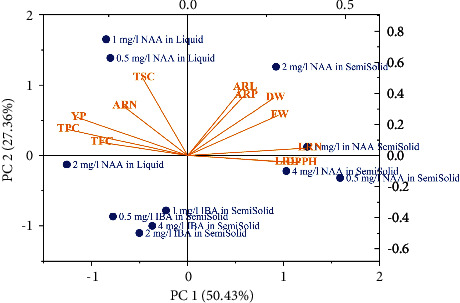
Pokeweed, L., is considered a widely spreading invasive plant, while saponin contents accumulated in the roots have pharmaceutical uses, such as rheumatism treatments and anti-inflammation. Adventitious root cultures are an important source of diverse secondary metabolites, which have significant applications in various fields. This study focused on the optimization of parameters for root induction using different medium states and treatments with auxins on a pokeweed leaf. Semisolid and liquid MS (Murashige and Skoog, 1962) media were supplemented with indole-3-butyric acid (IBA) and 1-naphthylacetic acid (NAA) at 0.5, 1, 2, and 4 mg/L. Root growth parameters, , induction percentage, root numbers, length, and weight, were measured to determine the adventitious root induction efficiency. Total phenolic content, total flavonoid content, total saponin content, and antioxidant activity were recorded. Results showed that adventitious roots induced in semisolid MS medium supplemented with 0.5 mg/L NAA exhibited a high density of lateral roots. Appropriate medium state and auxin for adventitious root induction in pokeweed were determined as semisolid medium supplemented with 2 mg/L NAA. Considering phytochemicals, adventitious roots induced in liquid medium containing 0.5-1 mg/L NAA had the highest yield extract percentage. Additionally, adventitious roots cultivated in a liquid medium enriched with 1 mg/L NAA exhibited the highest phenolic and saponin contents. A principal component analysis (PCA) biplot and hierarchical cluster analysis (HCA) heatmap demonstrated different response patterns between semisolid and liquid media applied with NAA. The results of the semisolid media were grouped together due to high expression levels of the root induction parameters, while elevated phytochemical values were observed in the liquid media treatments. The results suggested two different media that provide the highest adventitious root induction efficiency and the greatest phytochemical contents: semisolid medium with 2 mg/L NAA and liquid medium with 1 mg/L NAA, respectively. These culture media can be applied to optimize adventitious root culture of pokeweed and phytochemical production.
商陆(Phytolacca americana L.)被认为是一种广泛传播的入侵植物,而其根中积累的皂苷成分具有药用价值,如用于治疗风湿病和抗炎。不定根培养是多种次生代谢产物的重要来源,这些次生代谢产物在各个领域都有重要应用。本研究聚焦于使用不同的培养基状态以及用生长素处理商陆叶片来优化根诱导参数。半固体和液体MS(Murashige和Skoog,1962)培养基分别添加了浓度为0.5、1、2和4 mg/L的吲哚-3-丁酸(IBA)和1-萘乙酸(NAA)。通过测量根生长参数,如诱导率、根数、根长和根重,来确定不定根诱导效率。记录总酚含量、总黄酮含量、总皂苷含量和抗氧化活性。结果表明,在添加0.5 mg/L NAA的半固体MS培养基中诱导的不定根侧根密度较高。确定商陆不定根诱导的合适培养基状态和生长素为添加2 mg/L NAA的半固体培养基。从植物化学物质角度考虑,在含有0.5 - 1 mg/L NAA的液体培养基中诱导的不定根提取物产率最高。此外,在富含1 mg/L NAA的液体培养基中培养的不定根酚类和皂苷含量最高。主成分分析(PCA)双标图和层次聚类分析(HCA)热图显示了添加NAA的半固体和液体培养基之间不同的响应模式。半固体培养基的结果因根诱导参数的高表达水平而聚集在一起,而在液体培养基处理中观察到植物化学物质值升高。结果表明有两种不同的培养基分别提供最高的不定根诱导效率和最大的植物化学物质含量:分别是添加2 mg/L NAA的半固体培养基和添加1 mg/L NAA的液体培养基。这些培养基可用于优化商陆不定根培养和植物化学物质生产。