
甲醇中酚类与2,2-二苯基-1-苦基肼基(dpph˙)反应的浓度依赖性HAT/ET机制
Concentration-dependent HAT/ET mechanism of the reaction of phenols with 2,2-diphenyl-1-picrylhydrazyl (dpph˙) in methanol.
作者信息
Przybylski Paweł, Konopko Adrian, Łętowski Piotr, Jodko-Piórecka Katarzyna, Litwinienko Grzegorz
机构信息
University of Warsaw, Faculty of Chemistry Pasteura 1 02-093 Warsaw Poland
Polish Academy of Science, Institute of Experimental Biology Pasteura 3 02-093 Warsaw Poland.
出版信息
RSC Adv. 2022 Mar 15;12(13):8131-8136. doi: 10.1039/d2ra01033j. eCollection 2022 Mar 8.
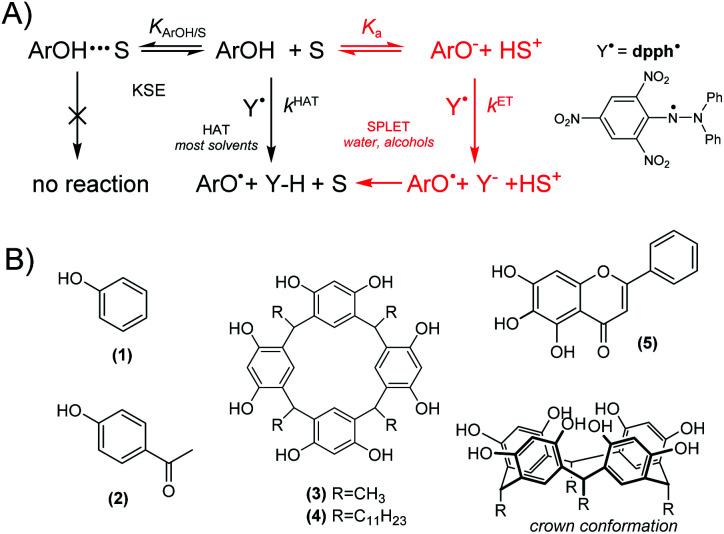
The reaction of a 2,2-diphenyl-1-picrylhydrazyl radical (dpph˙) with phenols carried out in alcohols is a frequently used assay for estimation of the antiradical activity of phenolic compounds. The rates of reactions of dpph˙ with five phenols (ArOH: unsubstituted phenol, 4-hydroxyacetophenone, two calix[4]resorcinarenes and baicalein) measured in methanol indicate the different kinetics of the process for very diluted phenols compared to their non-diluted solutions. This effect was explained as dependent on the ratio [ArO]/[ArOH] and for diluted ArOH corresponds to an increased contribution of much faster electron transfer (ET, ArO/dpph˙) over the Hydrogen Atom Transfer (HAT, ArOH/dpph˙). Simplified analysis of the reaction kinetics resulted in estimation of / ratios for each studied ArOH, and in calculation of the rate constants . Described results are cautionary examples of how the concentration of a phenol might change the reaction mechanism and the overall kinetics of the observed process.
在醇类溶剂中,2,2 - 二苯基 - 1 - 苦味酰基自由基(dpph˙)与酚类的反应是用于评估酚类化合物抗自由基活性的常用测定方法。在甲醇中测量dpph˙与五种酚(ArOH:未取代的苯酚、4 - 羟基苯乙酮、两种杯[4]间苯二酚芳烃和黄芩苷)的反应速率,结果表明,与未稀释溶液相比,极稀溶液中该过程的动力学有所不同。这种效应被解释为取决于[ArO]/[ArOH]的比例,对于稀释的ArOH,这对应于比氢原子转移(HAT,ArOH/dpph˙)快得多的电子转移(ET,ArO/dpph˙)的贡献增加。对反应动力学的简化分析得出了每个研究的ArOH的 / 比例估计值,并计算出了速率常数 。所描述的结果是酚类浓度如何改变反应机理和所观察过程的整体动力学的警示性例子。


 Zotero 插件