Cembran Alessandro, Fernandez-Funez Pedro
Department of Chemistry and Biochemistry, University of Minnesota Duluth, Duluth, MN, United States.
Department of Biomedical Sciences, University of Minnesota Medical School, Duluth, MN, United States.
Front Mol Neurosci. 2023 Aug 14;16:1231079. doi: 10.3389/fnmol.2023.1231079. eCollection 2023.
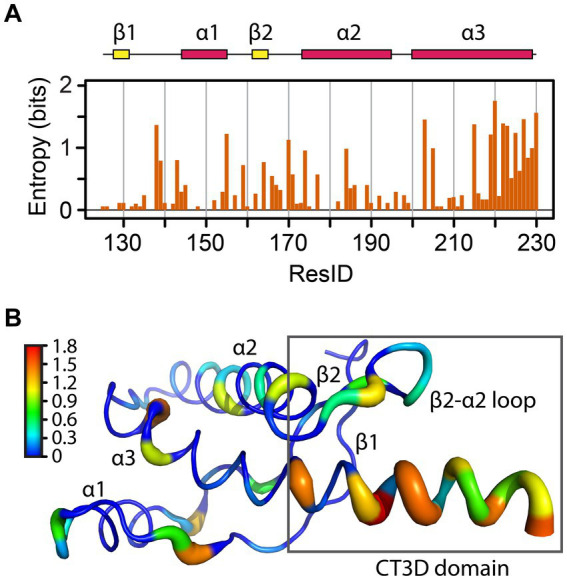
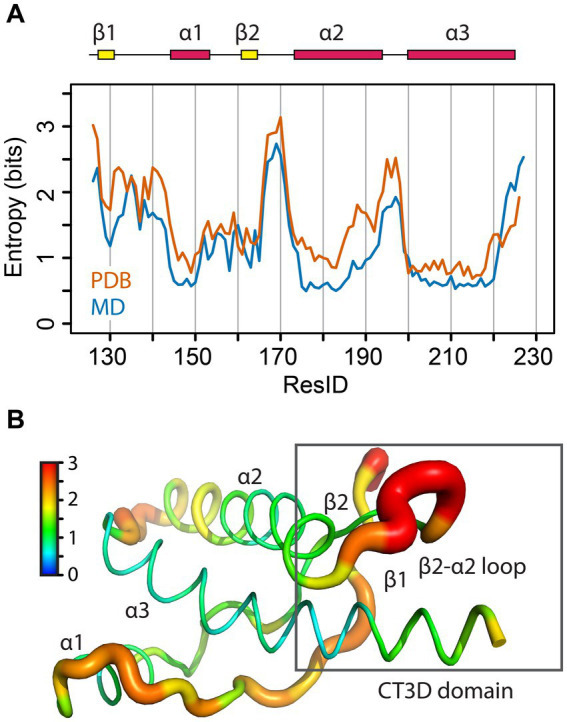
Prion diseases are fatal brain disorders characterized by deposition of insoluble isoforms of the prion protein (PrP). The normal and pathogenic structures of PrP are relatively well known after decades of studies. Yet our current understanding of the intrinsic determinants regulating PrP misfolding are largely missing. A 3D subdomain of PrP comprising the β2-α2 loop and helix 3 contains high sequence and structural variability among animals and has been proposed as a key domain regulating PrP misfolding. We combined work in with molecular dynamics (MD) simulations, which provide additional insight to assess the impact of candidate substitutions in PrP from conformational dynamics. MD simulations revealed that in human PrP WT the β2-α2 loop explores multiple β-turn conformations, whereas the Y225A (rabbit PrP-like) substitution strongly favors a 3-turn conformation, a short right-handed helix. This shift in conformational diversity correlates with lower neurotoxicity in flies. We have identified additional conformational features and candidate amino acids regulating the high toxicity of human PrP and propose a new strategy for testing candidate modifiers first in MD simulations followed by functional experiments in flies. In this review we expand on these new results to provide additional insight into the structural and functional biology of PrP through the prism of the conformational dynamics of a 3D domain in the C-terminus. We propose that the conformational dynamics of this domain is a sensitive measure of the propensity of PrP to misfold and cause toxicity. This provides renewed opportunities to identify the intrinsic determinants of PrP misfolding through the contribution of key amino acids to different conformational states by MD simulations followed by experimental validation in transgenic flies.
朊病毒疾病是致命的脑部疾病,其特征是朊病毒蛋白(PrP)的不溶性异构体沉积。经过数十年的研究,PrP的正常结构和致病结构已为人熟知。然而,我们目前对调节PrP错误折叠的内在决定因素仍知之甚少。PrP的一个三维子结构域,包括β2-α2环和螺旋3,在动物之间具有高度的序列和结构变异性,被认为是调节PrP错误折叠的关键结构域。我们将[具体工作内容]与分子动力学(MD)模拟相结合,MD模拟从构象动力学方面为评估PrP中候选取代的影响提供了更多见解。MD模拟显示,在人类PrP野生型中,β2-α2环探索多种β-转角构象,而Y225A(兔PrP样)取代强烈倾向于一种三转角构象,即一个短的右手螺旋。这种构象多样性的转变与果蝇中较低的神经毒性相关。我们已经确定了调节人类PrP高毒性的其他构象特征和候选氨基酸,并提出了一种新策略,即首先在MD模拟中测试候选修饰剂,然后在果蝇中进行功能实验。在这篇综述中,我们扩展这些新结果,通过C末端三维结构域的构象动力学这一视角,为PrP的结构和功能生物学提供更多见解。我们认为该结构域的构象动力学是PrP错误折叠和产生毒性倾向的敏感指标。这为通过MD模拟确定关键氨基酸对不同构象状态的贡献,进而识别PrP错误折叠的内在决定因素,并随后在转基因果蝇中进行实验验证提供了新的机会。