Yuan Ye, Chen Qianqian, Brovkina Margarita, Clowney E Josephine, Yadlapalli Swathi
Cellular and Molecular Biology Program, University of Michigan, Ann Arbor, MI 48109, USA.
Department of Cell and Developmental Biology, University of Michigan, Ann Arbor, MI 48109, USA.
bioRxiv. 2023 Aug 16:2023.08.15.553315. doi: 10.1101/2023.08.15.553315.
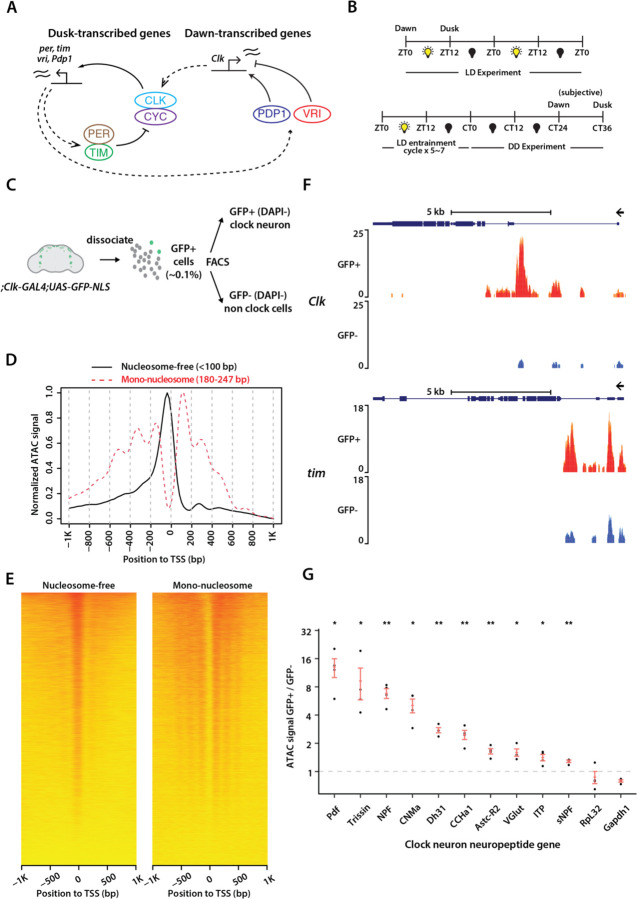
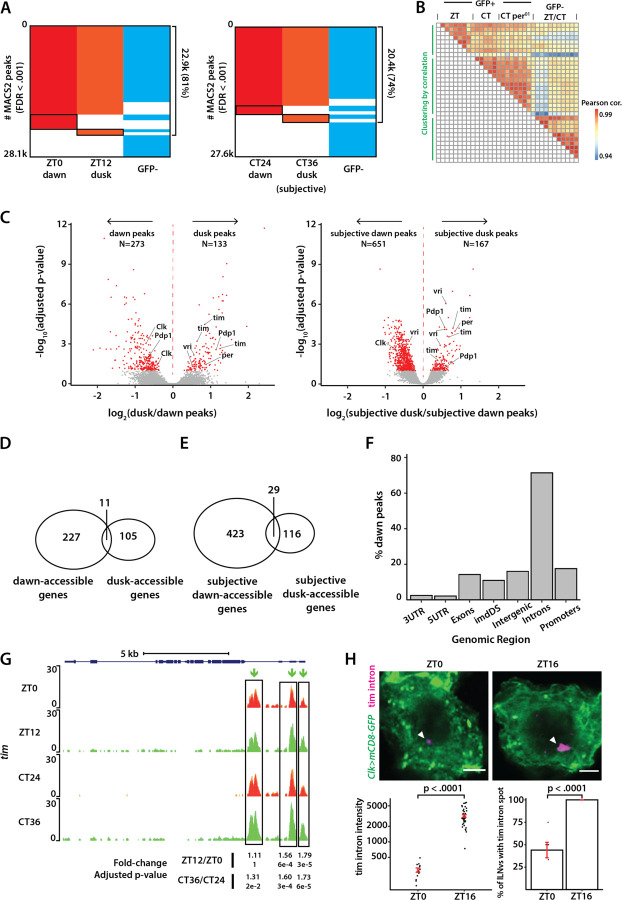
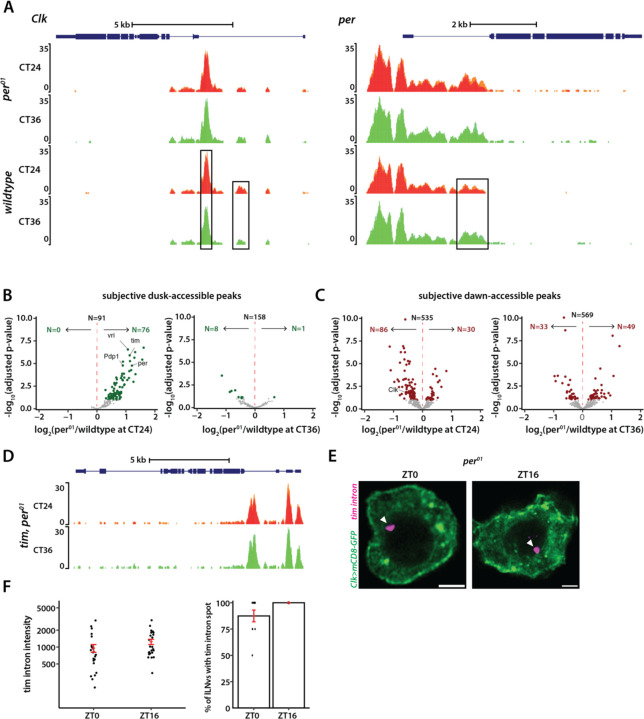
Chromatin organization plays a crucial role in gene regulation by controlling the accessibility of DNA to transcription machinery. While significant progress has been made in understanding the regulatory role of clock proteins in circadian rhythms, how chromatin organization affects circadian rhythms remains poorly understood. Here, we employed ATAC-seq (Assay for Transposase-Accessible Chromatin with Sequencing) on FAC-sorted Drosophila clock neurons to assess genome-wide chromatin accessibility over the circadian cycle. We observed significant circadian oscillations in chromatin accessibility at promoter and enhancer regions of hundreds of genes, with enhanced accessibility either at dusk or dawn, which correlated with their peak transcriptional activity. Notably, genes with enhanced accessibility at dusk were enriched with E-box motifs, while those more accessible at dawn were enriched with VRI/PDP1-box motifs, indicating that they are regulated by the core circadian feedback loops, PER/CLK and VRI/PDP1, respectively. Further, we observed a complete loss of chromatin accessibility rhythms in null mutants, with chromatin consistently accessible throughout the circadian cycle, underscoring the critical role of Period protein in driving chromatin compaction during the repression phase. Together, this study demonstrates the significant role of chromatin organization in circadian regulation, revealing how the interplay between clock proteins and chromatin structure orchestrates the precise timing of biological processes throughout the day. This work further implies that variations in chromatin accessibility might play a central role in the generation of diverse circadian gene expression patterns in clock neurons.
染色质组织通过控制DNA对转录机制的可及性在基因调控中发挥关键作用。虽然在理解生物钟蛋白在昼夜节律中的调控作用方面已取得重大进展,但染色质组织如何影响昼夜节律仍知之甚少。在这里,我们对经荧光激活细胞分选(FAC)的果蝇生物钟神经元进行了转座酶可及染色质测序(ATAC-seq),以评估整个昼夜周期内全基因组的染色质可及性。我们观察到数百个基因的启动子和增强子区域的染色质可及性存在显著的昼夜振荡,在黄昏或黎明时可及性增强,这与其转录活性峰值相关。值得注意的是,在黄昏时可及性增强的基因富含E-box基序,而在黎明时更易接近的基因则富含VRI/PDP1-box基序,这表明它们分别受核心昼夜反馈环PER/CLK和VRI/PDP1的调控。此外,我们在缺失突变体中观察到染色质可及性节律完全丧失,染色质在整个昼夜周期中始终可及,这突出了周期蛋白在抑制阶段驱动染色质压缩中的关键作用。总之,这项研究证明了染色质组织在昼夜节律调控中的重要作用,揭示了生物钟蛋白与染色质结构之间的相互作用如何协调全天生物过程的精确时间。这项工作进一步表明,染色质可及性的变化可能在生物钟神经元中多种昼夜基因表达模式的产生中起核心作用。