Borges Fernando S, Protachevicz Paulo R, Souza Diogo L M, Bittencourt Conrado F, Gabrick Enrique C, Bentivoglio Lucas E, Szezech José D, Batista Antonio M, Caldas Iberê L, Dura-Bernal Salvador, Pena Rodrigo F O
Department of Physiology and Pharmacology, State University of New York Downstate Health Sciences University, Brooklyn, New York, USA.
Center for Mathematics, Computation, and Cognition, Federal University of ABC, 09606-045 São Bernardo do Campo, SP, Brazil.
bioRxiv. 2023 Aug 17:2023.08.16.553625. doi: 10.1101/2023.08.16.553625.
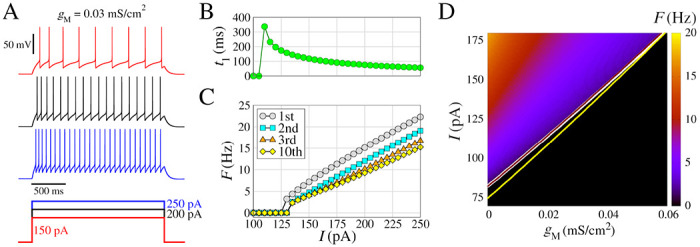
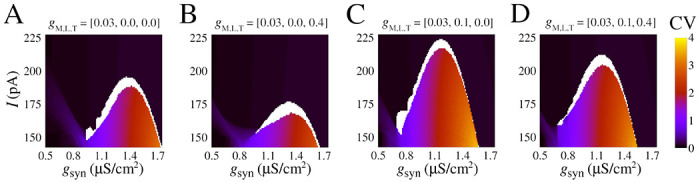
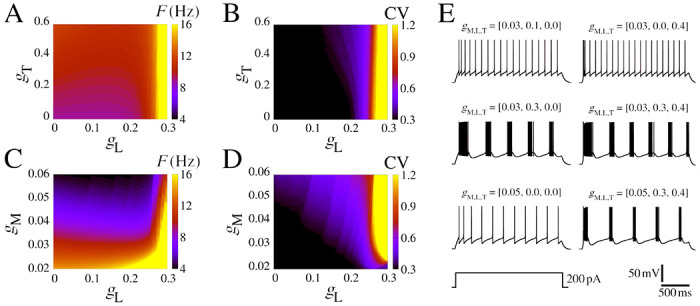
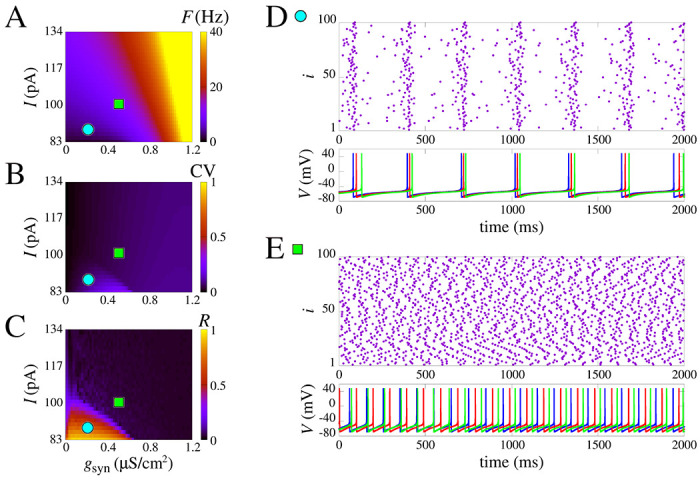
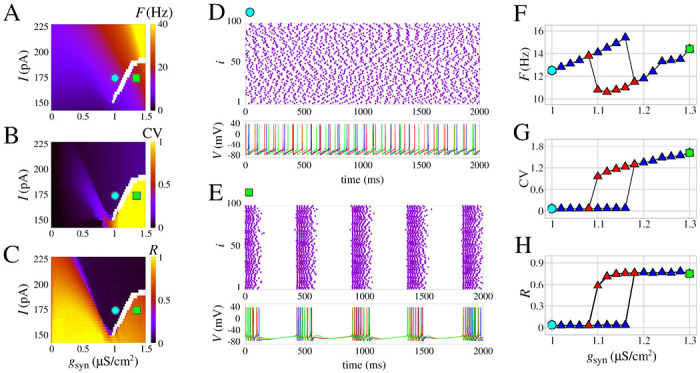
Healthy brains display a wide range of firing patterns, from synchronized oscillations during slowwave sleep to desynchronized firing during movement. These physiological activities coexist with periods of pathological hyperactivity in the epileptic brain, where neurons can fire in synchronized bursts. Most cortical neurons are pyramidal regular spiking cells (RS) with frequency adaptation and do not exhibit bursts in current-clamp experiments ( ). In this work, we investigate the transition mechanism of spike-to-burst patterns due to slow potassium and calcium currents, considering a conductance-based model of a cortical RS cell. The joint influence of potassium and calcium ion channels on high synchronous patterns is investigated for different synaptic couplings ( ) and external current inputs ( ). Our results suggest that slow potassium currents play an important role in the emergence of high-synchronous activities, as well as in the spike-to-burst firing pattern transitions. This transition is related to bistable dynamics of the neuronal network, where physiological asynchronous states coexist with pathological burst synchronization. The hysteresis curve of the coefficient of variation of the inter-spike interval demonstrates that a burst can be initiated by firing states with neuronal synchronization. Furthermore, we notice that high-threshold ( ) and low-threshold ( ) ion channels play a role in increasing and decreasing the parameter conditions ( and ) in which bistable dynamics occur, respectively. For high values of conductance, a synchronous burst appears when neurons are weakly coupled and receive more external input. On the other hand, when the conductance increases, higher coupling and lower are necessary to produce burst synchronization. In light of our results, we suggest that channel subtype-specific pharmacological interactions can be useful to induce transitions from pathological high bursting states to healthy states.
健康的大脑呈现出广泛的放电模式,从慢波睡眠期间的同步振荡到运动期间的去同步放电。这些生理活动与癫痫大脑中的病理性活动亢进时期共存,在癫痫大脑中神经元可同步爆发式放电。大多数皮质神经元是具有频率适应性的锥体常规放电细胞(RS),在电流钳实验中不表现出爆发式放电( )。在这项工作中,我们考虑皮质RS细胞的基于电导的模型,研究由于缓慢的钾电流和钙电流导致的尖峰到爆发模式的转变机制。针对不同的突触耦合( )和外部电流输入( ),研究了钾离子和钙离子通道对高同步模式的联合影响。我们的结果表明,缓慢的钾电流在高同步活动的出现以及尖峰到爆发放电模式的转变中起着重要作用。这种转变与神经网络的双稳动力学有关,其中生理异步状态与病理性爆发同步共存。峰间间隔变异系数的滞后曲线表明,爆发可由神经元同步的放电状态引发。此外,我们注意到高阈值( )和低阈值( )离子通道分别在增加和减少双稳动力学发生的参数条件( 和 )方面发挥作用。对于高值的 电导,当神经元弱耦合并接收更多外部输入时会出现同步爆发。另一方面,当 电导增加时,需要更高的耦合和更低的 才能产生爆发同步。根据我们的结果,我们建议通道亚型特异性的药理相互作用可能有助于诱导从病理性高爆发状态向健康状态的转变。