McLaughlin Maeve, Fiebig Aretha, Crosson Sean
Department of Microbiology and Molecular Genetics, Michigan State University, East Lansing, MI, USA.
bioRxiv. 2023 Aug 20:2023.08.20.554034. doi: 10.1101/2023.08.20.554034.
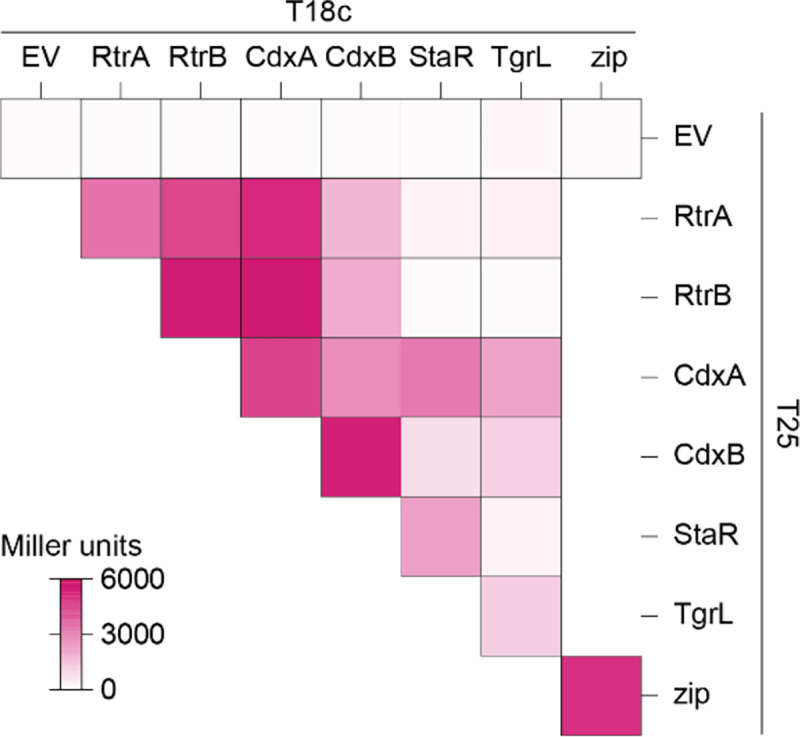
Upon infection, transcriptional shifts in both a host bacterium and its invading phage determine host and viral fitness. The xenobiotic response element (XRE) family of transcription factors (TFs), which are commonly encoded by bacteria and phages, regulate diverse features of bacterial cell physiology and impact phage infection dynamics. Through a pangenome analysis of species isolated from soil and aquatic ecosystems, we uncovered an apparent radiation of a paralogous XRE TF gene cluster, several of which have established functions in the regulation of holdfast adhesin development and biofilm formation in . We further discovered related XRE TFs across the class and its phages, including the φCbK Caulophage, suggesting that members of this gene cluster impact host-phage interactions. Here we show that that a closely related group of XRE proteins, encoded by both and φCbK, can form heteromeric associations and control the transcription of a common gene set, influencing processes including holdfast development and the production of φCbK virions. The φCbK XRE paralog, , is highly expressed at the earliest stages of infection and can directly repress transcription of , a potent holdfast inhibitor, and , a transcriptional activator of prophage-like gene transfer agents (GTAs) encoded on the chromosome. XRE proteins encoded from the chromosome also directly repress transcription, revealing a functionally redundant set of host regulators that may protect against spurious production of GTA particles and inadvertent cell lysis. Deleting host XRE transcription factors reduced φCbK burst size, while overexpressing these genes or φCbK rescued this burst defect. We conclude that an XRE TF gene cluster, shared by and φCbK, plays an important role in adhesion regulation under phage-free conditions, and influences host-phage dynamics during infection.
感染发生时,宿主细菌及其入侵噬菌体的转录变化决定了宿主和病毒的适应性。转录因子(TFs)的异生物质反应元件(XRE)家族通常由细菌和噬菌体编码,可调节细菌细胞生理学的多种特征并影响噬菌体感染动态。通过对从土壤和水生生态系统分离的物种进行泛基因组分析,我们发现了一个同源XRE TF基因簇的明显辐射现象,其中一些基因在[具体物种]的固着黏附素发育和生物膜形成调控中已确立了功能。我们还在[具体类别]及其噬菌体中发现了相关的XRE TFs,包括φCbK尾噬菌体,这表明该基因簇的成员会影响宿主 - 噬菌体相互作用。在这里,我们表明由[具体细菌]和φCbK编码的一组密切相关的XRE蛋白可以形成异源二聚体并控制一组共同基因的转录,影响包括固着发育和φCbK病毒粒子产生在内的过程。φCbK的XRE旁系同源物[具体基因名称]在感染的最早阶段高度表达,并且可以直接抑制[具体基因名称](一种有效的固着抑制剂)和[具体基因名称](一种编码在[具体细菌]染色体上的前噬菌体样基因转移因子(GTAs)的转录激活剂)的转录。从[具体细菌]染色体编码的XRE蛋白也直接抑制[具体基因名称]的转录,揭示了一组功能冗余的宿主调节因子,它们可能防止GTA颗粒的错误产生和意外的细胞裂解。删除宿主XRE转录因子会降低φCbK的爆发大小,而过度表达这些基因或φCbK的[具体基因名称]可挽救这种爆发缺陷。我们得出结论,[具体细菌]和φCbK共享的一个XRE TF基因簇在无噬菌体条件下的黏附调节中起重要作用,并在感染期间影响宿主 - 噬菌体动态。