
IFN-γ 通过靶向 SPRED1 增强 MSC 来源的外泌体通过 miR-126-3p 在糖尿病创面愈合中的治疗效果。
IFN-γ enhances the therapeutic efficacy of MSCs-derived exosome via miR-126-3p in diabetic wound healing by targeting SPRED1.
机构信息
Department of Endocrinology and Metabolism, The First Affiliated Hospital of Soochow University, Suzhou, China.
出版信息
J Diabetes. 2024 Jan;16(1):e13465. doi: 10.1111/1753-0407.13465. Epub 2023 Aug 30.
BACKGROUND AND AIMS
The traditional treatment of diabetic wounds is unsatisfactory. Exosomes isolated from bone marrow mesenchymal stem cells (BMSCs) promote the healing of diabetic wounds. However, whether the exosomes secreted by interferon (IFN)-γ-pretreated BMSCs have an enhanced therapeutic effect on diabetic wound healing and the relevant mechanisms remain unclear.
METHODS
In this study, we isolated exosomes from the corresponding supernatants of BMSCs with (IExos) or without IFN-γ treatment (NExos). Human umbilical vein endothelial cells (HUVECs) were used to investigate the proliferation, migration, and tube formation under different treatments in vitro. Diabetic mice were induced by intraperitoneal administration of streptozotocin, and a circular full-thickness dermal defect was then made on the back of each mouse, followed by a multisite subcutaneous injection of phosphate buffered saline or exosomes. Hematoxylin-eosin (H&E) staining, Masson's trichrome staining, and histological analysis were performed to assess the speed and quality of wound healing.
RESULTS
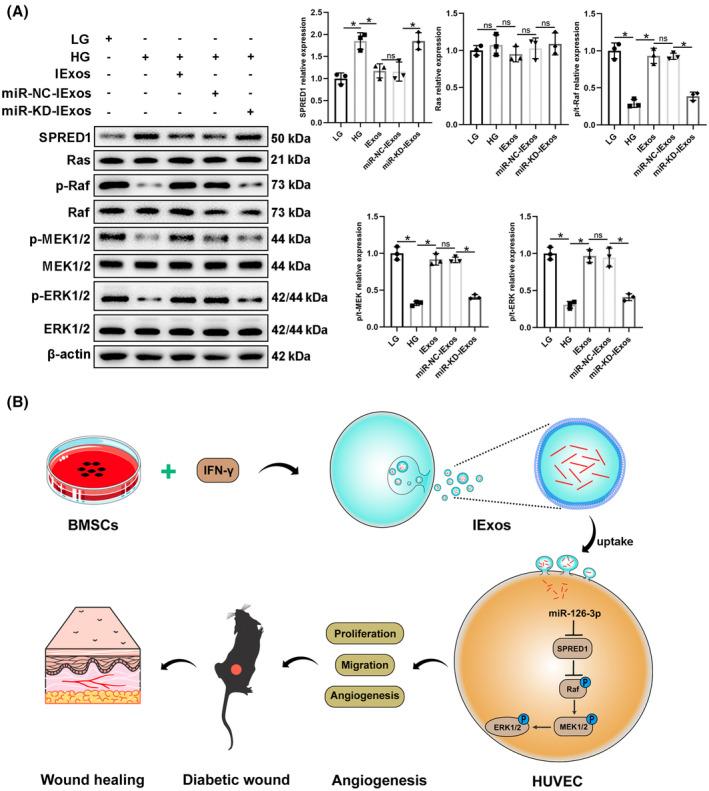
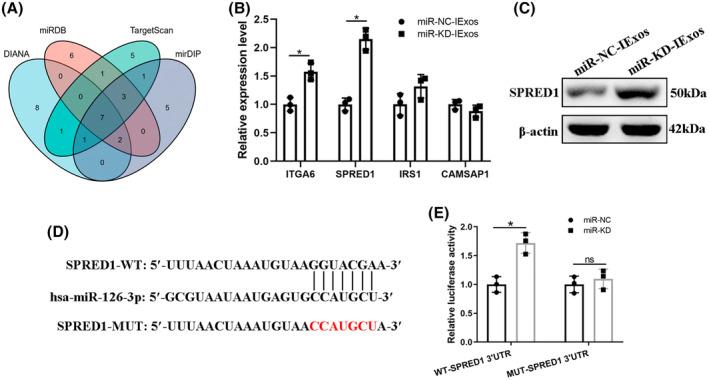
NExos treatment accelerated the healing of diabetic wounds by promoting angiogenesis in vivo and in vitro, and IExos exhibited superior therapeutic efficiency. MicroRNA (miR)-126-3p was significantly increased in IExos, and exosomal miR-126-3p promoted angiogenesis and diabetic wound healing via its transfer to HUVECs. miR-126-3p regulates SPRED1 by directly targeting the 3'-UTR. Mechanistically, IFN-γ-pretreated BMSCs secreted miR-126-3p-enriched exosomes, which enhanced the function of HUVECs and promoted angiogenesis via the SPRED1/Ras/Erk pathway.
CONCLUSION
Exosomal miR-126-3p secreted from IFN-γ-pretreated BMSCs exhibited higher therapeutic efficacy than NExos in diabetic wound healing by promoting angiogenesis via the SPRED1/Ras/Erk axis.
背景与目的
糖尿病创面的传统治疗效果并不理想。从骨髓间充质干细胞(BMSCs)中分离的外泌体可促进糖尿病创面愈合。然而,干扰素(IFN)-γ预处理的 BMSCs 分泌的外泌体是否对糖尿病创面愈合具有增强的治疗作用,以及相关机制尚不清楚。
方法
本研究中,我们从经 IFN-γ处理(IExos)或未经 IFN-γ处理(NExos)的 BMSC 相应上清液中分离出外泌体。体外用人脐静脉内皮细胞(HUVECs)研究不同处理条件下的增殖、迁移和管形成。通过腹腔注射链脲佐菌素诱导糖尿病小鼠,然后在每只小鼠背部制作一个圆形全层皮肤缺损,并在多个部位多点皮下注射磷酸盐缓冲盐水或外泌体。通过苏木精-伊红(H&E)染色、马松三色染色和组织学分析评估伤口愈合的速度和质量。
结果
NExos 治疗通过促进体内和体外的血管生成加速了糖尿病创面的愈合,而 IExos 表现出更好的治疗效果。IExos 中 miR-126-3p 显著增加,外泌体 miR-126-3p 通过转移到 HUVECs 促进血管生成和糖尿病创面愈合。miR-126-3p 通过直接靶向 3'-UTR 调节 SPRED1。机制上,IFN-γ预处理的 BMSCs 分泌富含 miR-126-3p 的外泌体,通过 SPRED1/Ras/Erk 通路增强 HUVECs 的功能并促进血管生成。
结论
IFN-γ预处理的 BMSCs 分泌的外泌体 miR-126-3p 通过 SPRED1/Ras/Erk 轴促进血管生成,在糖尿病创面愈合中的治疗效果高于 NExos。



 Zotero 插件