Centre for Inflammation Research, The University of Edinburgh, Edinburgh, UK
Centre for Inflammation Research, The University of Edinburgh, Edinburgh, UK.
J Immunother Cancer. 2023 Aug;11(8). doi: 10.1136/jitc-2023-006770.
An improved mechanistic understanding of immunosuppressive pathways in non-small cell lung cancer (NSCLC) is important to develop novel diagnostic and therapeutic approaches. Here, we investigate the prognostic significance of the ectonucleotidases CD39 and CD73 in NSCLC.
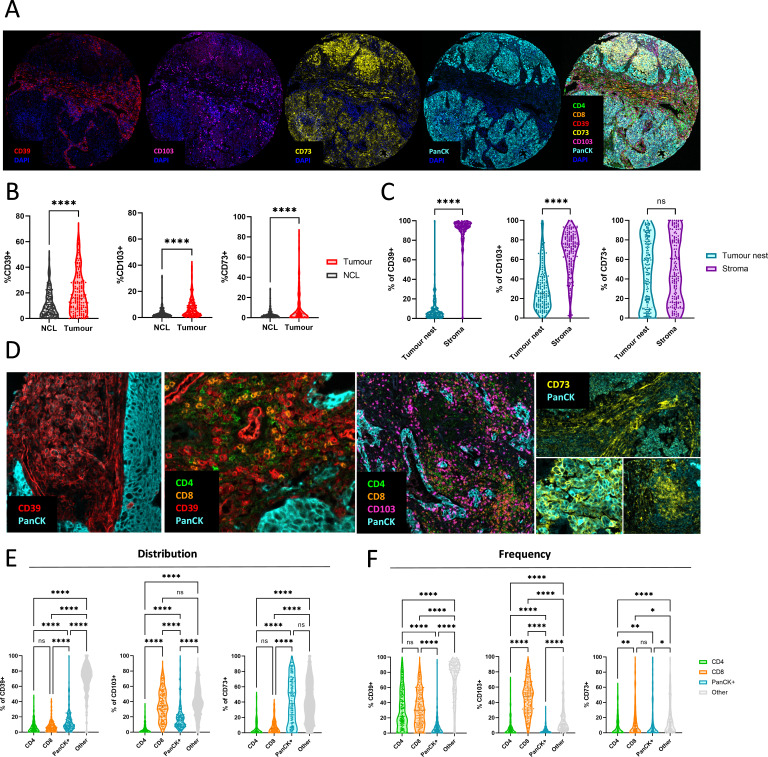
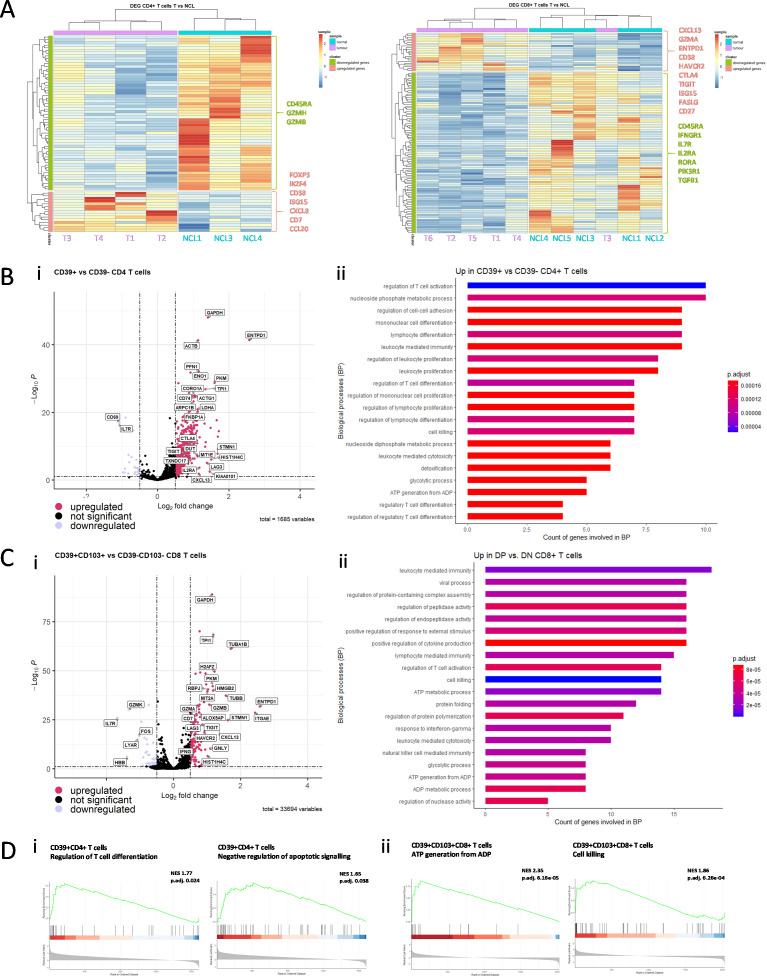
The expression and localization of CD39, CD73 and CD103 was digitally quantified in a cohort of 162 early treatment naïve NSCLC patients using multiplex-immunofluorescence and related to patient outcome. Expression among different cell-populations was assessed via flow cytometry. Targeted RNA-Seq was performed on CD4 and CD8 T cells from digested NSCLC tumor tissue and single-cell RNA-Seq data was analyzed to investigate the functional significance of CD39 T cell populations.
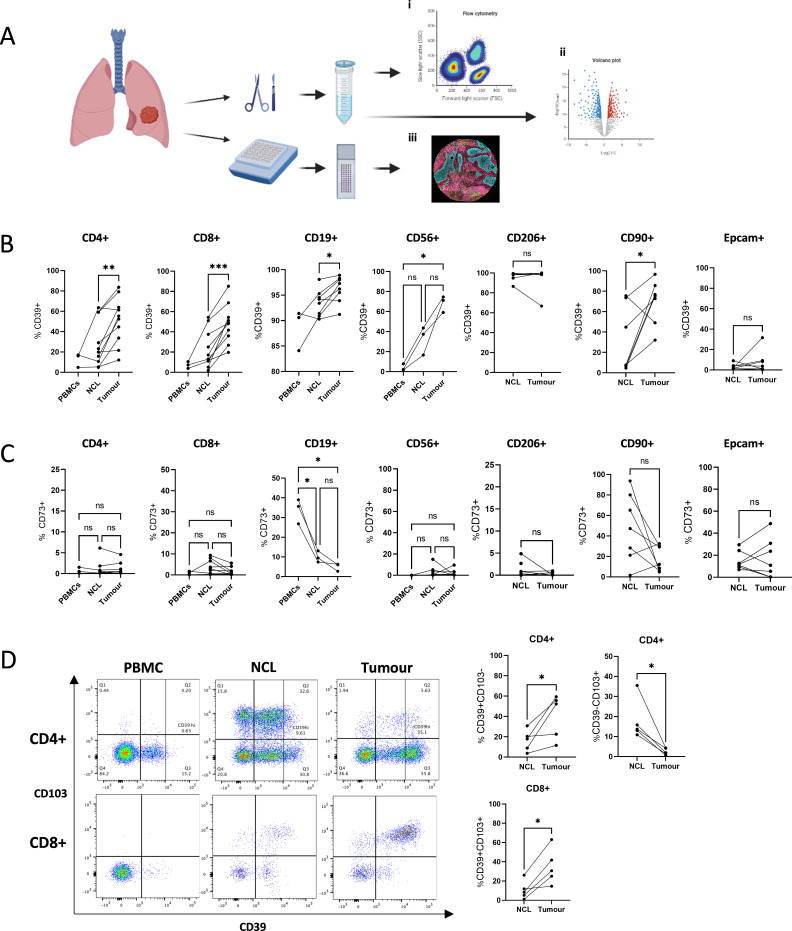
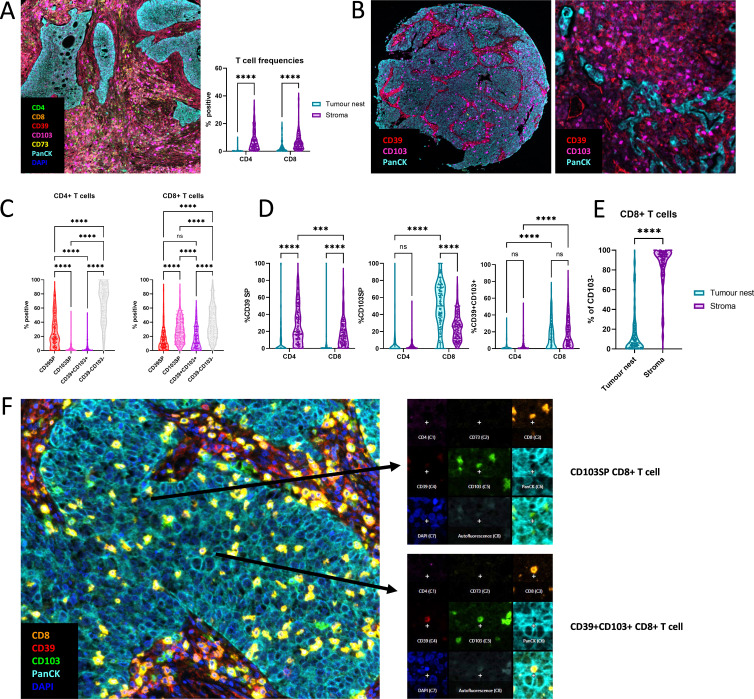
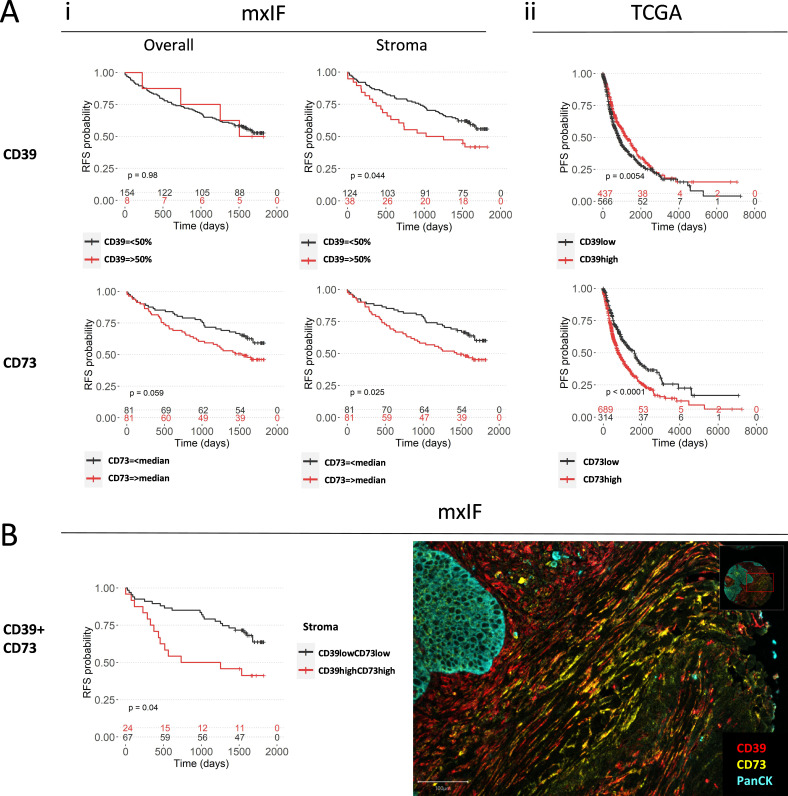
We demonstrate that flow cytometry of early untreated NSCLC patients shows an upregulation of CD39 expression in the tumor tissue among natural killer (NK) cells, fibroblasts and T cells. CD73 expression is mainly found among fibroblasts and Epcam+cells in the tumor tissue. Multiplex Immunofluorescence in a cohort of 162 early untreated NSCLC patients demonstrates that CD39 expression is mainly localized in the tumor stroma while CD73 expression is equally distributed between tumor nest and stroma, and high expression of CD39 and CD73 in the tumor stroma is associated with poor recurrence-free survival (RFS) at 5 years. Additionally, we find that CD8+T cells located in the tumor nest express CD103 and the density of CD39+CD103+CD8+ T cells in the tumor nest predicts improved RFS at 5 years. Targeted RNA-Seq shows that the tumor microenvironment of NSCLC upregulates regulatory pathways in CD4 T cells and exhaustion in CD8 T cells, and analysis of a single cell RNA sequencing dataset shows that CD39CD4 cells are enriched in Treg signature gene-sets, and CD39CD103 cytotoxic T lymphocyte show gene signatures indicative of an exhausted cytotoxic phenotype with upregulated expression of CXCL13.
Knowledge of patterns of distribution and location are required to understand the prognostic impact of CD39 T cell populations in NSCLC. This study provides an improved understanding of spatial and functional characteristics of CD39 T cells and their significance to patient outcome.
深入了解非小细胞肺癌(NSCLC)中免疫抑制途径的机制对于开发新的诊断和治疗方法非常重要。在这里,我们研究了外核苷酸酶 CD39 和 CD73 在 NSCLC 中的预后意义。
使用多重免疫荧光技术对 162 例早期治疗初治 NSCLC 患者的 CD39、CD73 和 CD103 的表达和定位进行了数字化量化,并将其与患者的预后相关联。通过流式细胞术评估不同细胞群之间的表达。对消化后的 NSCLC 肿瘤组织中的 CD4 和 CD8 T 细胞进行靶向 RNA-Seq,并对单细胞 RNA-Seq 数据进行分析,以研究 CD39 T 细胞群的功能意义。
我们证明,早期未经治疗的 NSCLC 患者的流式细胞术显示 NK 细胞、成纤维细胞和 T 细胞中肿瘤组织中 CD39 的表达上调。CD73 的表达主要存在于肿瘤组织中的成纤维细胞和 Epcam+细胞中。在 162 例未经治疗的早期 NSCLC 患者的队列中进行的多重免疫荧光显示,CD39 表达主要定位于肿瘤基质,而 CD73 表达在肿瘤巢和基质之间均匀分布,肿瘤基质中 CD39 和 CD73 的高表达与 5 年无复发生存率(RFS)不良相关。此外,我们发现肿瘤巢中 CD8+T 细胞表达 CD103,肿瘤巢中 CD39+CD103+CD8+T 细胞的密度可预测 5 年 RFS 改善。靶向 RNA-Seq 显示 NSCLC 的肿瘤微环境上调了 CD4 T 细胞中的调节途径和 CD8 T 细胞中的衰竭,单细胞 RNA 测序数据集的分析表明,CD39CD4 细胞富含 Treg 特征基因集,而 CD39CD103 细胞毒性 T 淋巴细胞显示出衰竭的细胞毒性表型的基因特征,上调表达 CXCL13。
为了了解 CD39 T 细胞群体在 NSCLC 中的预后影响,需要了解其分布和位置的模式。本研究提供了对 CD39 T 细胞的空间和功能特征及其对患者预后意义的更好理解。