Bennewitz John W, Burr Jason R, Bigler Blaine R, Burke Robert F, Lemcherfi Aaron, Mundt Tyler, Rezzag Taha, Plaehn Ethan W, Sosa Jonathan, Walters Ian V, Schumaker S Alexander, Ahmed Kareem A, Slabaugh Carson D, Knowlen Carl, Hargus William A
Rocket Combustion Devices Branch, Air Force Research Laboratory, Edwards AFB, CA, 93524, USA.
Jacobs Technology Group, Edwards, CA, 93524, USA.
Sci Rep. 2023 Aug 30;13(1):14204. doi: 10.1038/s41598-023-40156-y.
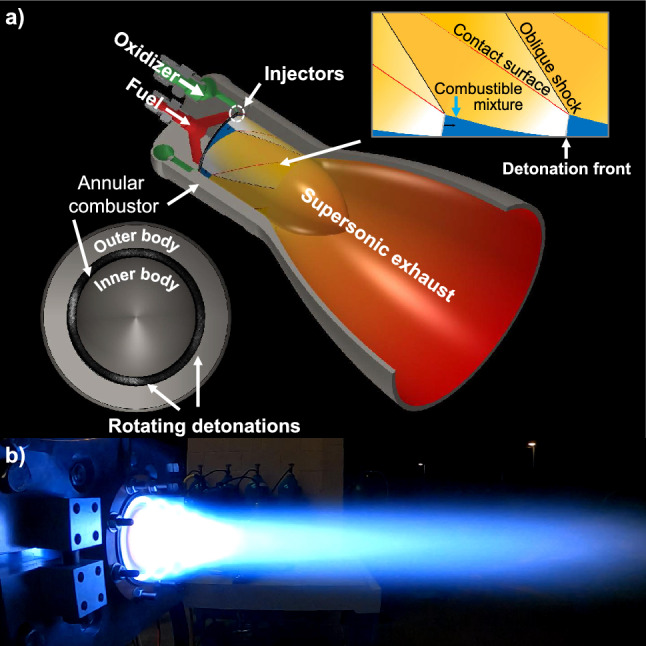
Space travel requires high-powered, efficient rocket propulsion systems for controllable launch vehicles and safe planetary entry. Interplanetary travel will rely on energy-dense propellants to produce thrust via combustion as the heat generation process to convert chemical to thermal energy. In propulsion devices, combustion can occur through deflagration or detonation, each having vastly different characteristics. Deflagration is subsonic burning at effectively constant pressure and is the main means of thermal energy generation in modern rockets. Alternatively, detonation is a supersonic combustion-driven shock offering several advantages. Detonations entail compact heat release zones at elevated local pressure and temperature. Specifically, rotating detonation rocket engines (RDREs) use detonation as the primary means of energy conversion, producing more useful available work compared to equivalent deflagration-based devices; detonation-based combustion is poised to radically improve rocket performance compared to today's constant pressure engines, producing up to 10[Formula: see text] increased thrust. This new propulsion cycle will also reduce thruster size and/or weight, lower injection pressures, and are less susceptible to engine-damaging acoustic instabilities. Here we present a collective effort to benchmark performance and standardize operability of rotating detonation rocket engines to develop the RDRE technology readiness level towards a flight demonstration. Key detonation physics unique to RDREs, driving consistency and control of chamber dynamics across the engine operating envelope, are identified and addressed to drive down the variability and stochasticity observed in previous studies. This effort demonstrates an RDRE operating consistently across multiple facilities, validating this technology's performance as the foundation of RDRE architecture for future aerospace applications.
太空旅行需要高性能、高效的火箭推进系统,用于可控运载火箭和安全的行星进入。星际旅行将依赖能量密集型推进剂,通过燃烧作为热生成过程将化学能转化为热能来产生推力。在推进装置中,燃烧可以通过爆燃或爆轰发生,每种方式都有截然不同的特性。爆燃是在有效恒定压力下的亚音速燃烧,是现代火箭中热能产生的主要方式。相比之下,爆轰是一种超音速燃烧驱动的激波,具有几个优点。爆轰在局部压力和温度升高时会产生紧凑的热释放区。具体而言,旋转爆轰火箭发动机(RDRE)将爆轰用作能量转换的主要方式,与等效的基于爆燃的装置相比,能产生更多有用的可用功;与当今的恒压发动机相比,基于爆轰的燃烧有望从根本上提高火箭性能,产生高达10[公式:见原文]的推力增加。这种新的推进循环还将减小推进器的尺寸和/或重量,降低喷射压力,并且更不易受到损害发动机的声学不稳定性的影响。在这里,我们共同努力对旋转爆轰火箭发动机的性能进行基准测试并规范其可操作性,以提高RDRE技术的成熟度,迈向飞行演示。识别并解决了RDRE特有的关键爆轰物理问题,这些问题推动了发动机工作范围内燃烧室动力学的一致性和控制,以降低先前研究中观察到的变异性和随机性。这项工作展示了一台在多个设施中持续运行的RDRE,验证了这项技术的性能,将其作为未来航空航天应用中RDRE架构的基础。