Psychology and Digital Mental Health Care, Technical University Munich, Georg-Brauchle-Ring 60-62, Munich, 80992, Germany.
Clinical Psychology and Psychotherapy, Institute for Psychology, Friedrich-Alexander-University Erlangen-Nuremberg, Erlangen, Germany.
Trials. 2023 Aug 30;24(1):562. doi: 10.1186/s13063-023-07596-3.
Considered one of the highest levels of evidence, results of randomized controlled trials (RCTs) remain an essential building block in mental health research. They are frequently used to confirm that an intervention "works" and to guide treatment decisions. Given their importance in the field, it is concerning that the quality of many RCT evaluations in mental health research remains poor. Common errors range from inadequate missing data handling and inappropriate analyses (e.g., baseline randomization tests or analyses of within-group changes) to unduly interpretations of trial results and insufficient reporting. These deficiencies pose a threat to the robustness of mental health research and its impact on patient care. Many of these issues may be avoided in the future if mental health researchers are provided with a better understanding of what constitutes a high-quality RCT evaluation.
In this primer article, we give an introduction to core concepts and caveats of clinical trial evaluations in mental health research. We also show how to implement current best practices using open-source statistical software.
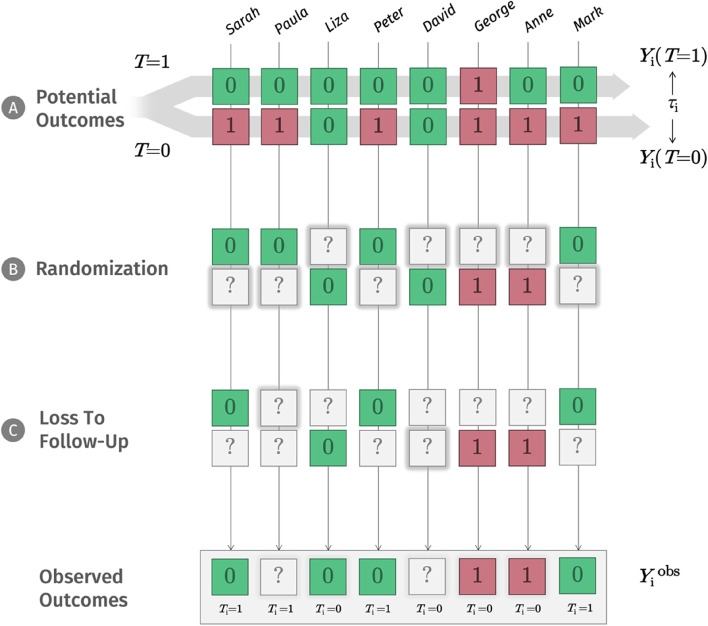
Drawing on Rubin's potential outcome framework, we describe that RCTs put us in a privileged position to study causality by ensuring that the potential outcomes of the randomized groups become exchangeable. We discuss how missing data can threaten the validity of our results if dropouts systematically differ from non-dropouts, introduce trial estimands as a way to co-align analyses with the goals of the evaluation, and explain how to set up an appropriate analysis model to test the treatment effect at one or several assessment points. A novice-friendly tutorial is provided alongside this primer. It lays out concepts in greater detail and showcases how to implement techniques using the statistical software R, based on a real-world RCT dataset.
Many problems of RCTs already arise at the design stage, and we examine some avoidable and unavoidable "weak spots" of this design in mental health research. For instance, we discuss how lack of prospective registration can give way to issues like outcome switching and selective reporting, how allegiance biases can inflate effect estimates, review recommendations and challenges in blinding patients in mental health RCTs, and describe problems arising from underpowered trials. Lastly, we discuss why not all randomized trials necessarily have a limited external validity and examine how RCTs relate to ongoing efforts to personalize mental health care.
随机对照试验(RCT)的结果被认为是最高级别的证据之一,仍然是精神健康研究的重要基础。它们经常被用来确认干预措施“有效”,并指导治疗决策。考虑到它们在该领域的重要性,令人担忧的是,精神健康研究中许多 RCT 评估的质量仍然很差。常见的错误包括数据缺失处理不当和分析不当(例如,基线随机分组检验或组内变化分析)、对试验结果的过度解释以及报告不充分。这些缺陷对精神健康研究的稳健性及其对患者护理的影响构成了威胁。如果精神健康研究人员更好地了解高质量 RCT 评估的构成,许多这些问题在未来可能会避免。
在这篇入门文章中,我们介绍了精神健康研究中临床试验评估的核心概念和注意事项。我们还展示了如何使用开源统计软件来实施当前的最佳实践。
借鉴鲁宾的潜在结果框架,我们描述了 RCT 通过确保随机分组的潜在结果变得可交换,使我们能够处于研究因果关系的有利位置。我们讨论了如果辍学者与非辍学者系统地不同,缺失数据如何威胁我们的结果的有效性,引入试验目标作为将分析与评估目标对齐的一种方法,并解释了如何设置适当的分析模型来测试一个或几个评估点的治疗效果。本文提供了一个适合初学者的教程。它更详细地阐述了概念,并展示了如何使用统计软件 R 实现技术,基于一个真实的 RCT 数据集。
许多 RCT 的问题已经在设计阶段出现,我们检查了精神健康研究中这种设计中一些可避免和不可避免的“弱点”。例如,我们讨论了缺乏前瞻性注册如何导致结果切换和选择性报告等问题,如何忠诚偏见会夸大效应估计,审查精神健康 RCT 中患者双盲的建议和挑战,并描述了由于试验效力不足而产生的问题。最后,我们讨论了为什么并非所有随机试验都一定具有有限的外部有效性,并研究了 RCT 与正在努力个性化精神保健的关系。