Department of Physiology, University College Cork, College Road, Cork, T12 K8AF, Ireland.
School of Microbiology, University College Cork, College Road, Cork, T12 K8AF, Ireland.
Hum Mol Genet. 2023 Nov 17;32(23):3237-3248. doi: 10.1093/hmg/ddad143.
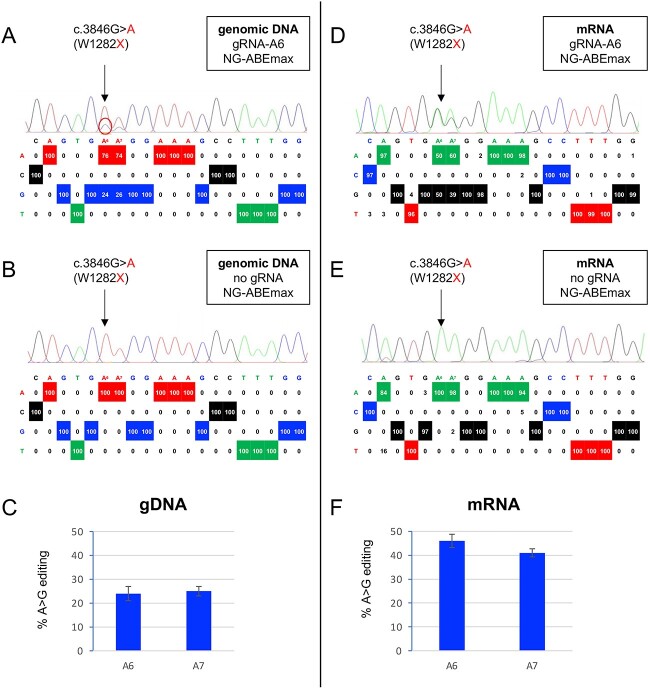
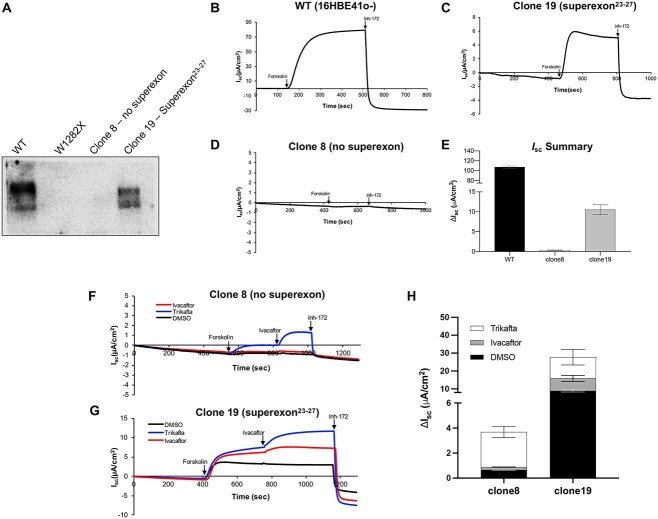
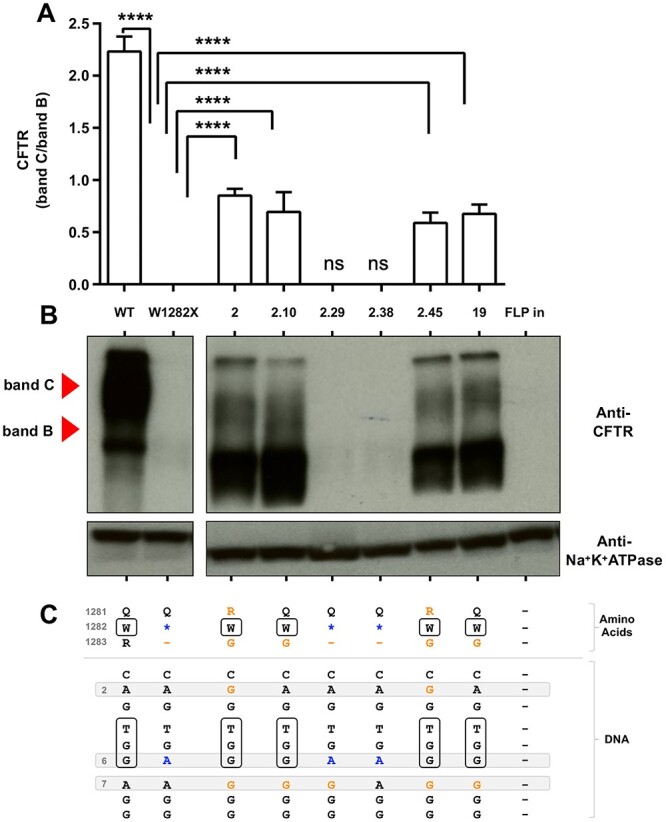
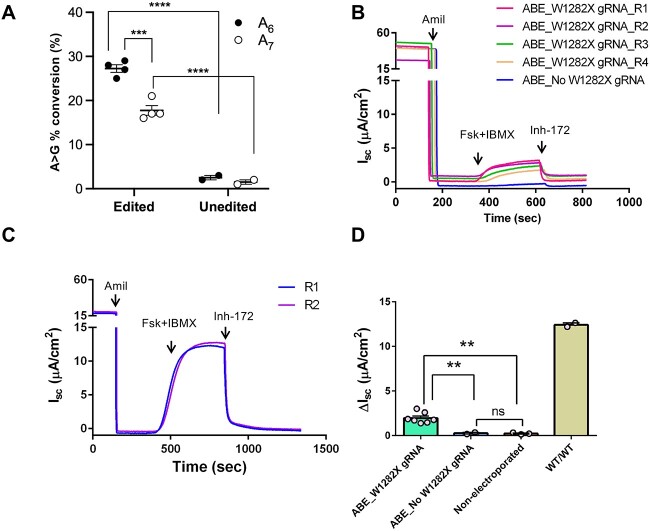
Small molecule drugs known as modulators can treat ~90% of people with cystic fibrosis (CF), but do not work for premature termination codon variants such as W1282X (c.3846G>A). Here we evaluated two gene editing strategies, Adenine Base Editing (ABE) to correct W1282X, and Homology-Independent Targeted Integration (HITI) of a CFTR superexon comprising exons 23-27 (SE23-27) to enable expression of a CFTR mRNA without W1282X. In Flp-In-293 cells stably expressing a CFTR expression minigene bearing W1282X, ABE corrected 24% of W1282X alleles, rescued CFTR mRNA from nonsense mediated decay and restored protein expression. However, bystander editing at the adjacent adenine (c.3847A>G), caused an amino acid change (R1283G) that affects CFTR maturation and ablates ion channel activity. In primary human nasal epithelial cells homozygous for W1282X, ABE corrected 27% of alleles, but with a notably lower level of bystander editing, and CFTR channel function was restored to 16% of wild-type levels. Using the HITI approach, correct integration of a SE23-27 in intron 22 of the CFTR locus in 16HBEge W1282X cells was detected in 5.8% of alleles, resulting in 7.8% of CFTR transcripts containing the SE23-27 sequence. Analysis of a clonal line homozygous for the HITI-SE23-27 produced full-length mature protein and restored CFTR anion channel activity to 10% of wild-type levels, which could be increased three-fold upon treatment with the triple combination of CF modulators. Overall, these data demonstrate two different editing strategies can successfully correct W1282X, the second most common class I variant, with a concomitant restoration of CFTR function.
已知小分子药物调节剂可治疗约 90%的囊性纤维化(CF)患者,但对 W1282X(c.3846G>A)等过早终止密码子变异无效。在这里,我们评估了两种基因编辑策略,腺嘌呤碱基编辑(ABE)纠正 W1282X 和无同源依赖性靶向整合(HITI)包含外显子 23-27 的 CFTR 超外显子(SE23-27),以实现无 W1282X 的 CFTR mRNA 表达。在稳定表达带有 W1282X 的 CFTR 表达 minigene 的 Flp-In-293 细胞中,ABE 纠正了 24%的 W1282X 等位基因,从无意义介导的衰变中拯救 CFTR mRNA 并恢复蛋白表达。然而,在相邻腺嘌呤(c.3847A>G)的旁观者编辑导致氨基酸变化(R1283G),影响 CFTR 成熟并消除离子通道活性。在纯合 W1282X 的原代人鼻上皮细胞中,ABE 纠正了 27%的等位基因,但旁观者编辑水平明显较低,CFTR 通道功能恢复至野生型水平的 16%。使用 HITI 方法,在 16HBEge W1282X 细胞中 CFTR 基因座内含子 22 中正确整合 SE23-27 在 5.8%的等位基因中检测到,导致含有 SE23-27 序列的 CFTR 转录本占 7.8%。对含有 HITI-SE23-27 的克隆系的分析产生全长成熟蛋白,并将 CFTR 阴离子通道活性恢复至野生型水平的 10%,在用 CF 调节剂三重组合处理后可增加三倍。总体而言,这些数据表明两种不同的编辑策略可以成功纠正 W1282X,这是第二常见的 I 类变体,同时恢复 CFTR 功能。