EU/WOAH & National Reference Laboratory for Animal Brucellosis, Animal Health Laboratory, Paris-Est University/ANSES, Maisons-Alfort, France.
National and WOAH Reference Laboratory for Brucellosis, Istituto Zooprofilattico Sperimentale dell'Abruzzo e Molise "G. Caporale", Teramo, Italy.
Emerg Microbes Infect. 2023 Dec;12(2):2249126. doi: 10.1080/22221751.2023.2249126. Epub 2023 Aug 31.
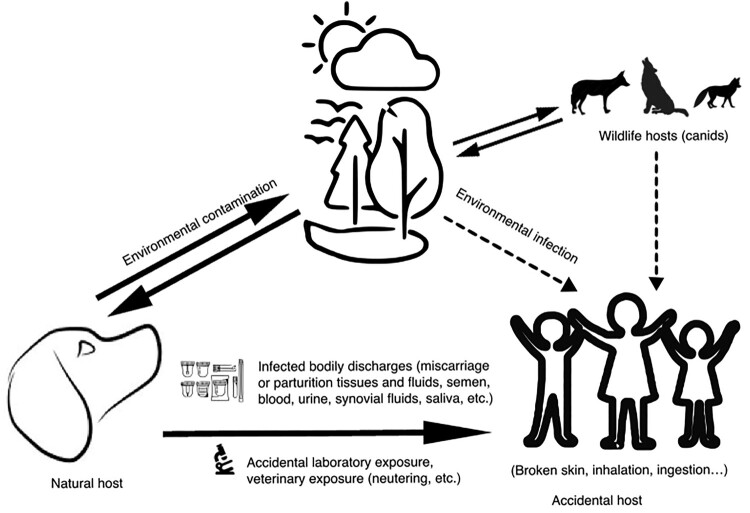
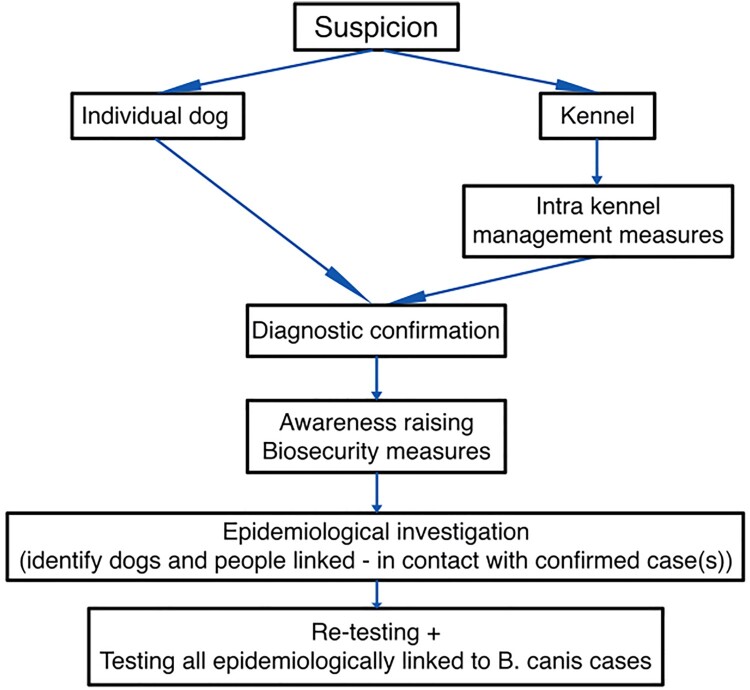
The zoonotic bacteria, , is becoming the leading cause of canine brucellosis in Europe. In dogs, it causes reproductive problems as well as non-specific lameness or discospondilitis. In humans, can be origin of chronic debilitating conditions characteristic to its genus such as undulant fever, splenomegaly, and lymphadenopathy. Although shows some pathogenic characteristics similar to and , it lacks surface O-polysaccharide, like nonzoonotic . This review shows that host- interactions are still poorly understood, with many knowledge and capability gaps, causing relatively poor sensitivity and specificity of existing diagnostic tools. Currently, there is no vaccine for this rough species. Besides, antimicrobial therapy does not guarantee bacterial elimination, and infection relapses are frequently reported, increasing the risks of antibiotic resistance development. has been detected in dogs in almost all European countries which increased human exposure, but currently there is no systematic surveillance. Moreover, caused brucellosis is not included in Animal Health Law, and therefore there is no legal framework to tackle this emerging infectious disease. To map out the diagnostic strategies, identify risks for human infections and propose management scheme for infected pet and kennel dogs, we present current understanding of canine caused brucellosis, outline major knowledge gaps and propose future steps. To address and highlight challenges veterinary and public health services encounter in Europe, we developed two infection scenarios: of a single household pet and of a kennel dog in larger group.
人畜共患病细菌 正在成为欧洲犬布鲁氏菌病的主要原因。在犬类中,它会导致生殖问题以及非特异性跛行或椎间盘炎。在人类中, 可能导致布鲁氏菌属的慢性衰弱疾病,如波浪热、脾肿大和淋巴结病。尽管 表现出与 和 相似的一些致病特征,但它缺乏表面 O-多糖,与非人畜共患的 一样。这篇综述表明,宿主- 相互作用仍未被充分了解,存在许多知识和能力差距,导致现有诊断工具的敏感性和特异性相对较差。目前,还没有针对这种粗糙 物种的疫苗。此外,抗菌治疗并不能保证细菌的消除,感染的复发经常发生,增加了抗生素耐药性发展的风险。几乎所有欧洲国家的犬只中都检测到了 ,这增加了人类的暴露风险,但目前没有系统的监测。此外,动物健康法中不包括引起布鲁氏菌病的 ,因此没有法律框架来应对这种新出现的传染病。为了制定诊断策略,确定人类感染的风险,并为受感染的宠物和犬舍犬提出管理方案,我们介绍了犬布鲁氏菌病的现状,概述了主要的知识差距,并提出了未来的步骤。为了了解欧洲兽医和公共卫生服务部门面临的挑战和问题,我们开发了两种 感染情景:一个家庭宠物和一个更大群体的犬舍犬。