Nafees Beenish, de Freitas Hayley M, Beaudet Amélie, Todd Eunju, Gin-Sing Wendy
Patient-Reported Outcomes, Nafees Consulting Limited, London, UK.
Global Market Access and Pricing, Actelion Pharmaceuticals Ltd, Allschwil, Switzerland.
Patient Prefer Adherence. 2023 Aug 25;17:2119-2130. doi: 10.2147/PPA.S400061. eCollection 2023.
Pulmonary hypertension (PH) is a rare, severe, and progressive pulmonary vascular disease, which includes five subgroups with similar presentation. Symptoms include dyspnea, and fatigue, and can significantly impact one's health-related quality of life (HRQL). Although treatments are mainly medical, PH group 4, chronic thromboembolic pulmonary hypertension (CTEPH), can be managed with procedures, ie pulmonary endarterectomy (PEA) and balloon pulmonary angioplasty (BPA). Currently, drugs in Europe are only approved for pulmonary arterial hypertension (PAH), and CTEPH therefore the aim of this study was to elicit novel societal health state utilities in the UK for PAH and CTEPH based on disease severity, functional class (FC), clinical events, and treatment procedures specifically for CTEPH.
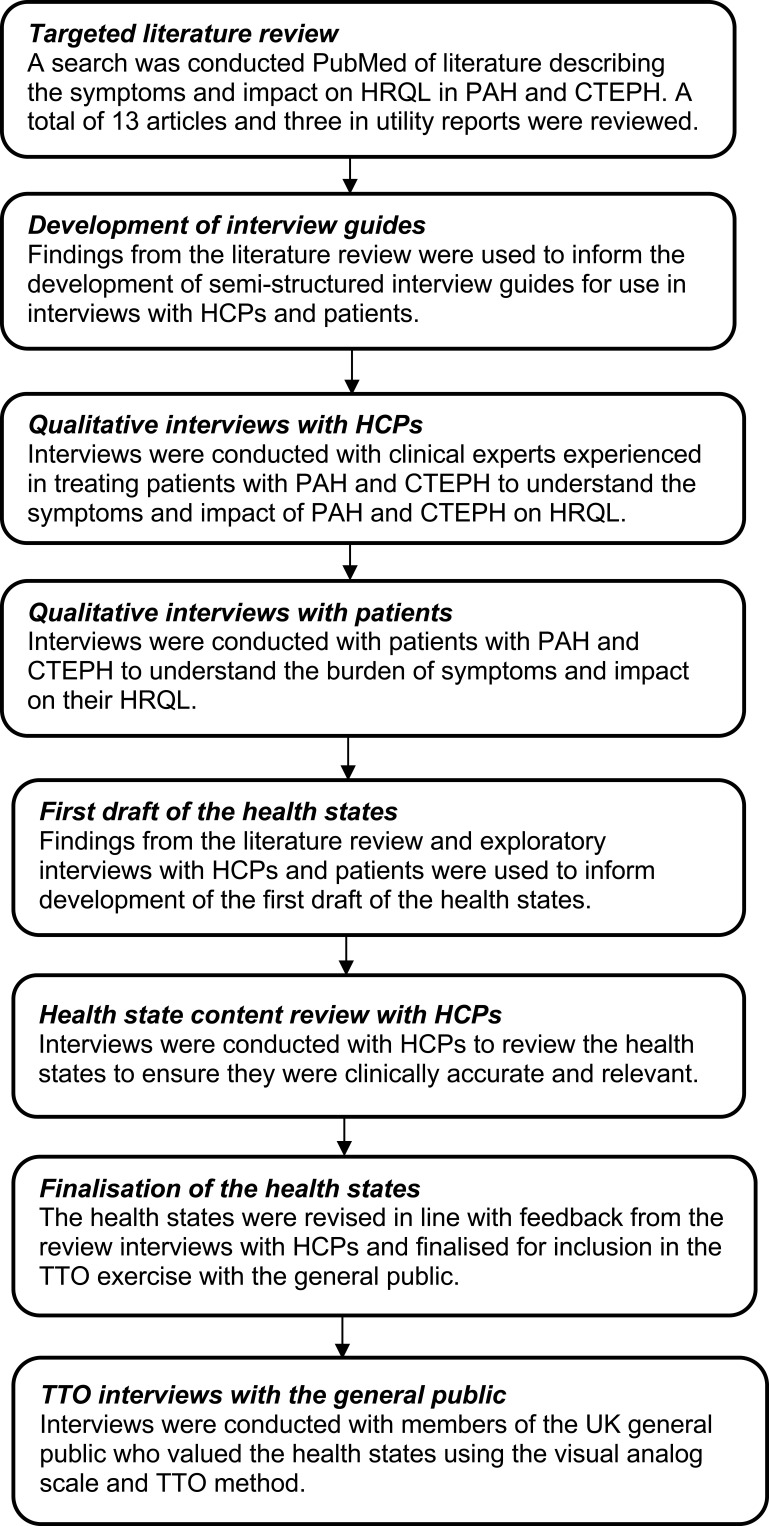
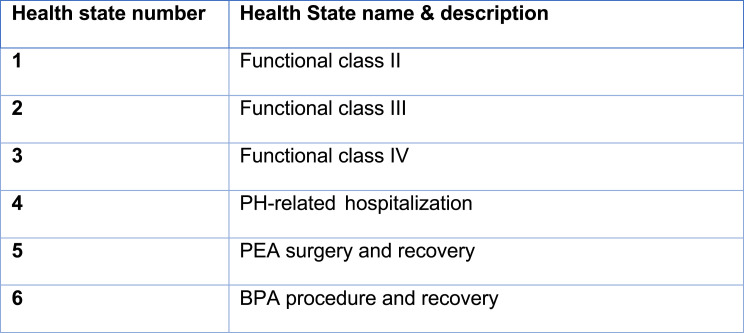
Six health states were defined: World Health Organization (WHO)-FC II, WHO-FC III, and WHO-FC IV [defined by the New York Heart Association (NYHA)]; PH-related hospitalization; and "BPA procedure and recovery" and "PEA surgery and recovery". Health states were based on a targeted literature review and two rounds of interviews with clinical experts (N = 4) and patients (N = 6). Draft health states were validated in cognitive debriefing interviews with clinical experts (N = 3). Health states were valued by the UK general public (n = 200), using a visual analogue scale (VAS) and time trade-off (TTO) assessment with the lead time method.
The mean TTO values/utilities were 0.81 (FC II), 0.80 (BPA), 0.78 (PEA), 0.59 (FC III), 0.28 (FC IV), and 0.25 (PH-related hospitalization). Each progression in FC was associated with worse TTO scores.
This study reports societal utility values for PAH and CTEPH in the UK. It provides first utility estimates for states such as BPA procedure and recovery, PEA surgery and recovery and PH-related hospitalization for this population. The results show important distinctions between FC, treatment procedures, and hospitalization, and the significant burden of disease on HRQL.
肺动脉高压(PH)是一种罕见、严重且进行性的肺血管疾病,包括五个表现相似的亚组。症状包括呼吸困难和疲劳,会对患者的健康相关生活质量(HRQL)产生重大影响。虽然治疗主要是药物治疗,但第4组肺动脉高压,即慢性血栓栓塞性肺动脉高压(CTEPH),可通过手术治疗,即肺动脉内膜剥脱术(PEA)和球囊肺动脉成形术(BPA)。目前,欧洲的药物仅被批准用于治疗肺动脉高压(PAH),因此本研究的目的是基于疾病严重程度、功能分级(FC)、临床事件以及专门针对CTEPH的治疗程序,得出英国PAH和CTEPH新的社会健康状态效用值。
定义了六种健康状态:世界卫生组织(WHO)功能分级II级、III级和IV级[由纽约心脏协会(NYHA)定义];与PH相关的住院治疗;以及“BPA手术及康复”和“PEA手术及康复”。健康状态基于有针对性的文献综述以及与临床专家(N = 4)和患者(N = 6)进行的两轮访谈。在与临床专家(N = 3)进行的认知反馈访谈中对健康状态草案进行了验证。通过英国普通公众(n = 200)使用视觉模拟量表(VAS)以及采用提前期法的时间权衡(TTO)评估对健康状态进行赋值。
TTO均值/效用值分别为0.81(功能分级II级)、0.80(BPA)、0.78(PEA)、0.59(功能分级III级)、0.28(功能分级IV级)和0.25(与PH相关的住院治疗)。功能分级每进展一级,TTO得分就越差。
本研究报告了英国PAH和CTEPH的社会效用值。它首次提供了诸如BPA手术及康复、PEA手术及康复以及该人群与PH相关的住院治疗等状态的效用估计值。结果显示了功能分级、治疗程序和住院治疗之间的重要差异,以及疾病对HRQL的重大负担。