Isse Hamdi Mohamed, Lukande Robert, Sereke Senai Goitom, Odubu Fualal Jane, Nassanga Rita, Bugeza Samuel
Department of Radiology and Radiotherapy, College of Health Science, MakerereUniversity, Kampala, Uganda.
Department of Pathology, College of Health Science, MakerereUniversity, Kampala, Uganda.
Thyroid Res. 2023 Sep 1;16(1):26. doi: 10.1186/s13044-023-00169-1.
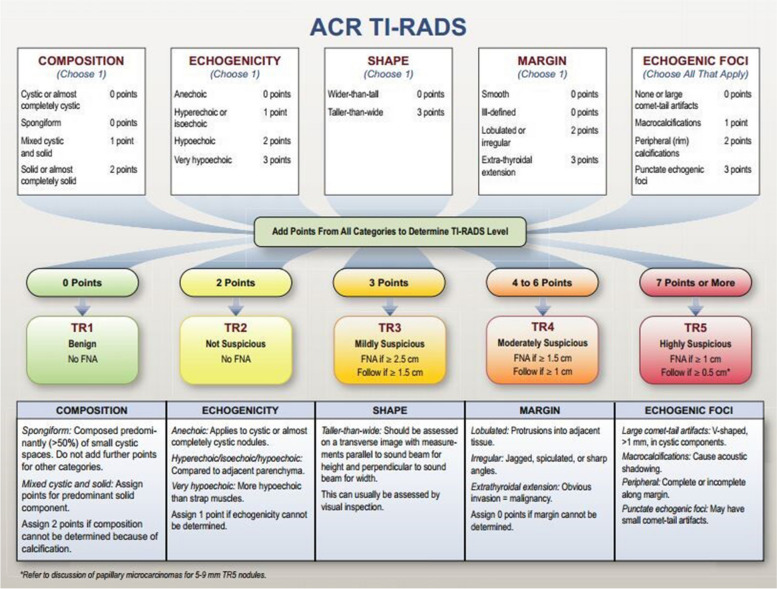
Ultrasonography is a noninvasive modality for the initial assessment of thyroid nodules. The American College of Radiology Thyroid Imaging Reporting and Data System (ACR TI-RADS) has demonstrated good performance in differentiating malignant thyroid nodules. However, the combination of ACR TI-RADS categories and cytology has not been studied extensively, in Uganda. The study aims to correlate ACR TI-RADS with cytology among patients referred for US-guided fine-needle aspiration at Mulago National Referral Hospital.
This was a hospital-based cross-sectional study that recruited 132 patients with thyroid nodules. Spearman's correlation was used to establish a relationship between TI-RADS and cytology findings. The diagnostic accuracy of TI-RADS was assessed using sensitivity, specificity, positive and negative predictive values, and positive and negative likelihood ratios.
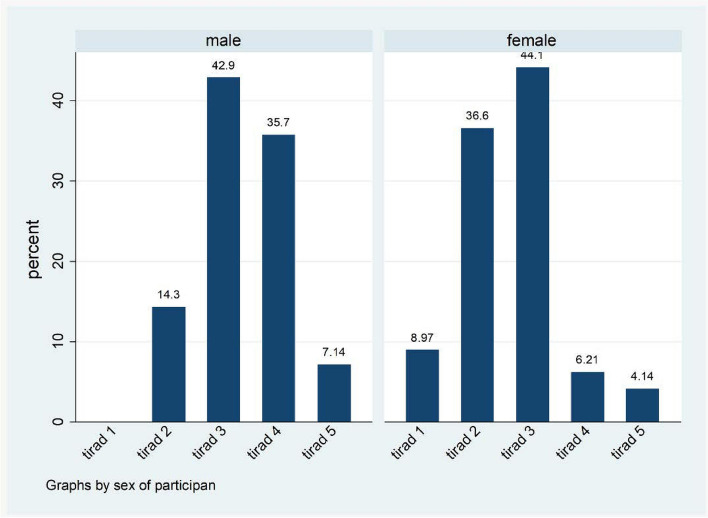
Of 132 study participants, 90% (n = 117) were females, and the mean age was 41 ± 13 years. One hundred sixty-one thyroid nodules were analyzed. More than half of the thyroid nodules (54.7%, n = 87) were solid or almost solid, 96.9% (n = 154) were shaped wider than tall, 57.2% (n = 91) had smooth margins, 83.7% (n = 133) were hyperechoic or isoechoic, and 88.7% (n = 141) had no echogenic foci. TI-RADS 3 was the most common at 42.9% (n = 69). The proportions of malignancy for TI-RADS 4 and TI-RADS 5 were 73.3% and 85.7%, respectively. The correlation between ACR TI-RADS and the Bethesda system of thyroid classification scores was r = 0.577. The sensitivity, specificity, positive and negative predictive values, and positive and negative likelihood ratios of ACR TI-RADS were 90.9%, 98.5%, 90%, 99.3%, 62.3, and 0.1, respectively.
We found that ACR TI-RADS classification is an appropriate and noninvasive method for assessing thyroid nodules in routine practice. It can safely reduce the number of unnecessary fine-needle aspiration in a significant proportion of benign thyroid lesions. Thyroid nodules classified as TI-RADS 3 should be followed routinely. ACR TI-RADS should be standardized as the screening tool in resource-limited areas.
超声检查是对甲状腺结节进行初步评估的一种非侵入性方法。美国放射学会甲状腺影像报告和数据系统(ACR TI-RADS)在鉴别甲状腺恶性结节方面表现良好。然而,在乌干达,ACR TI-RADS分类与细胞学检查的联合应用尚未得到广泛研究。本研究旨在探讨在穆拉戈国家转诊医院接受超声引导下细针穿刺的患者中,ACR TI-RADS与细胞学检查结果之间的相关性。
这是一项基于医院的横断面研究,纳入了132例甲状腺结节患者。采用Spearman相关性分析来确定TI-RADS与细胞学检查结果之间的关系。通过敏感性、特异性、阳性和阴性预测值以及阳性和阴性似然比来评估TI-RADS的诊断准确性。
132名研究参与者中,90%(n = 117)为女性,平均年龄为41±13岁。共分析了161个甲状腺结节。超过一半的甲状腺结节(54.7%,n = 87)为实性或几乎实性,96.9%(n = 154)呈宽大于高的形态,57.2%(n = 91)边缘光滑,83.7%(n = 133)为高回声或等回声,88.7%(n = 141)无回声灶。TI-RADS 3最为常见,占42.9%(n = 69)。TI-RADS 4和TI-RADS 5的恶性比例分别为73.3%和85.7%。ACR TI-RADS与甲状腺分类贝塞斯达系统评分之间的相关性为r = 0.577。ACR TI-RADS的敏感性、特异性、阳性和阴性预测值以及阳性和阴性似然比分别为90.9%、98.5%、90%、99.3%、62.3和0.1。
我们发现ACR TI-RADS分类是一种在常规实践中评估甲状腺结节的合适且非侵入性的方法。它可以在很大比例的良性甲状腺病变中安全地减少不必要的细针穿刺次数。分类为TI-RADS 3的甲状腺结节应定期随访。在资源有限的地区,ACR TI-RADS应作为筛查工具进行标准化。