• 文献检索
  • 文档翻译
  • 深度研究
  • 学术资讯
  • Suppr Zotero 插件Zotero 插件
  • 邀请有礼
  • 套餐&价格
  • 历史记录
应用&插件
Suppr Zotero 插件Zotero 插件浏览器插件Mac 客户端Windows 客户端微信小程序
定价
高级版会员购买积分包购买API积分包
服务
文献检索文档翻译深度研究API 文档MCP 服务
关于我们
关于 Suppr公司介绍联系我们用户协议隐私条款
关注我们

Suppr 超能文献

核心技术专利:CN118964589B侵权必究
粤ICP备2023148730 号-1Suppr @ 2026

文献检索

告别复杂PubMed语法,用中文像聊天一样搜索,搜遍4000万医学文献。AI智能推荐,让科研检索更轻松。

立即免费搜索

文件翻译

保留排版,准确专业,支持PDF/Word/PPT等文件格式,支持 12+语言互译。

免费翻译文档

深度研究

AI帮你快速写综述,25分钟生成高质量综述,智能提取关键信息,辅助科研写作。

立即免费体验

石松球果原位光合作用和呼吸作用的温度响应。

L. Strobilus In Situ Photosynthesis and Respiration Temperature Responses.

作者信息

Bauerle William L, Hazlett Michael

机构信息

Department of Horticulture and Landscape Architecture, Colorado State University, Fort Collins, CO 80523, USA.

出版信息

Plants (Basel). 2023 May 19;12(10):2030. doi: 10.3390/plants12102030.

DOI:10.3390/plants12102030
PMID:37653947
原文链接:https://pmc.ncbi.nlm.nih.gov/articles/PMC10223736/
Abstract

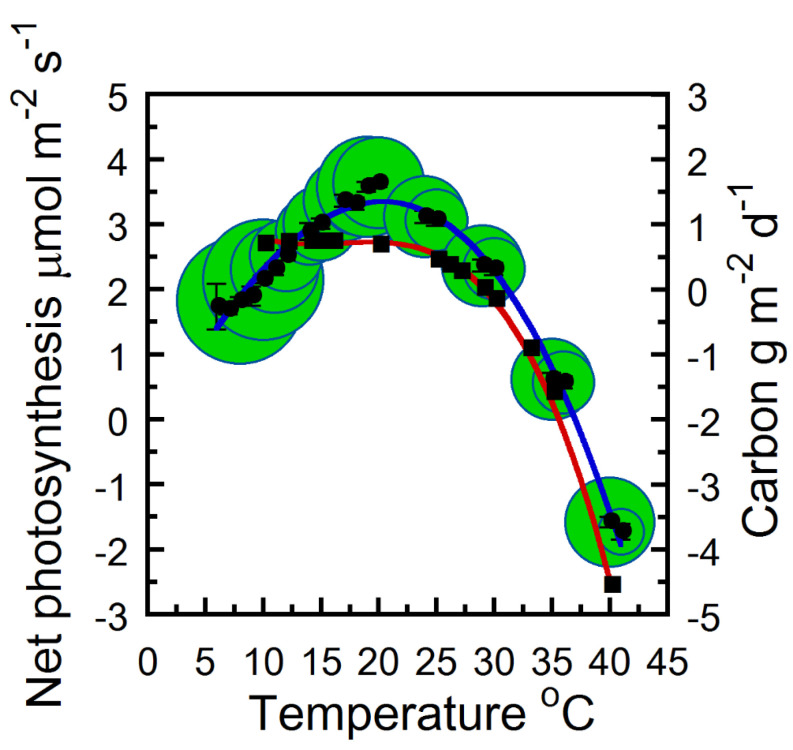
The primary metabolism and respiration of the hop strobilus has not been quantified in response to daily temperature fluctuations. The objective of this study was to assess strobilus gas exchange, specifically the response to temperature fluctuations. Hop strobilus were measured under controlled environment conditions to assess the organ's contribution to carbon assimilation and respiration during the maturation phase. Strobilus-specific daily carbon budgets were estimated in response to temperature fluctuation. The optimal temperature for net carbon gain occurred at 15.7 °C. Estimated strobilus carbon uptake decreased approximately 41% per 5 °C increase in temperature above 20 °C. Daily temperatures within 10-27 °C resulted in a net positive strobilus daily carbon balance, whereas temperature increases beyond 27 °C increasingly exhaust strobilus carbon reserves. The Q temperature coefficient (the rate respiration increases every 10 °C rise in temperature) approximately doubled per 10 °C rise in temperature from 7-40 °C (1.94-2) with slightly reduced values at lower temperatures. In conclusion, we show that photosynthetically active bracts maintain a positive strobilus carbon balance at moderate temperatures and as mean daily temperatures progressively exceed 27 °C, strobilus net carbon reserves are precipitously exhausted due to ever-increasing respiration rates.

摘要

尚未对酒花球果的主要代谢和呼吸作用随每日温度波动的情况进行量化。本研究的目的是评估球果的气体交换,特别是对温度波动的响应。在可控环境条件下对酒花球果进行测量,以评估该器官在成熟阶段对碳同化和呼吸作用的贡献。针对温度波动估计了球果特定的每日碳预算。净碳增益的最佳温度出现在15.7℃。温度在20℃以上每升高5℃,估计的球果碳吸收量大约减少41%。10 - 27℃范围内的日温度导致球果每日碳平衡呈净正增长,而温度升高超过27℃会越来越多地耗尽球果的碳储备。温度系数Q(温度每升高10℃呼吸速率增加的比率)在7 - 40℃范围内每升高10℃大约翻倍(从1.94增至2),在较低温度下数值略有降低。总之,我们表明,在适度温度下,具有光合活性的苞片可维持球果的正碳平衡,并且随着日平均温度逐渐超过27℃,由于呼吸速率不断增加,球果的净碳储备会急剧耗尽。

https://cdn.ncbi.nlm.nih.gov/pmc/blobs/8158/10223736/927770ccd0f6/plants-12-02030-g004.jpg
https://cdn.ncbi.nlm.nih.gov/pmc/blobs/8158/10223736/0d10270a92ee/plants-12-02030-g001.jpg
https://cdn.ncbi.nlm.nih.gov/pmc/blobs/8158/10223736/eab0aef0ba46/plants-12-02030-g002.jpg
https://cdn.ncbi.nlm.nih.gov/pmc/blobs/8158/10223736/1bcd54ff6120/plants-12-02030-g003.jpg
https://cdn.ncbi.nlm.nih.gov/pmc/blobs/8158/10223736/927770ccd0f6/plants-12-02030-g004.jpg
https://cdn.ncbi.nlm.nih.gov/pmc/blobs/8158/10223736/0d10270a92ee/plants-12-02030-g001.jpg
https://cdn.ncbi.nlm.nih.gov/pmc/blobs/8158/10223736/eab0aef0ba46/plants-12-02030-g002.jpg
https://cdn.ncbi.nlm.nih.gov/pmc/blobs/8158/10223736/1bcd54ff6120/plants-12-02030-g003.jpg
https://cdn.ncbi.nlm.nih.gov/pmc/blobs/8158/10223736/927770ccd0f6/plants-12-02030-g004.jpg

相似文献

1
L. Strobilus In Situ Photosynthesis and Respiration Temperature Responses.石松球果原位光合作用和呼吸作用的温度响应。
Plants (Basel). 2023 May 19;12(10):2030. doi: 10.3390/plants12102030.
2
L. Strobilus Photosynthetic Capacity and Carbon Assimilation.L. 球果的光合能力与碳同化作用。
Plants (Basel). 2023 Apr 28;12(9):1816. doi: 10.3390/plants12091816.
3
[The effect of light and temperature of the CO exchange of different life forms in the ground vegetation of a montane beech forest].[山地山毛榉林地面植被中不同生命形式的二氧化碳交换对光照和温度的影响]
Oecologia. 1972 Sep;9(3):235-258. doi: 10.1007/BF00345234.
4
Higher growth temperatures decreased net carbon assimilation and biomass accumulation of northern red oak seedlings near the southern limit of the species range.较高的生长温度降低了接近北方红栎物种分布南限的北方红栎幼苗的净碳同化和生物量积累。
Tree Physiol. 2011 Dec;31(12):1277-88. doi: 10.1093/treephys/tpr091. Epub 2011 Sep 21.
5
Temperature dependency of bark photosynthesis in beech (Fagus sylvatica L.) and birch (Betula pendula Roth.) trees.山毛榉(欧洲山毛榉)和桦树(垂枝桦)树皮光合作用的温度依赖性
J Exp Bot. 2007;58(15-16):4293-306. doi: 10.1093/jxb/erm313.
6
Thermal Acclimation of Respiration and Photosynthesis in the Marine Macroalga Gracilaria lemaneiformis (Gracilariales, Rhodophyta).龙须菜(江蓠目,红藻门)呼吸作用和光合作用的热驯化
J Phycol. 2013 Feb;49(1):61-8. doi: 10.1111/jpy.12009. Epub 2012 Nov 7.
7
Altitudinal changes in temperature responses of net photosynthesis and dark respiration in tropical bryophytes.热带苔藓净光合和暗呼吸对温度响应的海拔变化。
Ann Bot. 2013 Mar;111(3):455-65. doi: 10.1093/aob/mcs267. Epub 2012 Dec 19.
8
Carbon fluxes acclimate more strongly to elevated growth temperatures than to elevated CO2 concentrations in a northern conifer.在北方针叶林中,碳通量对生长温度升高的适应强于对 CO2 浓度升高的适应。
Glob Chang Biol. 2016 Aug;22(8):2913-28. doi: 10.1111/gcb.13215. Epub 2016 Mar 8.
9
Estimation of a whole plant Q10 to assess seagrass productivity during temperature shifts.估算植物 Q10 以评估温度变化期间海草的生产力。
Sci Rep. 2019 Sep 2;9(1):12667. doi: 10.1038/s41598-019-49184-z.
10
[Eco-physiological investigations on wild and cultivated plants in the Negev Desert : II. The influence of climatic factors on carbon dioxide exchange and transpiration at the end of the dry period].内盖夫沙漠野生和栽培植物的生态生理研究:II. 干旱期末气候因子对二氧化碳交换和蒸腾作用的影响
Oecologia. 1972 Dec;8(4):334-355. doi: 10.1007/BF00367537.

引用本文的文献

1
Untapped: the 1891 hop yield record.未被利用的:1891年啤酒花产量记录。
Front Plant Sci. 2025 Apr 3;16:1539239. doi: 10.3389/fpls.2025.1539239. eCollection 2025.
2
Separate and Combined Effects of Supplemental CO, Gibberellic Acid, and Light on Hop Quality and Yield.补充一氧化碳、赤霉素和光照对啤酒花品质及产量的单独和综合影响
Plants (Basel). 2024 Jun 16;13(12):1670. doi: 10.3390/plants13121670.

本文引用的文献

1
L. Strobilus Photosynthetic Capacity and Carbon Assimilation.L. 球果的光合能力与碳同化作用。
Plants (Basel). 2023 Apr 28;12(9):1816. doi: 10.3390/plants12091816.
2
Respiration, Rather Than Photosynthesis, Determines Rice Yield Loss Under Moderate High-Temperature Conditions.在适度高温条件下,决定水稻产量损失的是呼吸作用,而非光合作用。
Front Plant Sci. 2021 Jun 24;12:678653. doi: 10.3389/fpls.2021.678653. eCollection 2021.
3
Internode elongation and strobili production of Humulus lupulus cultivars in response to local strain sensing.
对地方菌株感应的响应下,啤酒花品种的节间伸长和柔荑花序产生。
Sci Rep. 2021 Apr 27;11(1):9017. doi: 10.1038/s41598-021-88720-8.
4
What happens at night? Physiological mechanisms related to maintaining grain yield under high night temperature in rice.夜间发生了什么?与高温夜晚下维持水稻粒产量有关的生理机制。
Plant Cell Environ. 2021 Jul;44(7):2245-2261. doi: 10.1111/pce.14046. Epub 2021 Mar 25.
5
The hot and the cold: unravelling the variable response of plant respiration to temperature.热与冷:解读植物呼吸对温度的可变响应
Funct Plant Biol. 2005 Apr;32(2):87-105. doi: 10.1071/FP03176.
6
The Hidden Costs of Nighttime Warming on Yields.夜间升温对产量的隐性成本。
Trends Plant Sci. 2020 Jul;25(7):644-651. doi: 10.1016/j.tplants.2020.02.003. Epub 2020 Mar 10.
7
Disentangling photoperiod from hop vernalization and dormancy for global production and speed breeding.为了实现全球生产和加速繁殖,需要将光周期与春化和休眠分开。
Sci Rep. 2019 Nov 5;9(1):16003. doi: 10.1038/s41598-019-52548-0.
8
Integrating field-based heat tents and cyber-physical system technology to phenotype high night-time temperature impact on winter wheat.整合基于田间的热帐篷和网络物理系统技术,以表型分析夜间高温对冬小麦的影响。
Plant Methods. 2019 Apr 24;15:41. doi: 10.1186/s13007-019-0424-x. eCollection 2019.
9
Engineering Strategies to Boost Crop Productivity by Cutting Respiratory Carbon Loss.工程策略通过减少呼吸碳损失来提高作物生产力。
Plant Cell. 2019 Feb;31(2):297-314. doi: 10.1105/tpc.18.00743. Epub 2019 Jan 22.
10
Plant carbon metabolism and climate change: elevated CO and temperature impacts on photosynthesis, photorespiration and respiration.植物碳代谢与气候变化:高浓度 CO 和温度对光合作用、光呼吸和呼吸作用的影响。
New Phytol. 2019 Jan;221(1):32-49. doi: 10.1111/nph.15283. Epub 2018 Jul 8.