Genitourinary Malignancies Research Center, Lerner Research Institute.
Department of Urology, Glickman Urological and Kidney Institute.
J Clin Invest. 2023 Sep 1;133(17):e171117. doi: 10.1172/JCI171117.
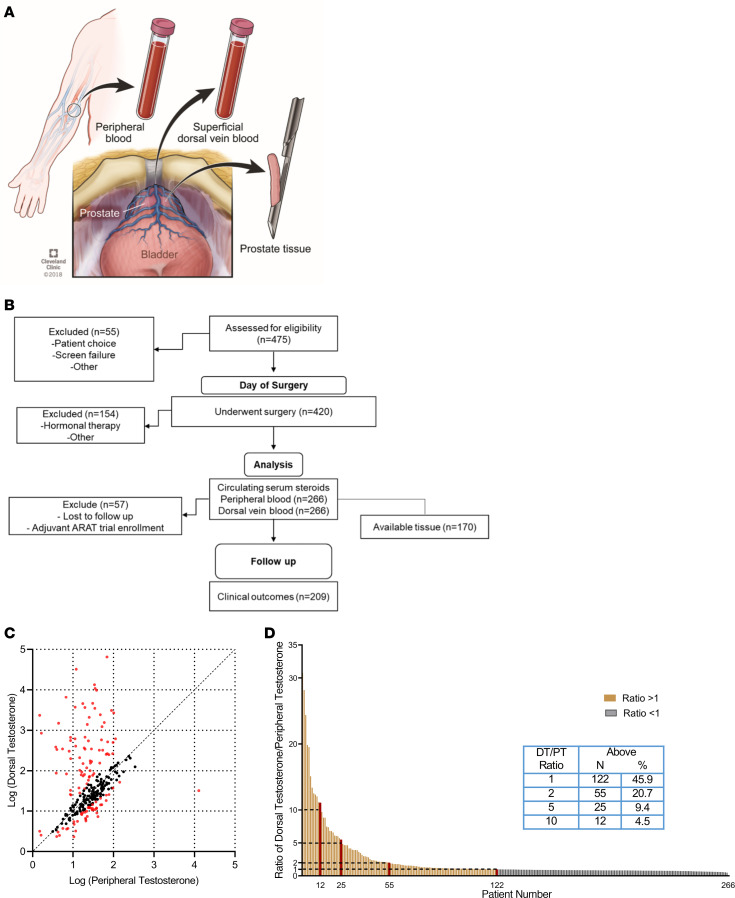
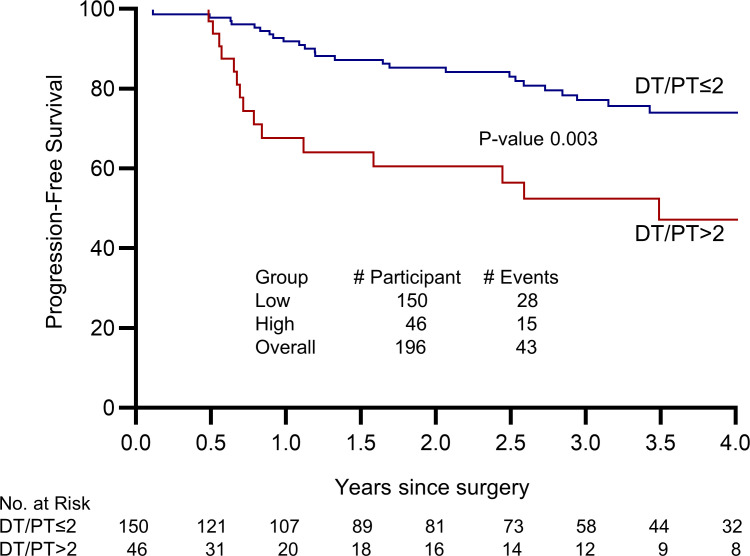
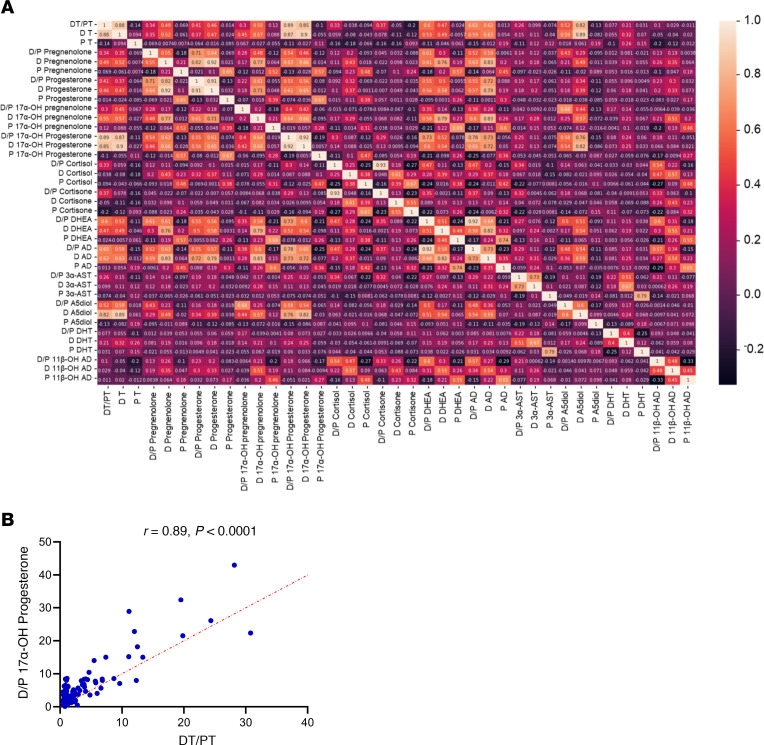
BACKGROUNDGenerally, clinical assessment of gonadal testosterone (T) in human physiology is determined using concentrations measured in peripheral blood. Prostatic T exposure is similarly thought to be determined from peripheral T exposure. Despite the fact that androgens drive prostate cancer, peripheral T has had no role in the clinical evaluation or treatment of men with localized prostate cancer.METHODSTo assess the role of local androgen delivery in prostate cancer, we obtained blood from the (periprostatic) prostatic dorsal venous complex in 266 men undergoing radical prostatectomy from July 2014 to August 2021 and compared dorsal T (DT) levels with those in circulating peripheral blood (PT) and prostatic tissue. Comprehensive targeted steroid analysis and unbiased metabolomics analyses were performed. The association between the DT/PT ratio and progression-free survival after prostatectomy was assessed.RESULTSSurprisingly, in some men, DT levels were enriched several-fold compared with PT levels. For example, 20% of men had local T concentrations that were at least 2-fold higher than peripheral T concentrations. Isocaproic acid, a byproduct of androgen biosynthesis, and 17-OH-progesterone, a marker of intratesticular T, were also enriched in the dorsal vein of these men, consistent with testicular shunting. Men with enriched DT had higher rates of prostate cancer recurrence. DT/PT concentration ratios predicted worse outcomes even when accounting for known clinical predictors.CONCLUSIONSThese data suggest that a large proportion of men have a previously unappreciated exposure to an undiluted and highly concentrated T supply. Elevated periprostatic T exposure was associated with worse clinical outcomes after radical prostatectomy.FUNDINGNational Cancer Institute (NCI), NIH grants R01CA172382, R01CA236780, R01CA261995, R01CA249279, and R50CA251961; US Army Medical Research and Development Command grants W81XWH2010137 and W81XWH-22-1-0082.
通常,人体生理学中睾丸酮(T)的临床评估是通过外周血中测量的浓度来确定的。同样,前列腺 T 的暴露被认为是由外周 T 的暴露决定的。尽管雄激素驱动前列腺癌的发生,但外周 T 在局部前列腺癌男性的临床评估或治疗中没有作用。
为了评估局部雄激素输送在前列腺癌中的作用,我们从 2014 年 7 月至 2021 年 8 月期间接受根治性前列腺切除术的 266 名男性中获得了(前列腺周围)前列腺背侧静脉丛的血液,并将背侧 T(DT)水平与循环外周血(PT)和前列腺组织中的 T 水平进行了比较。进行了全面的靶向类固醇分析和无偏代谢组学分析。评估了 DT/PT 比值与前列腺切除术后无进展生存期的关系。
令人惊讶的是,在一些男性中,DT 水平比 PT 水平高出数倍。例如,20%的男性局部 T 浓度至少是外周 T 浓度的两倍。这些男性的背静脉中也富含异亮氨酸酸,这是雄激素生物合成的副产物,以及 17-羟孕酮,这是睾丸内 T 的标志物,这与睾丸分流一致。DT 丰富的男性前列腺癌复发率更高。即使考虑到已知的临床预测因素,DT/PT 浓度比也预测了更差的结局。
这些数据表明,很大一部分男性以前没有意识到自己受到了未稀释的高浓度 T 供应的影响。背侧 T 暴露升高与根治性前列腺切除术后的临床结局较差有关。
美国国立卫生研究院(NCI),NIH 拨款 R01CA172382、R01CA236780、R01CA261995、R01CA249279 和 R50CA251961;美国陆军医学研究与发展司令部拨款 W81XWH2010137 和 W81XWH-22-1-0082。