Health Economics Bristol, Bristol Medical School, University of Bristol, Bristol, United Kingdom.
National Institute for Health and Care Research Applied Research Collaboration West (NIHR ARC West) at University Hospitals Bristol and Weston NHS Foundation Trust, Bristol, United Kingdom.
PLoS One. 2023 Sep 1;18(9):e0290996. doi: 10.1371/journal.pone.0290996. eCollection 2023.
Health systems are under pressure to maintain services within limited resources. The Evidence-Based Interventions (EBI) programme published a first list of guidelines in 2019, which aimed to reduce inappropriate use of interventions within the NHS in England, reducing potential harm and optimising the use of limited resources. Seventeen procedures were selected in the first round, published in April 2019.
We evaluated changes in the trends for each procedure after its inclusion in the EBI's first list of guidelines using interrupted time series analysis. We explored whether there was any evidence of spill-over effects onto related or substitute procedures, as well as exploring changes in geographical variation following the publication of national guidance.
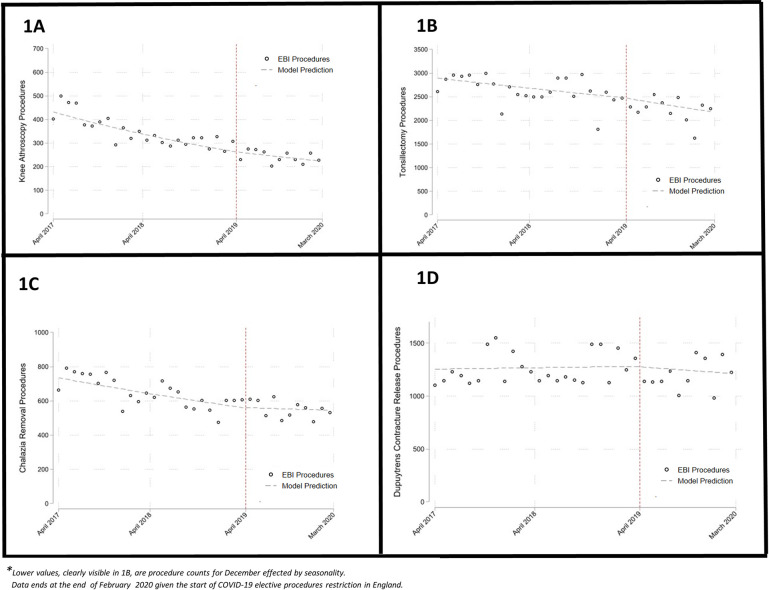
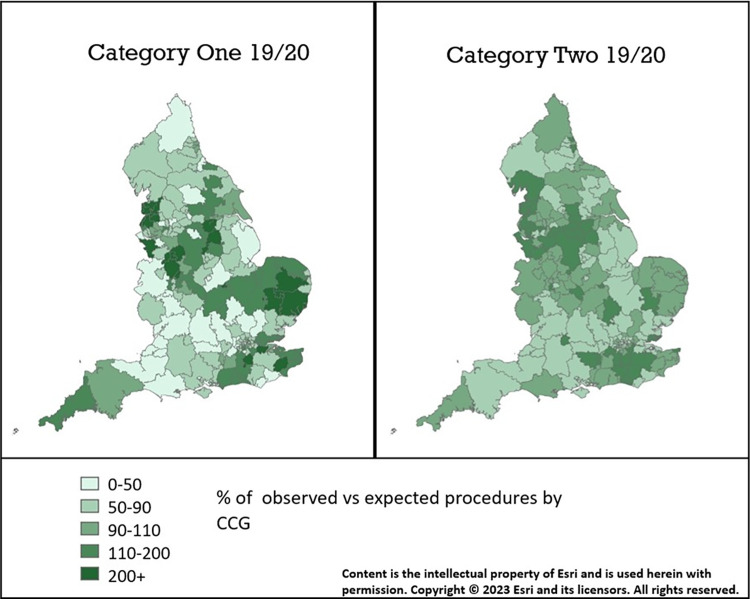
Most procedures were experiencing downward trends in the years prior to the launch of EBI. We found no evidence of a trend change in any of the 17 procedures following the introduction of the guidance. No evidence of spill-over increases in substitute or related procedures was found. Geographic variation in the number of procedures performed across English CCGs remained at similar levels before and after EBI.
The EBI programme had little success in its aim to further reduce the use of the 17 procedures it deemed inappropriate in all or certain circumstances. Most procedure rates were already decreasing before EBI and all continued with a similar trend afterwards. Geographical variation in the number of procedures remained at a similar level post EBI. De-adoption of inappropriate care is essential in maintaining health systems across the world. However, further research is needed to explore context specific enablers and barriers to effective identification and de-adoption of such inappropriate health care to support future de-adoption endeavours.
医疗体系在有限资源的情况下,面临维持服务的压力。循证干预措施(EBI)计划于 2019 年发布了第一份指南清单,旨在减少英格兰国民保健制度中干预措施的不当使用,减少潜在危害并优化有限资源的利用。第一轮选择了 17 种程序,于 2019 年 4 月发布。
我们使用中断时间序列分析评估了每种程序在被纳入 EBI 的第一份指南清单后趋势的变化。我们探讨了是否存在对相关或替代程序的溢出效应的证据,以及在发布国家指南后是否存在地理差异变化的证据。
大多数程序在 EBI 推出前的几年中呈下降趋势。我们发现,在指南发布后,17 种程序中没有任何一种程序的趋势发生变化。没有发现替代或相关程序的溢出增加的证据。在 EBI 之前和之后,英格兰 CCG 中执行的程序数量的地理差异保持在相似水平。
EBI 计划在其目标方面几乎没有成功,即在所有或某些情况下进一步减少其认为不适当的 17 种程序的使用。在 EBI 之前,大多数程序的使用率已经在下降,并且之后所有程序都继续保持类似的趋势。EBI 之后,程序数量的地理差异保持在相似水平。在全球范围内,淘汰不适当的医疗保健对于维持医疗体系至关重要。然而,需要进一步研究来探索特定背景下有效识别和淘汰此类不适当医疗保健的促进因素和障碍,以支持未来的淘汰努力。