Francetic Igor, Meacock Rachel, Elliott Jack, Kristensen Søren R, Britteon Phillip, Lugo-Palacios David G, Wilson Paul, Sutton Matt
Health Organization, Policy and Economics (HOPE) Research Group, Centre for Primary Care and Health Services Research, School of Health Sciences, University of Manchester, Manchester, UK.
Danish Centre for Health Economics, University of Southern Denmark, Odense, Denmark.
Implement Sci Commun. 2022 Mar 14;3(1):30. doi: 10.1186/s43058-022-00280-8.
There is increasing awareness among researchers and policymakers of the potential for healthcare interventions to have consequences beyond those initially intended. These unintended consequences or "spillover effects" result from the complex features of healthcare organisation and delivery and can either increase or decrease overall effectiveness. Their potential influence has important consequences for the design and evaluation of implementation strategies and for decision-making. However, consideration of spillovers remains partial and unsystematic. We develop a comprehensive framework for the identification and measurement of spillover effects resulting from changes to the way in which healthcare services are organised and delivered.
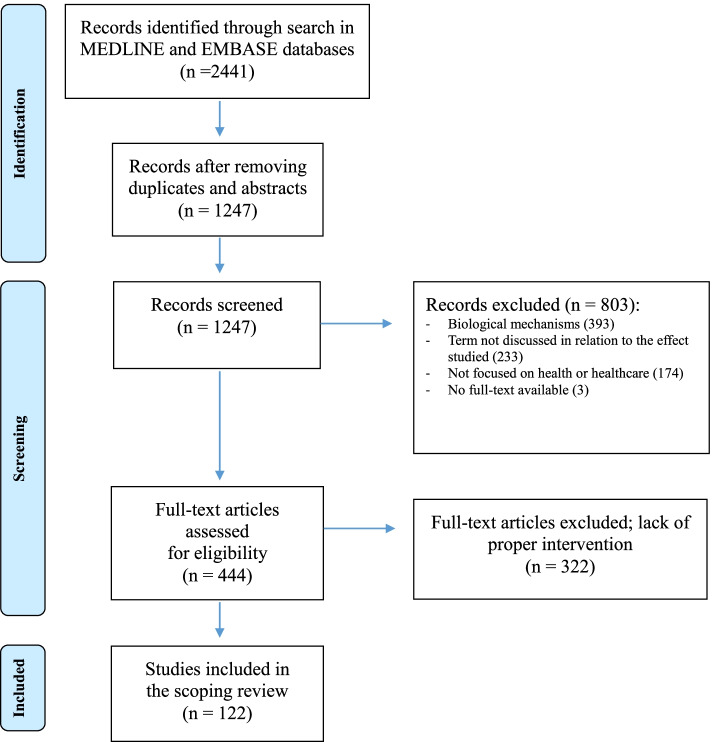
We conducted a scoping review to map the existing literature on spillover effects in health and healthcare interventions and used the findings of this review to develop a comprehensive framework to identify and measure spillover effects.
The scoping review identified a wide range of different spillover effects, either experienced by agents not intentionally targeted by an intervention or representing unintended effects for targeted agents. Our scoping review revealed that spillover effects tend to be discussed in papers only when they are found to be statistically significant or might account for unexpected findings, rather than as a pre-specified feature of evaluation studies. This hinders the ability to assess all potential implications of a given policy or intervention. We propose a taxonomy of spillover effects, classified based on the outcome and the unit experiencing the effect: within-unit, between-unit, and diagonal spillover effects. We then present the INTENTS framework: Intended Non-intended TargEted Non-Targeted Spillovers. The INTENTS framework considers the units and outcomes which may be affected by an intervention and the mechanisms by which spillover effects are generated.
The INTENTS framework provides a structured guide for researchers and policymakers when considering the potential effects that implementation strategies may generate, and the steps to take when designing and evaluating such interventions. Application of the INTENTS framework will enable spillover effects to be addressed appropriately in future evaluations and decision-making, ensuring that the full range of costs and benefits of interventions are correctly identified.
研究人员和政策制定者越来越意识到医疗保健干预措施可能产生超出最初预期的后果。这些意外后果或“溢出效应”源于医疗保健组织和提供的复杂特征,可能会提高或降低整体效果。它们的潜在影响对实施策略的设计和评估以及决策具有重要意义。然而,对溢出效应的考虑仍然是片面和不系统的。我们开发了一个综合框架,用于识别和衡量医疗保健服务组织和提供方式的变化所产生的溢出效应。
我们进行了一项范围审查,以梳理关于健康和医疗保健干预措施中溢出效应的现有文献,并利用该审查的结果开发一个综合框架来识别和衡量溢出效应。
范围审查确定了广泛的不同溢出效应,这些效应要么由未被干预措施有意针对的主体经历,要么代表针对主体的意外效应。我们的范围审查表明,溢出效应往往仅在被发现具有统计学意义或可能解释意外发现时才在论文中被讨论,而不是作为评估研究的预先指定特征。这阻碍了评估给定政策或干预措施所有潜在影响的能力。我们提出了一种溢出效应分类法,根据结果和经历效应的单位进行分类:单位内、单位间和对角溢出效应。然后我们介绍了INTENTS框架:预期的、非预期的、目标的、非目标的溢出效应。INTENTS框架考虑了可能受干预措施影响的单位和结果以及产生溢出效应的机制。
INTENTS框架为研究人员和政策制定者在考虑实施策略可能产生的潜在影响以及设计和评估此类干预措施时应采取的步骤提供了结构化指导。INTENTS框架的应用将使溢出效应在未来的评估和决策中得到适当处理,确保正确识别干预措施的全部成本和收益。