
解码血栓形成的密码:计算模型综述。
Decoding thrombosis through code: a review of computational models.
机构信息
Carnegie Mellon University, Department of Mechanical Engineering Pittsburgh, PA, USA. Electronic address: https://twitter.com/ngrandeg.
University of Colorado Boulder, Paul M. Rady Department of Mechanical Engineering Boulder, CO, USA. Electronic address: https://twitter.com/debanjanmukh.
出版信息
J Thromb Haemost. 2024 Jan;22(1):35-47. doi: 10.1016/j.jtha.2023.08.021. Epub 2023 Aug 30.
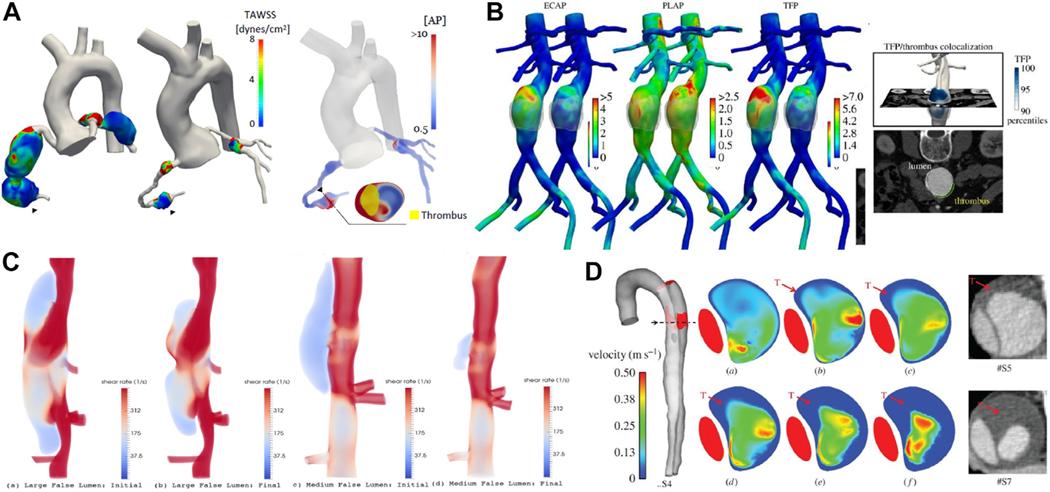
From the molecular level up to a blood vessel, thrombosis and hemostasis involves many interconnected biochemical and biophysical processes over a wide range of length and time scales. Computational modeling has gained eminence in offering insights into these processes beyond what can be obtained from in vitro or in vivo experiments, or clinical measurements. The multiscale and multiphysics nature of thrombosis has inspired a wide range of modeling approaches that aim to address how a thrombus forms and dismantles. Here, we review recent advances in computational modeling with a focus on platelet-based thrombosis. We attempt to summarize the diverse range of modeling efforts straddling the wide-spectrum of physical phenomena, length scales, and time scales; highlighting key advancements and insights from existing studies. Potential information gleaned from models is discussed, ranging from identification of thrombus-prone regions in patient-specific vasculature to modeling thrombus deformation and embolization in response to fluid forces. Furthermore, we highlight several limitations of current models, future directions in the field, and opportunities for clinical translation, to illustrate the state-of-the-art. There are a plethora of opportunity areas for which models can be expanded, ranging from topics of thromboinflammation to platelet production and clearance. Through successes demonstrated in existing studies described here, as well as continued advancements in computational methodologies and computer processing speeds and memory, in silico investigations in thrombosis are poised to bring about significant knowledge growth in the years to come.
从分子水平到血管,血栓形成和止血涉及许多相互关联的生化和生物物理过程,跨越广泛的长度和时间尺度。计算建模在提供超越体外或体内实验或临床测量所能获得的这些过程的见解方面获得了卓越的地位。血栓形成的多尺度和多物理性质激发了广泛的建模方法,旨在解决血栓形成和分解的方式。在这里,我们回顾了最近在基于血小板的血栓形成的计算建模方面的进展。我们试图总结跨越广泛的物理现象、长度和时间尺度的各种建模工作;强调现有研究中的关键进展和见解。讨论了可以从模型中获取的潜在信息,从识别患者特定血管中的血栓形成倾向区域到模拟血栓变形和栓塞以响应流体力。此外,我们突出了当前模型的几个局限性、该领域的未来方向以及临床转化的机会,以说明现状。有很多机会可以扩展模型,从血栓炎症到血小板生成和清除的主题。通过这里描述的现有研究中展示的成功,以及计算方法和计算机处理速度和内存方面的持续进步,血栓形成的计算研究有望在未来几年带来重大的知识增长。




 Zotero 插件