
家庭 COVID-19:一项横断面研究的结果——感染和未感染家庭成员的长期结局。
FamilyCoviDD19: results of a cross-sectional study-long-term outcomes of infected and uninfected household members.
机构信息
Department of Pediatrics, University Hospital and Medical Faculty Carl Gustav Carus, Technische Universität Dresden, Dresden, Germany
Department of Pediatrics, University Hospital and Medical Faculty Carl Gustav Carus, Technische Universität Dresden, Dresden, Germany.
出版信息
Fam Med Community Health. 2023 Sep;11(3). doi: 10.1136/fmch-2022-002057.
OBJECTIVE
In this study, we aimed to compare long-term physical and mental health outcome between SARS-CoV-2 infected and uninfected household members to differentiate between infection-related and pandemic-related outcomes after about two and a half years of the pandemic. Furthermore, possible differences in the outcome of adults and children and young people (CYP) were of interest.
DESIGN
In a cross-sectional study design, we compared the long-term physical and mental health outcome of between infected and uninfected as well as between adult and CYP (household members).
SETTING
The FamilyCoviDD19 study-a serology study in households-was initially conducted to evaluate virus transmission in a close contact setting focusing on households with children and adolescents in Germany. At least 1 year after initial infection in the respective households, a follow-up took place in which the prevalence and type of possible long-term consequences were surveyed on the basis of self-reported information on physical and mental health.
PARTICIPANT
In this study, a total of 533 household members of 146 families participated and responded to our survey, including 296 (55.5%) adults and 237 (44.5%) CYP.
RESULT
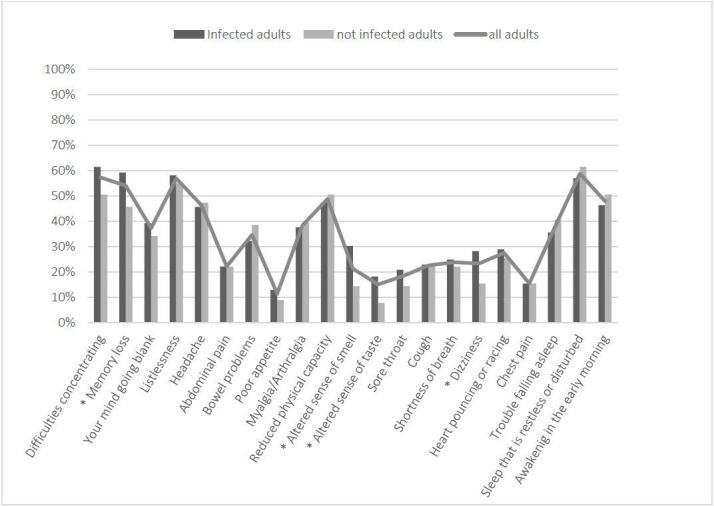
The difference in frequency of reported symptoms between infected and uninfected individuals was very moderate, suggesting that the vast majority of reported symptoms were not attributable to a previous SARS-CoV-2 infection. However, regardless of age and infection status, this study showed overall high rates of self-reported symptoms with CYP having fewer long-term sequelae than adults one year after infection. Furthermore, over 50% of those reporting symptoms were not affected in their daily life, with CYPs reporting an even lower percentage compared with adults.
CONCLUSION
CYP are at reduced risk not only to develop symptomatic infection or severe disease courses (previous analyses) but also to develop infection-associated long-term sequelae (this study). Independent of infection CYP reported high rates of neurocognitive, pain, somatic and mood symptoms, which makes the influence of the pandemic itself-including pandemic control measures-decisive.
目的
在这项研究中,我们旨在比较 SARS-CoV-2 感染和未感染的家庭成员之间的长期身心健康结果,以区分大流行后大约两年半的感染相关和大流行相关结果。此外,成人和儿童及青少年(CYP)之间结果的可能差异也引起了关注。
设计
在一项横断面研究设计中,我们比较了感染组和未感染组以及成人组和 CYP 组(家庭成员)之间的长期身心健康结果。
设置
FamilyCoviDD19 研究是一项在家庭中进行的血清学研究,最初旨在评估密切接触环境中的病毒传播,重点是德国有儿童和青少年的家庭。在各自家庭中最初感染至少 1 年后,进行了一项随访,基于身体和心理健康的自我报告信息,调查可能的长期后果的患病率和类型。
参与者
这项研究共有 146 个家庭的 533 名家庭成员参与并回答了我们的调查,包括 296 名(55.5%)成年人和 237 名(44.5%)CYP。
结果
感染组和未感染组报告症状的频率差异非常适中,这表明绝大多数报告的症状与以前的 SARS-CoV-2 感染无关。然而,无论年龄和感染状况如何,这项研究都显示出总体上较高的自我报告症状率,感染后一年 CYP 的长期后遗症较少。此外,超过 50%报告有症状的人没有受到日常生活的影响,CYP 报告的比例甚至低于成年人。
结论
CYP 不仅感染后出现症状性感染或严重疾病过程的风险降低(以前的分析),而且出现感染相关的长期后遗症的风险也降低(本研究)。与感染无关,CYP 报告了较高的神经认知、疼痛、躯体和情绪症状发生率,这使得大流行本身的影响(包括大流行控制措施)具有决定性。


 Zotero 插件