Zhou Yangjie, Wang Yige, Wan Juan, Zhao Yuwen, Pan Hongxu, Zeng Qian, Zhou Xun, He Runcheng, Zhou Xiaoxia, Xiang Yaqin, Zhou Zhou, Chen Bin, Sun Qiying, Xu Qian, Tan Jieqiong, Shen Lu, Jiang Hong, Yan Xinxiang, Li Jinchen, Guo Jifeng, Tang Beisha, Wu Heng, Liu Zhenhua
Department of Neurology, Xiangya Hospital, Central South University, Changsha, Hunan, China.
Department of Neurology, & Multi-Omics Research Center for Brain Disorders, The First Affiliated Hospital, University of South China, Hengyang, Hunan, China.
NPJ Parkinsons Dis. 2023 Sep 1;9(1):129. doi: 10.1038/s41531-023-00571-4.
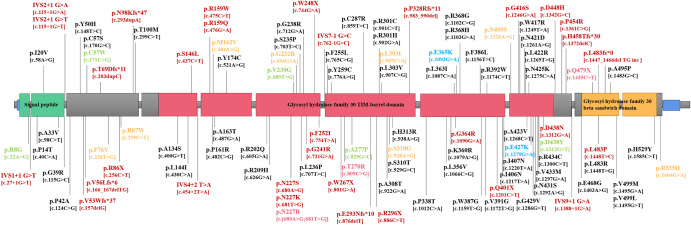
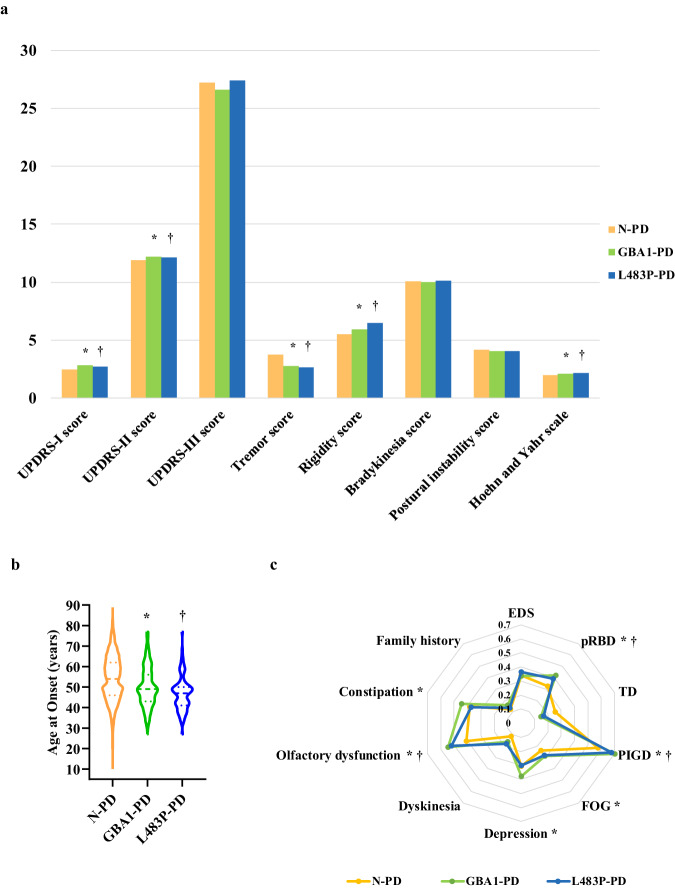
GBA1 variants are important risk factors for Parkinson's disease (PD). Most studies assessing GBA1-related PD risk have been performed in European-derived populations. Although the coding region of the GBA1 gene in the Chinese population has been analyzed, the sample sizes were not adequate. In this study, we aimed to investigate GBA1 variants in a large Chinese cohort of patients with PD and healthy control and explore the associated clinical characteristics. GBA1 variants in 4034 patients and 2931 control participants were investigated using whole-exome and whole-genome sequencing. The clinical features of patients were evaluated using several scales. Regression analysis, chi-square, and Fisher exact tests were used to analyze GBA1 variants and the clinical symptoms of different groups. We identified 104 variants, including 8 novel variants, expanding the spectrum of GBA1 variants. The frequency of GBA1 variants in patients with PD was 7.46%, higher than that in the control (1.81%) (P < 0.001, odds ratio [OR] = 4.38, 95% confidence interval [CI]: 3.26-5.89). Among patients, 176 (4.36%) had severe variants, 34 (0.84%) carried mild variants, three (0.07%) had risk variants, and 88 (2.18%) carried unknown variants. Our study, for the first time, found that p.G241R (P = 0.007, OR = 15.3, 95% CI: 1.25-261.1) and p.S310G (P = 0.005, OR = 4.86, 95% CI: 1.52-28.04) variants increased the risk of PD. Patients with GBA1 variants exhibited an earlier onset age and higher risk of probable rapid-eye-movement sleep behavior disorder, olfactory dysfunction, depression, and autonomic dysfunction than patients without GBA1 variants.
GBA1基因变异是帕金森病(PD)的重要风险因素。大多数评估GBA1相关帕金森病风险的研究是在欧洲裔人群中进行的。虽然对中国人群中GBA1基因的编码区进行了分析,但样本量不足。在本研究中,我们旨在调查一大群中国帕金森病患者和健康对照中的GBA1基因变异,并探索相关的临床特征。使用全外显子组和全基因组测序对4034例患者和2931名对照参与者的GBA1基因变异进行了研究。使用多种量表对患者的临床特征进行了评估。采用回归分析、卡方检验和Fisher精确检验来分析GBA1基因变异与不同组别的临床症状。我们鉴定出104个变异,包括8个新变异,扩展了GBA1基因变异谱。帕金森病患者中GBA1基因变异的频率为7.46%,高于对照组(1.81%)(P < 0.001,比值比[OR] = 4.38,95%置信区间[CI]:3.26 - 5.89)。在患者中,176例(4.36%)有严重变异,34例(0.84%)携带轻度变异,3例(0.07%)有风险变异,88例(2.18%)携带未知变异。我们的研究首次发现,p.G241R(P = 0.007,OR = 15.3,95% CI:1.25 - 261.1)和p.S310G(P = 0.005,OR = 4.86,95% CI:1.52 - 28.04)变异增加了帕金森病的风险。与无GBA1基因变异的患者相比,有GBA1基因变异的患者发病年龄更早,且出现快速眼动睡眠行为障碍、嗅觉功能障碍、抑郁和自主神经功能障碍的风险更高。