Department of Neurology, Xiangya Hospital, Central South University, Changsha, 410008, China.
National Clinical Research Center for Geriatric Disorders, Xiangya Hospital, Central South University, Changsha, 410008, China.
Transl Neurodegener. 2020 Aug 4;9(1):31. doi: 10.1186/s40035-020-00212-3.
Common and rare variants of guanosine triphosphate cyclohydrolase 1 (GCH1) gene may play important roles in Parkinson's disease (PD). However, there is a lack of comprehensive analysis of GCH1 genotypes, especially in non-coding regions. The aim of this study was to explore the genetic characteristics of GCH1, including rare and common variants in coding and non-coding regions, in a large population of PD patients in Chinese mainland, as well as the phenotypic characteristics of GCH1 variant carriers.
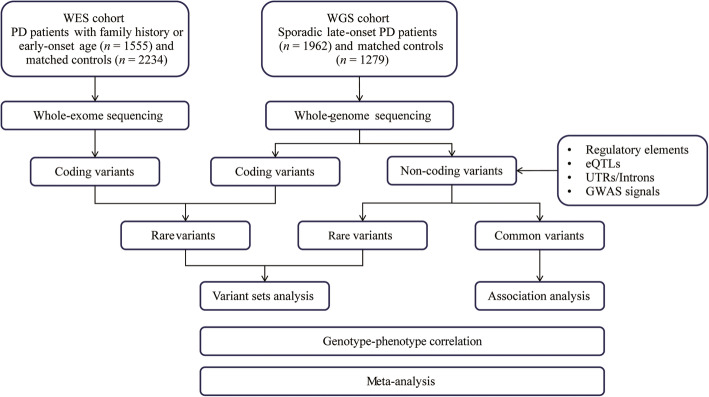
In the first cohort of this case-control study, we performed whole-exome sequencing in 1555 patients with early-onset or familial PD and 2234 healthy controls; then in the second cohort, whole-genome sequencing was performed in sporadic late-onset PD samples (1962 patients), as well as 1279 controls. Variants at target GCH1 regions were extracted, and then genetic and detailed phenotypic data were analyzed using regression models and the sequence kernel association test. We also performed a meta-analysis to correlate deleterious GCH1 variants with age at onset (AAO) in PD patients.
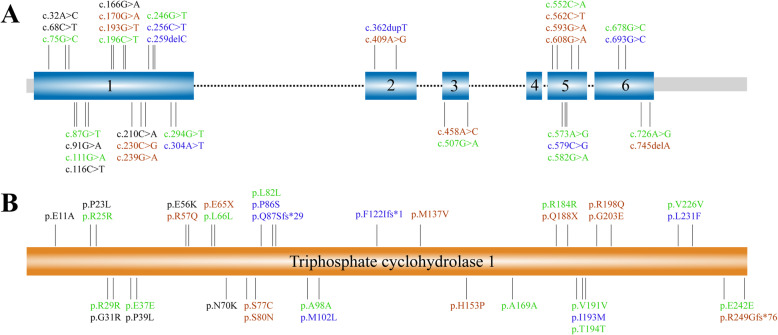
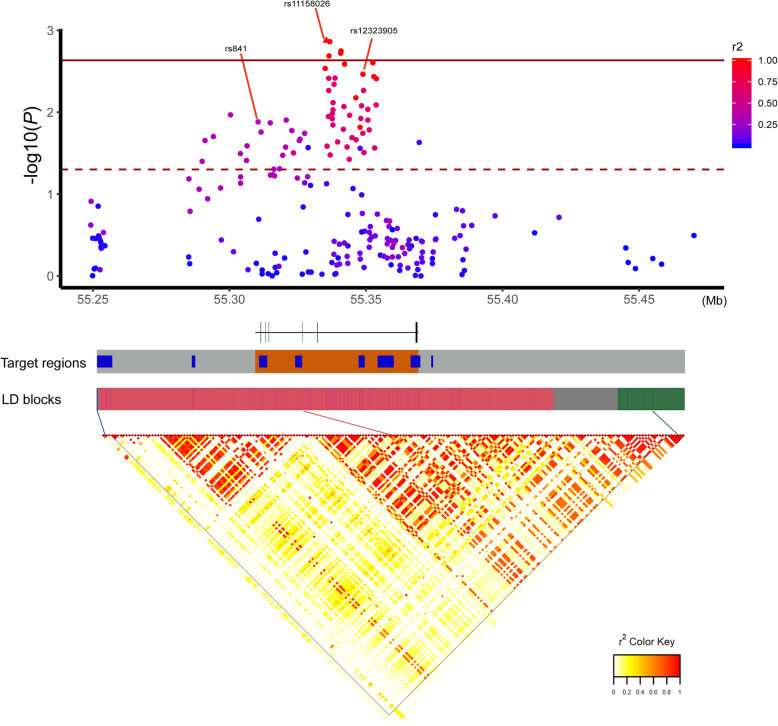
For coding variants, we identified a significant burden of GCH1 deleterious variants in early-onset or familial PD cases compared to controls (1.2% vs 0.1%, P < 0.0001). In the analysis of possible regulatory variants in GCH1 non-coding regions, rs12323905 (P = 0.001, odds ratio = 1.19, 95%CI 1.07-1.32) was significantly associated with PD, and variant sets in untranslated regions and intron regions, GCH1 brain-specific expression quantitative trait loci, and two possible promoter/enhancer (GH14J054857 and GH14J054880) were suggestively associated with PD. Genotype-phenotype correlation analysis revealed that the carriers of GCH1 deleterious variants manifested younger AAO (P < 0.0001), and had milder motor symptoms, milder fatigue symptoms and more autonomic nervous dysfunctions. Meta-analysis of six studies demonstrated 6.4-year earlier onset in GCH1 deleterious variant carriers (P = 0.0009).
The results highlight the importance of deleterious variants and non-coding variants of GCH1 in PD in Chinese mainland and suggest that GCH1 mutation can influence the PD phenotype, which may help design experimental studies to elucidate the mechanisms of GCH1 in the pathogenesis of PD.
鸟苷三磷酸环化水解酶 1(GCH1)基因的常见和罕见变异可能在帕金森病(PD)中发挥重要作用。然而,对 GCH1 基因型的综合分析,尤其是非编码区域的分析还很缺乏。本研究的目的是探索 GCH1 的遗传特征,包括编码和非编码区域的罕见和常见变异,以及 GCH1 变异携带者的表型特征。
在这项病例对照研究的第一部分队列中,我们对 1555 例早发性或家族性 PD 患者和 2234 例健康对照者进行了全外显子组测序;然后在第二部分队列中,对散发性晚发性 PD 样本(1962 例)和 1279 例对照者进行了全基因组测序。提取目标 GCH1 区域的变异体,然后使用回归模型和序列核关联测试分析遗传和详细的表型数据。我们还进行了荟萃分析,以确定 PD 患者中有害的 GCH1 变异与发病年龄(AAO)之间的相关性。
对于编码变异体,与对照组相比,早发性或家族性 PD 病例中 GCH1 有害变异体的负担显著增加(1.2% vs 0.1%,P<0.0001)。在 GCH1 非编码区域可能的调节变异体分析中,rs12323905(P=0.001,优势比=1.19,95%CI 1.07-1.32)与 PD 显著相关,非翻译区和内含子区的变异体集、GCH1 大脑特异性表达定量性状基因座,以及两个可能的启动子/增强子(GH14J054857 和 GH14J054880)与 PD 呈提示性相关。基因型-表型相关性分析显示,GCH1 有害变异体携带者的 AAO 出现得更早(P<0.0001),且运动症状较轻、疲劳症状较轻、自主神经功能障碍较多。六项研究的荟萃分析显示,GCH1 有害变异携带者的发病年龄提前了 6.4 年(P=0.0009)。
这些结果突出了 GCH1 中有害变异体和非编码变异体在中国大陆 PD 中的重要性,并表明 GCH1 突变可以影响 PD 的表型,这可能有助于设计实验研究,以阐明 GCH1 在 PD 发病机制中的作用。