Department of Biomedical Engineering, Cullen College of Engineering, University of Houston, Houston, TX, USA.
Department of Mechanical Engineering, Korea Advanced Institute of Science and Technology, 291 Daehak-ro, Yuseong-gu, Daejeon, South Korea.
J Neuroeng Rehabil. 2023 Sep 1;20(1):112. doi: 10.1186/s12984-023-01236-2.
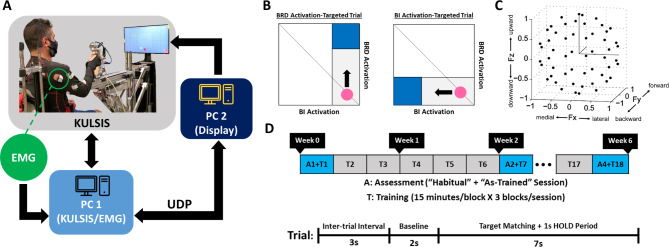
Muscle synergies, computationally identified intermuscular coordination patterns, have been utilized to characterize neuromuscular control and learning in humans. However, it is unclear whether it is possible to alter the existing muscle synergies or develop new ones in an intended way through a relatively short-term motor exercise in adulthood. This study aimed to test the feasibility of expanding the repertoire of intermuscular coordination patterns through an isometric, electromyographic (EMG) signal-guided exercise in the upper extremity (UE) of neurologically intact individuals.
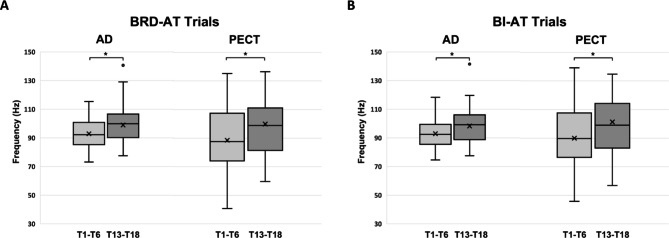
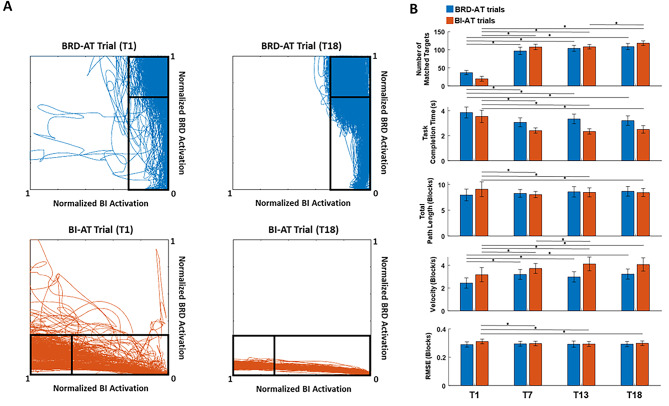
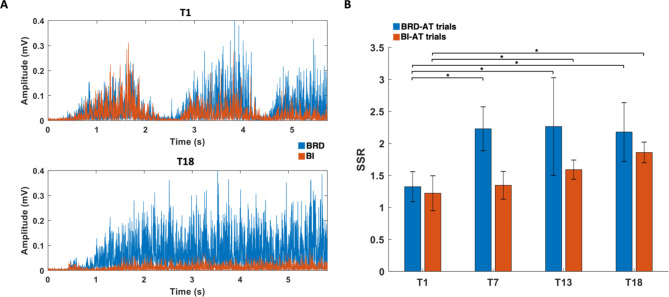
10 participants were trained for six weeks to induce independent control of activating a pair of elbow flexor muscles that tended to be naturally co-activated in force generation. An untrained isometric force generation task was performed to assess the effect of the training on the intermuscular coordination of the trained UE. We applied a non-negative matrix factorization on the EMG signals recorded from 12 major UE muscles during the assessment to identify the muscle synergies. In addition, the performance of training tasks and the characteristics of individual muscles' activity in both time and frequency domains were quantified as the training outcomes.
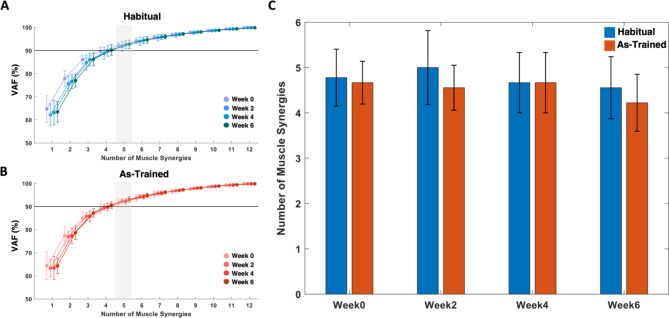
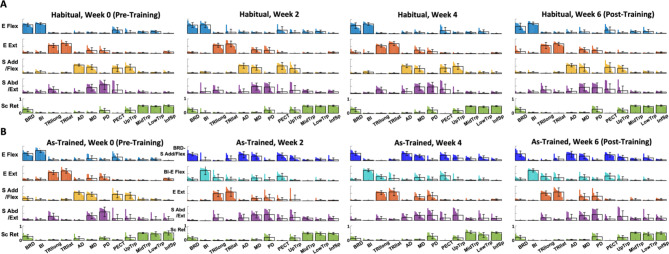
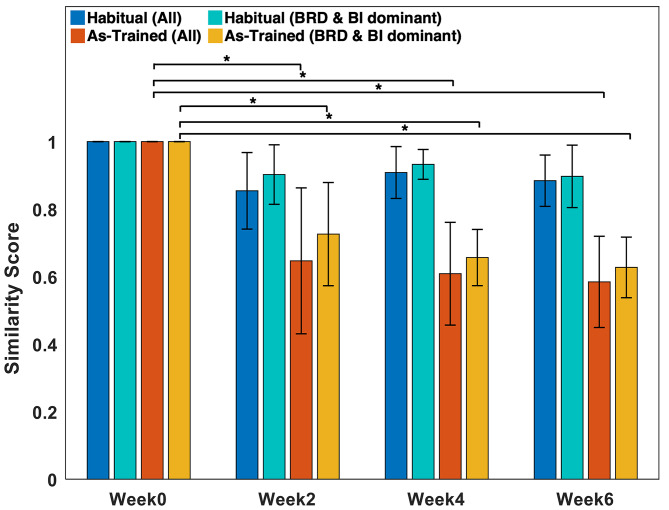
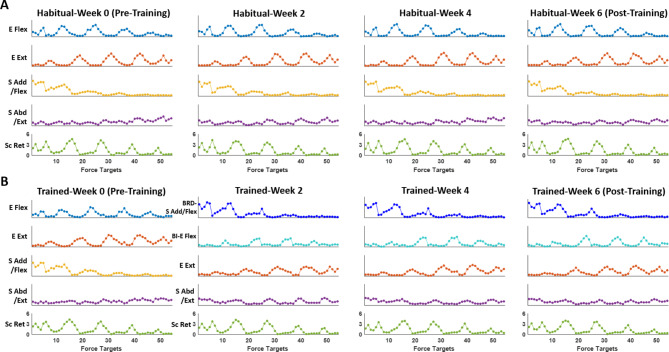
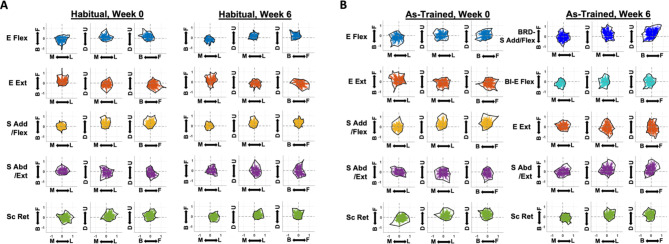
Typically, in two weeks of the training, participants could use newly developed muscle synergies when requested to perform new, untrained motor tasks by activating their UE muscles in the trained way. Meanwhile, their habitually expressed muscle synergies, the synergistic muscle activation groups that were used before the training, were conserved throughout the entire training period. The number of muscle synergies activated for the task performance remained the same. As the new muscle synergies were developed, the neuromotor control of the trained muscles reflected in the metrics, such as the ratio between the targeted muscles, number of matched targets, and task completion time, was improved.
These findings suggest that our protocol can increase the repertoire of readily available muscle synergies and improve motor control by developing the activation of new muscle coordination patterns in healthy adults within a relatively short period. Furthermore, the study shows the potential of the isometric EMG-guided protocol as a neurorehabilitation tool for aiming motor deficits induced by abnormal intermuscular coordination after neurological disorders.
This study was registered at the Clinical Research Information Service (CRiS) of the Korea National Institute of Health (KCT0005803) on 1/22/2021.
肌肉协同作用是通过计算识别的肌肉间协调模式,已被用于描述人类的神经肌肉控制和学习。然而,目前尚不清楚是否可以通过成年人相对短期的运动练习以预期的方式改变现有的肌肉协同作用或开发新的肌肉协同作用。本研究旨在通过上肢(UE)的等长、肌电图(EMG)信号引导的运动来测试通过相对短期的运动练习来扩展肌肉间协调模式的可能性。
10 名参与者接受了 6 周的训练,以诱导对激活一对肘屈肌的独立控制,这对肌肉在产生力量时往往会自然协同激活。进行了未经训练的等长力量产生任务,以评估训练对受过训练的 UE 的肌肉间协调的影响。我们对评估过程中记录的 12 个主要 UE 肌肉的 EMG 信号应用非负矩阵分解,以识别肌肉协同作用。此外,还量化了训练任务的表现和个体肌肉在时间和频率域中的活动特征,作为训练结果。
通常,在训练的两周内,参与者可以通过以训练过的方式激活 UE 肌肉来执行新的、未经训练的运动任务时,使用新开发的肌肉协同作用。同时,他们习惯性表达的肌肉协同作用,即训练前使用的协同肌肉激活组,在整个训练期间保持不变。用于完成任务的肌肉协同作用的数量保持不变。随着新的肌肉协同作用的发展,受过训练的肌肉的神经运动控制在指标中得到了反映,例如目标肌肉之间的比例、匹配目标的数量和任务完成时间。
这些发现表明,我们的方案可以通过在相对较短的时间内开发新的肌肉协调模式的激活来增加健康成年人中现成的肌肉协同作用的数量,并改善运动控制。此外,该研究表明等长 EMG 引导方案作为神经康复工具的潜力,用于针对神经障碍后异常肌肉间协调引起的运动缺陷。
本研究于 2021 年 1 月 22 日在韩国国立卫生研究院(KCT0005803)的临床研究信息服务(CRiS)注册。