IEEE Trans Neural Syst Rehabil Eng. 2019 Feb;27(2):283-292. doi: 10.1109/TNSRE.2019.2894102. Epub 2019 Jan 21.
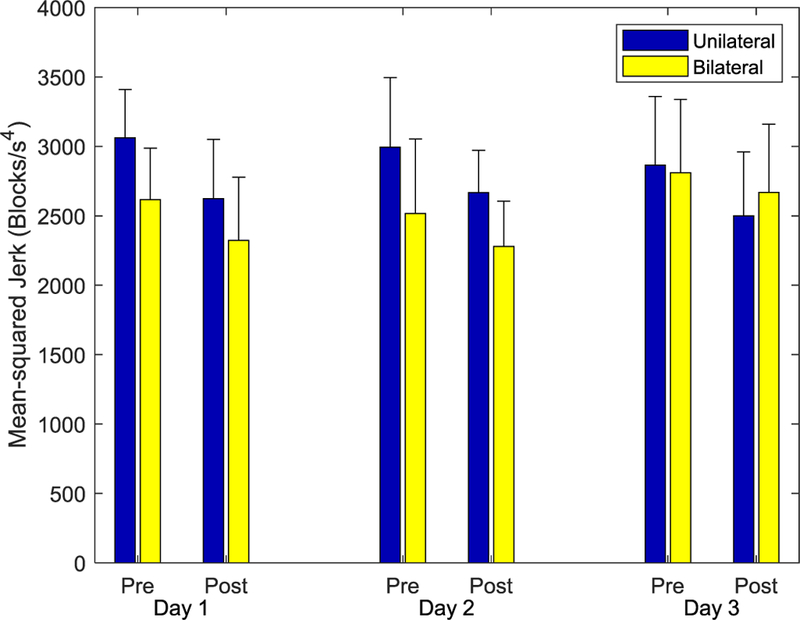
A majority of the seven million stroke survivors in the U.S. have hand impairments, adversely affecting performance of a variety of activities of daily living, because of the fundamental role of the hand in performing functional tasks. Disability in stroke survivors is largely attributable to damaged neuronal pathways, which result in inappropriate activation of muscles, a condition prevalent in distal upper extremity muscles following stroke. While conventional rehabilitation methods focus on the amplification of existing muscle activation, the effectiveness of therapy targeting the reorganization of pathological activation patterns is often unexplored. To encourage modulation of activation level and exploration of the activation workspace, we developed a novel platform for playing a serious game through electromyographic control. This system was evaluated by a group of neurologically intact subjects over multiple sessions held on different days. Subjects were assigned to one of two groups, training either with their non-dominant hand only (unilateral) or with both hands (bilateral). Both groups of subjects displayed improved performance in controlling the cursor with their non-dominant hand, with retention from one session to the next. The system holds promise for rehabilitation of control of muscle activation patterns.
美国有超过 700 万的中风幸存者存在手部功能障碍,严重影响其日常生活活动能力,这是因为手在完成各种功能任务中起着基础性作用。中风幸存者的残疾主要归因于神经元通路受损,导致肌肉活动不当,这在中风后上肢远端肌肉中很常见。虽然传统的康复方法侧重于增强现有的肌肉活动,但针对病理性活动模式重组的治疗效果往往尚未得到探索。为了鼓励激活水平的调节和激活工作空间的探索,我们开发了一种通过肌电图控制来玩严肃游戏的新型平台。该系统由一组神经功能正常的受试者在不同的日子进行多次会议进行评估。受试者被分配到两组中的一组,仅用非优势手(单侧)或双手(双侧)进行训练。两组受试者都表现出用非优势手控制光标能力的提高,且从一次会议到下一次会议都有保持。该系统有望用于康复肌肉激活模式的控制。