Li Miriam, Tadfie Hisham, Darnell Cameron G, Holland Cynthia K
Department of Biology, Williams College, Williamstown, Massachusetts, USA.
Department of Biology, Williams College, Williamstown, Massachusetts, USA.
J Biol Chem. 2023 Oct;299(10):105197. doi: 10.1016/j.jbc.2023.105197. Epub 2023 Aug 31.
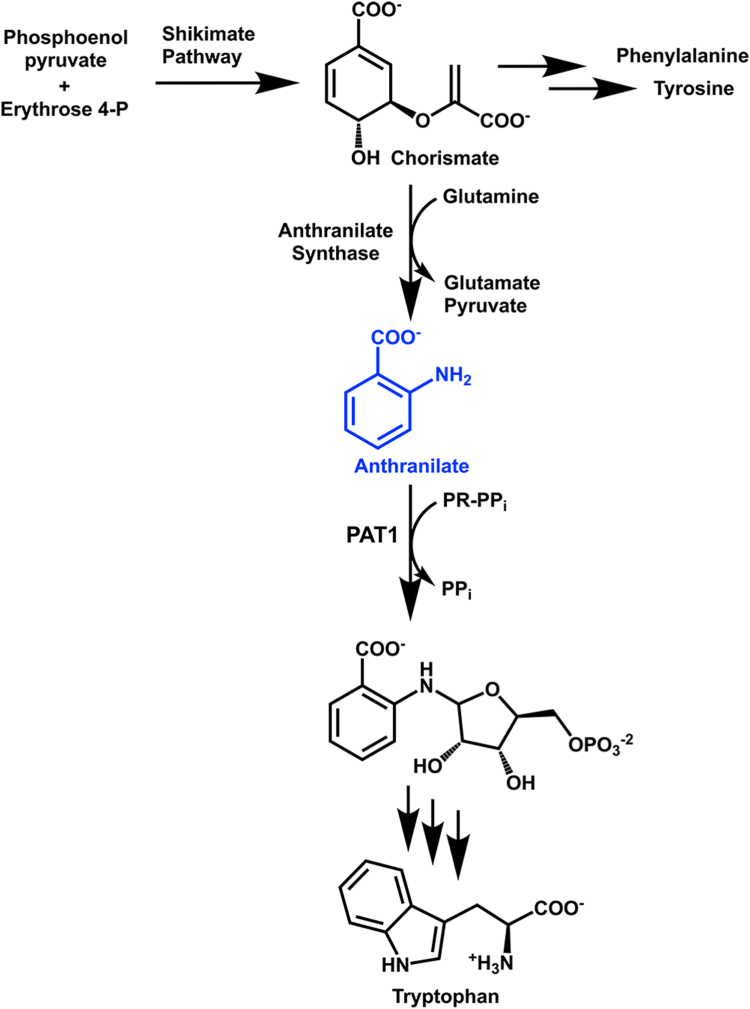
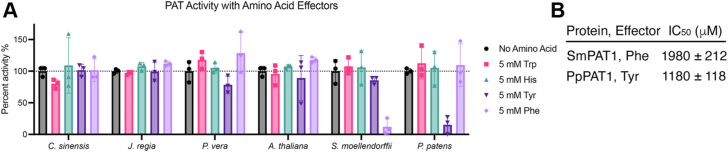
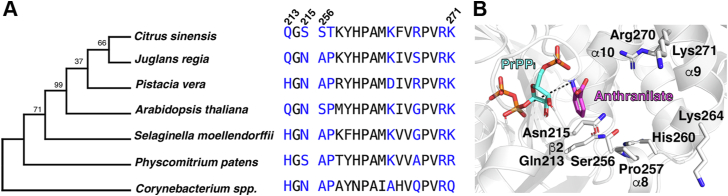
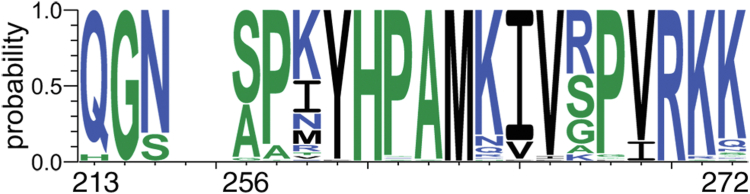
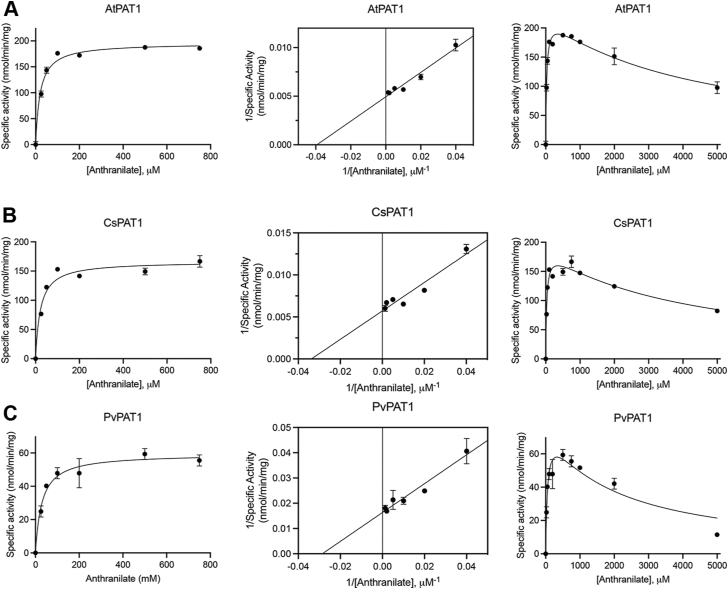
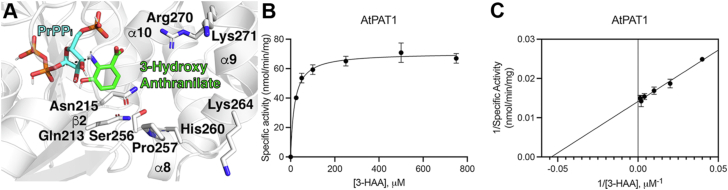
While mammals require the essential amino acid tryptophan (Trp) in their diet, plants and microorganisms synthesize Trp de novo. The five-step Trp pathway starts with the shikimate pathway product, chorismate. Chorismate is converted to the aromatic compound anthranilate, which is then conjugated to a phosphoribosyl sugar in the second step by anthranilate phosphoribosyltransferase (PAT1). As a single-copy gene in plants, all fixed carbon flux to indole and Trp for protein synthesis, specialized metabolism, and auxin hormone biosynthesis proceeds through PAT1. While bacterial PAT1s have been studied extensively, plant PAT1s have escaped biochemical characterization. Using a structure model, we identified putative active site residues that were variable across plants and kinetically characterized six PAT1s (Arabidopsis thaliana (thale cress), Citrus sinensis (sweet orange), Pistacia vera (pistachio), Juglans regia (English walnut), Selaginella moellendorffii (spike moss), and Physcomitrium patens (spreading earth-moss)). We probed the catalytic efficiency, substrate promiscuity, and regulation of these six enzymes and found that the C. sinensis PAT1 is highly specific for its cognate substrate, anthranilate. Investigations of site-directed mutants of the A. thaliana PAT1 uncovered an active site residue that contributes to promiscuity. While Trp inhibits bacterial PAT1 enzymes, the six plant PAT1s that we tested were not modulated by Trp. Instead, the P. patens PAT1 was inhibited by tyrosine, and the S. moellendorffii PAT1 was inhibited by phenylalanine. This structure-informed biochemical examination identified variations in activity, efficiency, specificity, and enzyme-level regulation across PAT1s from evolutionarily diverse plants.
虽然哺乳动物的饮食中需要必需氨基酸色氨酸(Trp),但植物和微生物能从头合成色氨酸。色氨酸的五步合成途径始于莽草酸途径的产物分支酸。分支酸转化为芳香族化合物邻氨基苯甲酸,然后在第二步中由邻氨基苯甲酸磷酸核糖转移酶(PAT1)将其与磷酸核糖糖结合。作为植物中的单拷贝基因,所有用于蛋白质合成、特殊代谢和生长素激素生物合成的固定碳通量流向吲哚和色氨酸均通过PAT1进行。虽然细菌的PAT1已得到广泛研究,但植物的PAT1尚未进行生化特性鉴定。我们利用结构模型确定了在不同植物中可变的假定活性位点残基,并对六种PAT1(拟南芥、甜橙、阿月浑子、核桃、卷柏和小立碗藓)进行了动力学表征。我们探究了这六种酶的催化效率、底物选择性和调控,发现甜橙PAT1对其同源底物邻氨基苯甲酸具有高度特异性。对拟南芥PAT1定点突变体的研究发现了一个导致选择性的活性位点残基。虽然色氨酸会抑制细菌的PAT1酶,但我们测试的六种植物PAT1不受色氨酸调节。相反,小立碗藓PAT1受酪氨酸抑制,卷柏PAT1受苯丙氨酸抑制。这种基于结构的生化检测确定了来自进化上不同植物的PAT1在活性、效率、特异性和酶水平调控方面的差异。