
识别与物质使用障碍数字干预措施的用户留存率及效果相关的因素:一项真实世界数据的回顾性分析
Identifying factors associated with user retention and outcomes of a digital intervention for substance use disorder: a retrospective analysis of real-world data.
作者信息
Günther Franziska, Wong David, Elison-Davies Sarah, Yau Christopher
机构信息
Division of Informatics, Imaging & Data Sciences, School of Health Sciences, University of Manchester, Manchester M13 9GB, United Kingdom.
TELUS Health, Manchester M15 6SE, United Kingdom.
出版信息
JAMIA Open. 2023 Sep 2;6(3):ooad072. doi: 10.1093/jamiaopen/ooad072. eCollection 2023 Oct.
OBJECTIVES
Successful delivery of digital health interventions is affected by multiple real-world factors. These factors may be identified in routinely collected, ecologically valid data from these interventions. We propose ideas for exploring these data, focusing on interventions targeting complex, comorbid conditions.
MATERIALS AND METHODS
This study retrospectively explores pre-post data collected between 2016 and 2019 from users of digital cognitive behavioral therapy (CBT)-containing psychoeducation and practical exercises-for substance use disorder (SUD) at UK addiction services. To identify factors associated with heterogenous user responses to the technology, we employed multivariable and multivariate regressions and random forest models of user-reported questionnaire data.
RESULTS
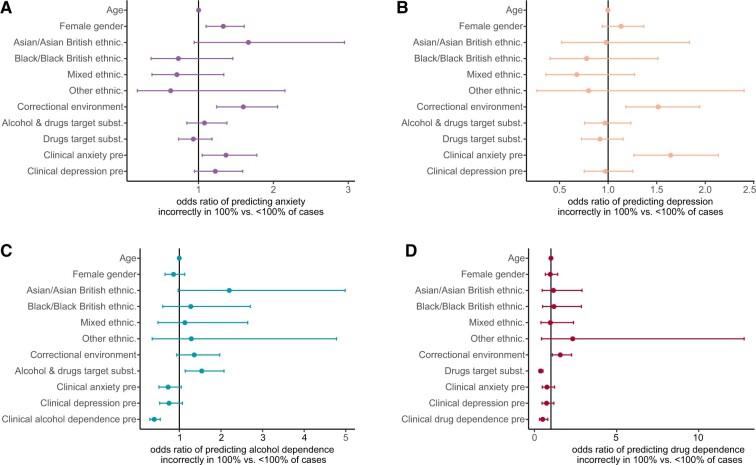
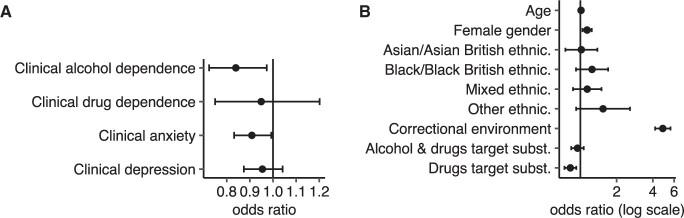
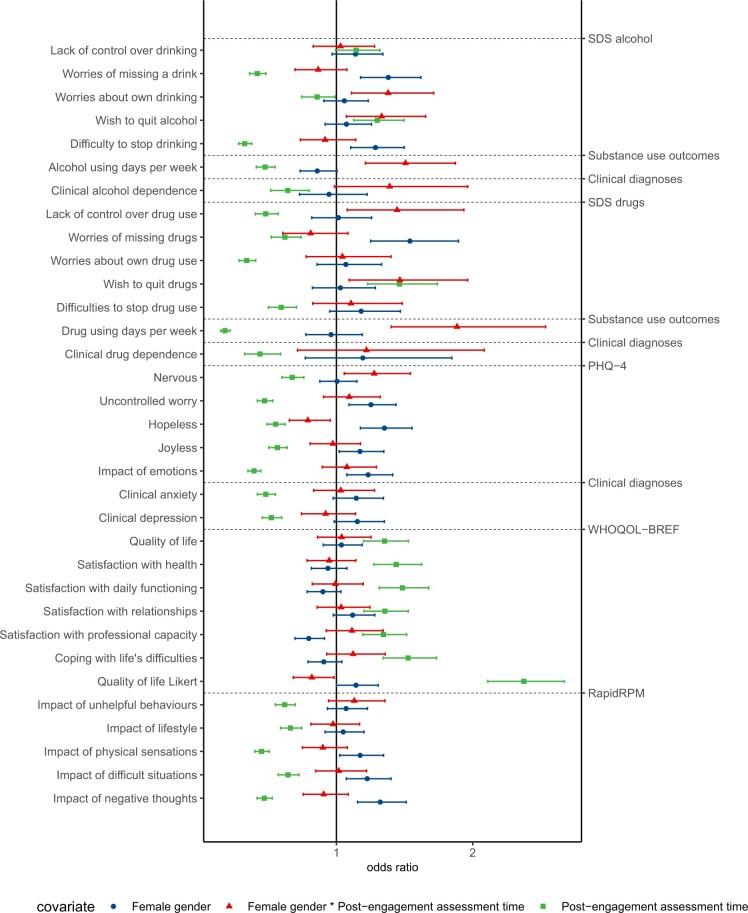
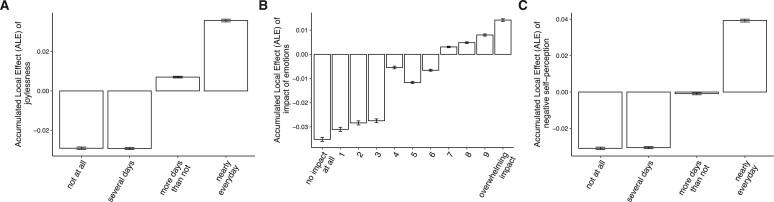
The dataset contained information from 14 078 individuals of which 12 529 reported complete data at baseline and 2925 did so again after engagement with the CBT. Ninety-three percent screened positive for dependence on 1 of 43 substances at baseline, and 73% screened positive for anxiety or depression. Despite pre-post improvements independent of user sociodemographics, women reported more frequent and persistent symptoms of SUD, anxiety, and depression. Retention-minimum 2 use events recorded-was associated more with deployment environment than user characteristics. Prediction accuracy of post-engagement outcomes was acceptable (Area Under Curve [AUC]: 0.74-0.79), depending non-trivially on user characteristics.
DISCUSSION
Traditionally, performance of digital health interventions is determined in controlled trials. Our analysis showcases multivariate models with which real-world data from these interventions can be explored and sources of user heterogeneity in retention and symptom reduction uncovered.
CONCLUSION
Real-world data from digital health interventions contain information on natural user-technology interactions which could enrich results from controlled trials.
目标
数字健康干预措施的成功实施受到多种现实因素的影响。这些因素可能会在从这些干预措施中常规收集的、具有生态效度的数据中被识别出来。我们提出了探索这些数据的思路,重点关注针对复杂共病情况的干预措施。
材料与方法
本研究回顾性地探索了2016年至2019年间从英国成瘾服务机构使用包含数字认知行为疗法(CBT)的心理教育和实践练习来治疗物质使用障碍(SUD)的用户那里收集的前后数据。为了确定与用户对该技术的异质性反应相关的因素,我们采用了多变量和多因素回归以及用户报告的问卷数据的随机森林模型。
结果
该数据集包含来自14078个人的信息,其中12529人在基线时报告了完整数据,2925人在参与CBT后再次报告了完整数据。93%的人在基线时对43种物质中的1种筛查出依赖呈阳性,73%的人对焦虑或抑郁筛查呈阳性。尽管与用户社会人口统计学无关的前后情况有所改善,但女性报告的SUD、焦虑和抑郁症状更频繁且持续。留存率(记录的最少2次使用事件)与部署环境的关联比与用户特征的关联更大。参与后结果的预测准确性是可以接受的(曲线下面积[AUC]:0.74 - 0.79),这在很大程度上取决于用户特征。
讨论
传统上,数字健康干预措施的效果是在对照试验中确定的。我们的分析展示了多变量模型,通过这些模型可以探索这些干预措施的现实世界数据,并揭示用户在留存率和症状减轻方面的异质性来源。
结论
数字健康干预措施的现实世界数据包含有关自然用户与技术交互的信息,这可以丰富对照试验的结果。


 Zotero 插件