Fleming Theresa, Bavin Lynda, Lucassen Mathijs, Stasiak Karolina, Hopkins Sarah, Merry Sally
Faculty of Health, Victoria University of Wellington, Wellington, New Zealand.
Department of Psychological Medicine, The University of Auckland, Auckland, New Zealand.
J Med Internet Res. 2018 Jun 6;20(6):e199. doi: 10.2196/jmir.9275.
Digital self-help interventions (including online or computerized programs and apps) for common mental health issues have been shown to be appealing, engaging, and efficacious in randomized controlled trials. They show potential for improving access to therapy and improving population mental health. However, their use in the real world, ie, as implemented (disseminated) outside of research settings, may differ from that reported in trials, and implementation data are seldom reported.
This study aimed to review peer-reviewed articles reporting user uptake and/or ongoing use, retention, or completion data (hereafter usage data or, for brevity, engagement) from implemented pure self-help (unguided) digital interventions for depression, anxiety, or the enhancement of mood.
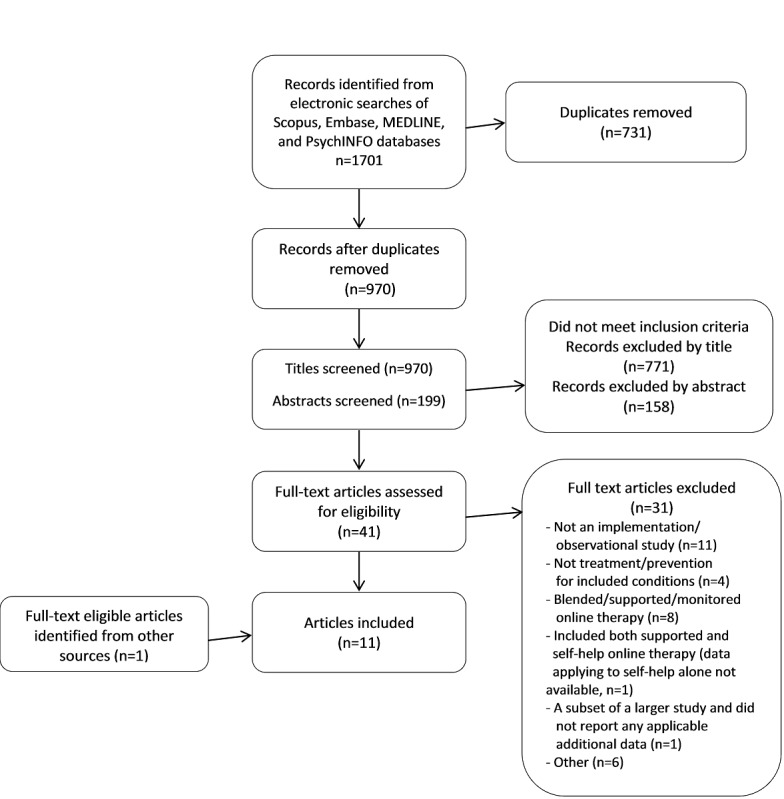
We conducted a systematic search of the Scopus, Embase, MEDLINE, and PsychINFO databases for studies reporting user uptake and/or usage data from implemented digital self-help interventions for the treatment or prevention of depression or anxiety, or the enhancement of mood, from 2002 to 2017. Additionally, we screened the reference lists of included articles, citations of these articles, and the titles of articles published in Internet Interventions, Journal of Medical Internet Research (JMIR), and JMIR Mental Health since their inception. We extracted data indicating the number of registrations or downloads and usage of interventions.
After the removal of duplicates, 970 papers were identified, of which 10 met the inclusion criteria. Hand searching identified 1 additional article. The included articles reported on 7 publicly available interventions. There was little consistency in the measures reported. The number of registrants or downloads ranged widely, from 8 to over 40,000 per month. From 21% to 88% of users engaged in at least minimal use (eg, used the intervention at least once or completed one module or assessment), whereas 7-42% engaged in moderate use (completing between 40% and 60% of modular fixed-length programs or continuing to use apps after 4 weeks). Indications of completion or sustained use (completion of all modules or the last assessment or continuing to use apps after six weeks or more) varied from 0.5% to 28.6%.
Available data suggest that uptake and engagement vary widely among the handful of implemented digital self-help apps and programs that have reported this, and that usage may vary from that reported in trials. Implementation data should be routinely gathered and reported to facilitate improved uptake and engagement, arguably among the major challenges in digital health.
在随机对照试验中,针对常见心理健康问题的数字自助干预措施(包括在线或计算机程序及应用程序)已被证明具有吸引力、能引起参与兴趣且有效。它们显示出改善治疗可及性和提升人群心理健康水平的潜力。然而,它们在现实世界中的应用,即在研究环境之外的实施(传播)情况,可能与试验中报告的情况有所不同,而且实施数据很少被报告。
本研究旨在回顾同行评审文章,这些文章报告了已实施的针对抑郁症、焦虑症或情绪提升的纯自助(无指导)数字干预措施的用户接受度和/或持续使用、留存率或完成数据(以下简称使用数据,或简称为参与度)。
我们对Scopus、Embase、MEDLINE和PsychINFO数据库进行了系统检索,以查找2002年至2017年期间报告已实施的用于治疗或预防抑郁症或焦虑症或提升情绪的数字自助干预措施的用户接受度和/或使用数据的研究。此外,我们筛选了纳入文章的参考文献列表、这些文章的引用以及自《互联网干预》《医学互联网研究杂志》(JMIR)和《JMIR心理健康》创刊以来发表的文章标题。我们提取了表明干预措施的注册或下载数量以及使用情况的数据。
在去除重复项后,共识别出970篇论文,其中10篇符合纳入标准。通过手工检索又发现了1篇文章。纳入的文章报告了7种公开可用的干预措施。所报告的测量方法几乎没有一致性。每月的注册者或下载者数量差异很大,从8人到超过40000人不等。21%至88%的用户至少有最低限度的使用(例如,至少使用过一次干预措施或完成了一个模块或评估),而7%至42%的用户有中度使用(完成模块化固定长度程序的40%至60%或在4周后继续使用应用程序)。完成或持续使用的指标(完成所有模块或最后一次评估或在六周或更长时间后继续使用应用程序)从0.5%到28.6%不等。
现有数据表明,在少数已报告此类情况的已实施数字自助应用程序和程序中,接受度和参与度差异很大,而且使用情况可能与试验中报告的情况不同。应常规收集和报告实施数据,以促进提高接受度和参与度,这可以说是数字健康领域的主要挑战之一。