• 文献检索
  • 文档翻译
  • 深度研究
  • 学术资讯
  • Suppr Zotero 插件Zotero 插件
  • 邀请有礼
  • 套餐&价格
  • 历史记录
应用&插件
Suppr Zotero 插件Zotero 插件浏览器插件Mac 客户端Windows 客户端微信小程序
定价
高级版会员购买积分包购买API积分包
服务
文献检索文档翻译深度研究API 文档MCP 服务
关于我们
关于 Suppr公司介绍联系我们用户协议隐私条款
关注我们

Suppr 超能文献

核心技术专利:CN118964589B侵权必究
粤ICP备2023148730 号-1Suppr @ 2026

文献检索

告别复杂PubMed语法,用中文像聊天一样搜索,搜遍4000万医学文献。AI智能推荐,让科研检索更轻松。

立即免费搜索

文件翻译

保留排版,准确专业,支持PDF/Word/PPT等文件格式,支持 12+语言互译。

免费翻译文档

深度研究

AI帮你快速写综述,25分钟生成高质量综述,智能提取关键信息,辅助科研写作。

立即免费体验

基于智能手机的双相情感障碍心理教育计划的真实世界实施:观察性生态研究。

Real-world Implementation of a Smartphone-Based Psychoeducation Program for Bipolar Disorder: Observational Ecological Study.

机构信息

Mental Health Research Group, Hospital del Mar Medical Research Institute (IMIM), Barcelona, Spain.

Department of Psychiatry and Forensic Medicine, School of Medicine, Universitat Autònoma de Barcelona, Barcelona, Spain.

出版信息

J Med Internet Res. 2022 Feb 2;24(2):e31565. doi: 10.2196/31565.

DOI:10.2196/31565
PMID:35107440
原文链接:https://pmc.ncbi.nlm.nih.gov/articles/PMC8851334/
Abstract

BACKGROUND

SIMPLe is an internet-delivered self-management mobile app for bipolar disorder (BD) designed to combine technology with evidence-based interventions and facilitate access to psychoeducational content. The SIMPLe app was launched to the real world to make it available worldwide within the context of BD treatment.

OBJECTIVE

The main aims of this study are as follows: to describe app use, engagement, and retention rates based on server data; to identify patterns of user retention over the first 6-month follow-up of use; and to explore potential factors contributing to discontinuation of app use.

METHODS

This was an observational ecological study in which we pooled available data from a real-world implementation of the SIMPLe app. Participation was open on the project website, and the data-collection sources were a web-based questionnaire on clinical data and treatment history administered at inclusion and at 6 months, subjective data gathered through continuous app use, and the use patterns captured by the app server. Characteristics and engagement of regular users, occasional users, and no users were compared using 2-tailed t tests or analysis of variance or their nonparametric equivalent. Survival analysis and risk functions were applied to regular users' data to examine and compare use and user retention. In addition, a user evaluation analysis was performed based on satisfaction, perceived usefulness, and reasons to discontinue app use.

RESULTS

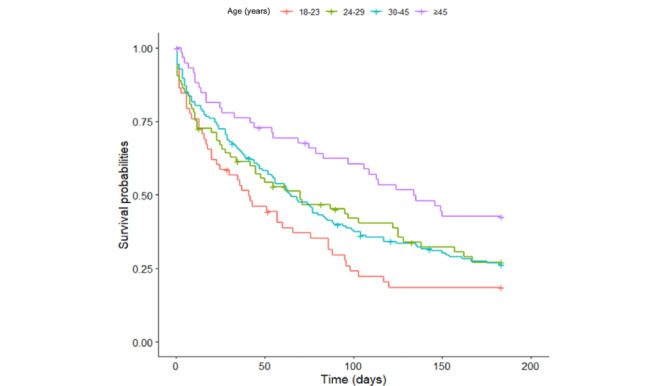
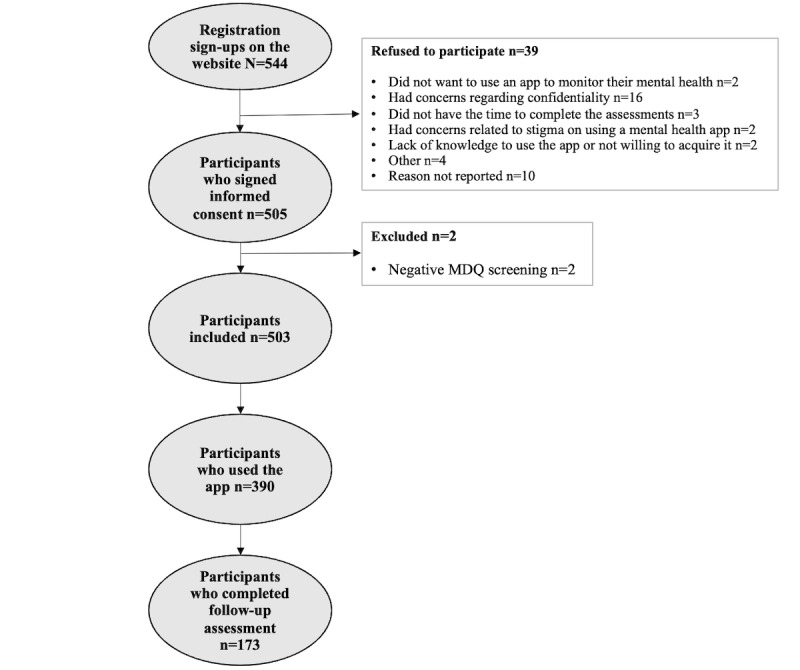
We included 503 participants with data collected between 2016 and 2018, of whom 77.5% (n=390) used the app. Among the app users, 44.4% (173/390) completed the follow-up assessment, and data from these participants were used in our analyses. Engagement declined gradually over the first 6 months of use. The probability of retention of the regular users after 1 month of app use was 67.4% (263/390; 95% CI 62.7%-72.4%). Age (P=.002), time passed since illness onset (P<.001), and years since diagnosis of BD (P=.048) correlate with retention duration. In addition, participants who had been diagnosed with BD for longer used the app on more days (mean 97.73, SD 69.15 days; P=.002) than those who had had a more recent onset (mean 66.49, SD 66.18 days; P=.002) or those who had been diagnosed more recently (mean 73.45, SD 66 days; P=.01).

CONCLUSIONS

The user retention rate of the app decreased rapidly after each month until reaching only one-third of the users at 6 months. There exists a strong association between age and app engagement of individuals with BD. Other variables such as years lived with BD, diagnosis of an anxiety disorder, and taking antipsychotics seem relevant as well. Understanding these associations can help in the definition of the most suitable user profiles for predicting trends of engagement, optimization of app prescription, and management.

摘要

背景

SimpLe 是一款用于双相情感障碍(BD)的互联网自我管理移动应用程序,旨在将技术与循证干预措施相结合,并方便获取心理教育内容。SimpLe 应用程序已在现实世界中推出,以便在 BD 治疗范围内在全球范围内使用。

目的

本研究的主要目的如下:根据服务器数据描述应用程序的使用、参与和保留率;确定使用前 6 个月随访期间用户保留的模式;并探讨导致应用程序使用中断的潜在因素。

方法

这是一项观察性生态学研究,我们汇总了 SimpLe 应用程序实际实施中的可用数据。项目网站上开放参与,数据收集来源包括纳入时和 6 个月时进行的临床数据和治疗史的基于网络的问卷、通过持续使用应用程序收集的主观数据以及应用程序服务器捕获的使用模式。使用 2 尾 t 检验或方差分析或其非参数等效项比较常规用户、偶尔用户和非用户的特征和参与度。对常规用户的数据应用生存分析和风险函数,以检查和比较使用和用户保留情况。此外,还基于满意度、感知有用性和停止使用应用程序的原因进行了用户评估分析。

结果

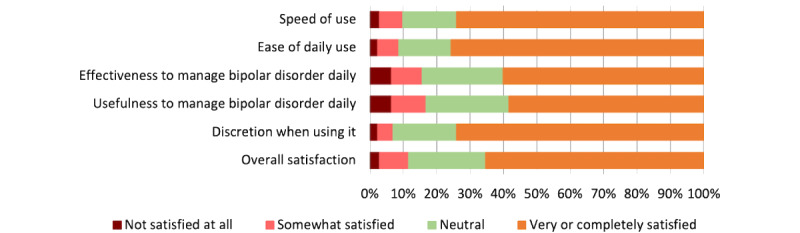
我们纳入了 2016 年至 2018 年间收集数据的 503 名参与者,其中 77.5%(n=390)使用了该应用程序。在应用程序用户中,44.4%(173/390)完成了随访评估,这些参与者的数据用于我们的分析。使用前 6 个月,参与度逐渐下降。在 SimpLe 应用程序使用 1 个月后,常规用户的保留概率为 67.4%(263/390;95%CI 62.7%-72.4%)。年龄(P=.002)、疾病发病时间(P<.001)和双相情感障碍诊断时间(P=.048)与保留时间相关。此外,与发病时间较近(平均 66.49,SD 66.18 天;P<.001)或最近诊断(平均 73.45,SD 66 天;P=.01)或诊断时间较短(平均 97.73,SD 69.15 天;P=.002)的患者相比,发病时间较长的患者使用该应用程序的天数更多。

结论

应用程序的用户保留率在每个月后迅速下降,直到 6 个月时仅保留三分之一的用户。BD 患者的年龄与应用程序参与度之间存在很强的关联。其他变量,如患有焦虑症和服用抗精神病药物的年限,似乎也很相关。了解这些关联有助于确定最适合预测参与趋势、优化应用程序处方和管理的用户特征。
https://cdn.ncbi.nlm.nih.gov/pmc/blobs/ebbe/8851334/f5661fd77063/jmir_v24i2e31565_fig3.jpg
https://cdn.ncbi.nlm.nih.gov/pmc/blobs/ebbe/8851334/2885bda9c66f/jmir_v24i2e31565_fig1.jpg
https://cdn.ncbi.nlm.nih.gov/pmc/blobs/ebbe/8851334/4dbac171aa4d/jmir_v24i2e31565_fig2.jpg
https://cdn.ncbi.nlm.nih.gov/pmc/blobs/ebbe/8851334/f5661fd77063/jmir_v24i2e31565_fig3.jpg
https://cdn.ncbi.nlm.nih.gov/pmc/blobs/ebbe/8851334/2885bda9c66f/jmir_v24i2e31565_fig1.jpg
https://cdn.ncbi.nlm.nih.gov/pmc/blobs/ebbe/8851334/4dbac171aa4d/jmir_v24i2e31565_fig2.jpg
https://cdn.ncbi.nlm.nih.gov/pmc/blobs/ebbe/8851334/f5661fd77063/jmir_v24i2e31565_fig3.jpg

相似文献

1
Real-world Implementation of a Smartphone-Based Psychoeducation Program for Bipolar Disorder: Observational Ecological Study.基于智能手机的双相情感障碍心理教育计划的真实世界实施:观察性生态研究。
J Med Internet Res. 2022 Feb 2;24(2):e31565. doi: 10.2196/31565.
2
OpenSIMPLe: A real-world implementation feasibility study of a smartphone-based psychoeducation programme for bipolar disorder.OpenSIMPLe:基于智能手机的双相情感障碍心理教育方案的真实世界实施可行性研究。
J Affect Disord. 2018 Dec 1;241:436-445. doi: 10.1016/j.jad.2018.08.048. Epub 2018 Aug 14.
3
Enhancing adherence to antipsychotic treatment for bipolar disorders. Comparison of mobile app-based psychoeducation, group psychoeducation, and the combination of both: protocol of a three-arm single-blinded parallel-group multi-centre randomised trial.提高双相情感障碍患者抗精神病药物治疗的依从性。基于移动应用程序的心理教育、团体心理教育以及两者结合的比较:一项三臂单盲平行组多中心随机试验方案
Clin Ter. 2020 Mar-Apr;171(2):e7-e93. doi: 10.7417/CT.2020.2194.
4
User Engagement and Attrition in an App-Based Physical Activity Intervention: Secondary Analysis of a Randomized Controlled Trial.基于应用程序的体育活动干预中的用户参与度和流失率:一项随机对照试验的二次分析
J Med Internet Res. 2019 Nov 27;21(11):e14645. doi: 10.2196/14645.
5
Pilot Testing in the Wild: Feasibility, Acceptability, Usage Patterns, and Efficacy of an Integrated Web and Smartphone Platform for Bipolar II Disorder.野外试点测试:用于双相II型障碍的集成网络与智能手机平台的可行性、可接受性、使用模式及疗效
JMIR Form Res. 2022 May 31;6(5):e32740. doi: 10.2196/32740.
6
Use of smartphone apps in bipolar disorder: An international web-based survey of feature preferences and privacy concerns.智能手机应用在双相情感障碍中的使用:一项针对特征偏好和隐私问题的国际网络调查。
J Affect Disord. 2021 Dec 1;295:1102-1109. doi: 10.1016/j.jad.2021.08.132. Epub 2021 Sep 2.
7
Does cognitive impairment in bipolar disorder impact on a SIMPLe app use?双相情感障碍的认知障碍是否会影响 SIMPLe 应用程序的使用?
J Affect Disord. 2021 Mar 1;282:488-494. doi: 10.1016/j.jad.2020.12.168. Epub 2020 Dec 29.
8
Supporting Self-management and Quality of Life in Bipolar Disorder With the PolarUs App (Alpha): Protocol for a Mixed Methods Study.使用PolarUs应用程序(Alpha版)支持双相情感障碍患者的自我管理和生活质量:一项混合方法研究的方案
JMIR Res Protoc. 2022 Aug 4;11(8):e36213. doi: 10.2196/36213.
9
Mobile Apps for Bipolar Disorder: A Systematic Review of Features and Content Quality.用于双相情感障碍的移动应用程序:功能与内容质量的系统评价
J Med Internet Res. 2015 Aug 17;17(8):e198. doi: 10.2196/jmir.4581.
10
Engagement and Nonusage Attrition With a Free Physical Activity Promotion Program: The Case of 10,000 Steps Australia.一项免费体育活动推广计划中的参与度与未使用损耗:以澳大利亚“万步计划”为例
J Med Internet Res. 2015 Jul 15;17(7):e176. doi: 10.2196/jmir.4339.

引用本文的文献

1
"A one-stop shop": Real-world use and app-users' experiences of a psychoeducational smartphone app for adults with ADHD.“一站式服务”:一款针对患有注意力缺陷多动障碍的成年人的心理教育智能手机应用程序在现实世界中的使用情况及应用用户体验
Internet Interv. 2025 Feb 4;39:100807. doi: 10.1016/j.invent.2025.100807. eCollection 2025 Mar.
2
Identifying digital biomarkers of illness activity and treatment response in bipolar disorder with a novel wearable device (TIMEBASE): protocol for a pragmatic observational clinical study.使用新型可穿戴设备(TIMEBASE)识别双相情感障碍中疾病活动和治疗反应的数字生物标志物:一项实用观察性临床研究的方案
BJPsych Open. 2024 Aug 1;10(5):e137. doi: 10.1192/bjo.2024.716.
3

本文引用的文献

1
Digital health developments and drawbacks: a review and analysis of top-returned apps for bipolar disorder.数字健康的发展与弊端:双相情感障碍顶级热门应用的综述与分析
Int J Bipolar Disord. 2020 Dec 1;8(1):39. doi: 10.1186/s40345-020-00202-4.
2
Assessing User Retention of a Mobile App: Survival Analysis.评估移动应用的用户留存率:生存分析。
JMIR Mhealth Uhealth. 2020 Nov 26;8(11):e16309. doi: 10.2196/16309.
3
A Machine Learning Approach to Understanding Patterns of Engagement With Internet-Delivered Mental Health Interventions.
Digital Mental Health for Schizophrenia and Other Severe Mental Illnesses: An International Consensus on Current Challenges and Potential Solutions.
数字心理健康在精神分裂症和其他严重精神疾病中的应用:当前挑战与潜在解决方案的国际共识。
JMIR Ment Health. 2024 May 8;11:e57155. doi: 10.2196/57155.
4
Exploring Digital Biomarkers of Illness Activity in Mood Episodes: Hypotheses Generating and Model Development Study.探索心境发作中疾病活动的数字生物标志物:假设生成和模型开发研究。
JMIR Mhealth Uhealth. 2023 May 4;11:e45405. doi: 10.2196/45405.
5
Vickybot, a Chatbot for Anxiety-Depressive Symptoms and Work-Related Burnout in Primary Care and Health Care Professionals: Development, Feasibility, and Potential Effectiveness Studies.Vickybot,一种用于初级保健和医疗保健专业人员的焦虑抑郁症状和与工作相关的倦怠的聊天机器人:开发、可行性和潜在有效性研究。
J Med Internet Res. 2023 Apr 3;25:e43293. doi: 10.2196/43293.
一种理解与互联网心理健康干预措施互动模式的机器学习方法。
JAMA Netw Open. 2020 Jul 1;3(7):e2010791. doi: 10.1001/jamanetworkopen.2020.10791.
4
A prospective longitudinal study searching for predictors of response to group psychoeducation in bipolar disorder.一项针对双相情感障碍患者群体心理教育反应预测因子的前瞻性纵向研究。
J Affect Disord. 2020 Sep 1;274:1113-1121. doi: 10.1016/j.jad.2020.02.047. Epub 2020 Feb 28.
5
Indicators of retention in remote digital health studies: a cross-study evaluation of 100,000 participants.远程数字健康研究中的留存指标:对10万名参与者的跨研究评估
NPJ Digit Med. 2020 Feb 17;3:21. doi: 10.1038/s41746-020-0224-8. eCollection 2020.
6
User Engagement and Attrition in an App-Based Physical Activity Intervention: Secondary Analysis of a Randomized Controlled Trial.基于应用程序的体育活动干预中的用户参与度和流失率:一项随机对照试验的二次分析
J Med Internet Res. 2019 Nov 27;21(11):e14645. doi: 10.2196/14645.
7
Objective User Engagement With Mental Health Apps: Systematic Search and Panel-Based Usage Analysis.目标 用户对心理健康应用程序的参与度:系统检索与基于小组的使用情况分析
J Med Internet Res. 2019 Sep 25;21(9):e14567. doi: 10.2196/14567.
8
The effect of smartphone-based monitoring on illness activity in bipolar disorder: the MONARCA II randomized controlled single-blinded trial.基于智能手机的监测对双相情感障碍疾病活动的影响:MONARCA II 随机对照单盲试验。
Psychol Med. 2020 Apr;50(5):838-848. doi: 10.1017/S0033291719000710. Epub 2019 Apr 4.
9
User Engagement in Mental Health Apps: A Review of Measurement, Reporting, and Validity.用户在心理健康 APP 中的参与度:测量、报告和有效性的综述。
Psychiatr Serv. 2019 Jul 1;70(7):538-544. doi: 10.1176/appi.ps.201800519. Epub 2019 Mar 27.
10
Examining Predictors of Real-World User Engagement with Self-Guided eHealth Interventions: Analysis of Mobile Apps and Websites Using a Novel Dataset.考察现实世界中用户对自我引导式电子健康干预措施的参与度预测因素:使用新数据集对移动应用程序和网站进行分析。
J Med Internet Res. 2018 Dec 14;20(12):e11491. doi: 10.2196/11491.