Jamal Imran, Paudel Anisha, Thompson Landon, Abdelmalek Michel, Khan Irfan A, Singh Vir B
Department of Basic and Clinical Sciences, Albany College of Pharmacy and Health Sciences, Albany, NY, 12208, USA.
J Virus Erad. 2023 Aug 12;9(3):100341. doi: 10.1016/j.jve.2023.100341. eCollection 2023 Sep.
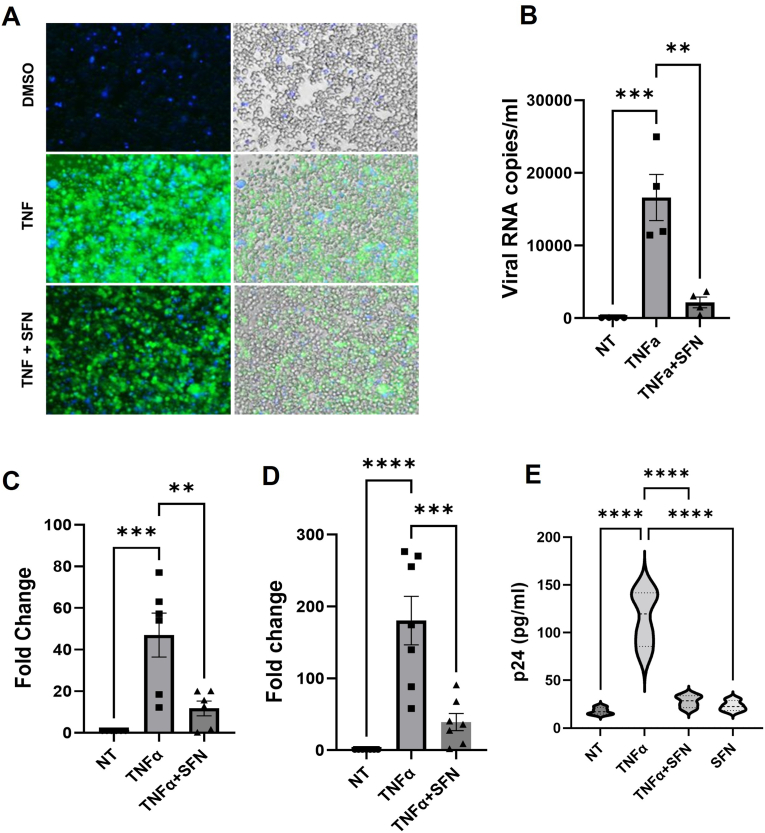
Despite more than 20 years of combination antiretroviral therapy (cART), complete eradication of HIV remains a daunting task. While cART has been very effective in limiting new cycles of infection and keeping viral load below detectable levels with partial restoration of immune functions, it cannot provide a cure. Evidently, the interruption of cART leads to a quick rebound of the viral load within a few weeks. These consistent observations have revealed HIV ability to persist as an undetectable latent reservoir in a variety of tissues that remain insensitive to antiretroviral therapies. The 'Block-and-Lock' approach to drive latent cells into deep latency has emerged as a viable strategy to achieve a functional cure. It entails the development of latency-promoting agents with anti-HIV functions. Recent reports have suggested sulforaphane (SFN), an inducer of NRF-2 (nuclear erythroid 2-related factor 2)-mediated antioxidative signaling, to possess anti-HIV properties by restricting HIV replication at the early stages. However, the effect of SFN on the expression of integrated provirus remains unexplored. We have hypothesized that SFN may promote latency and prevent reactivation. Our results indicate that SFN can render latently infected monocytes and CD4 T cells resistant to reactivation. SFN treatments antagonized the effects of known latency reactivating agents, tumor necrosis pactor (TNF-α), and phorbol 12-myristate 13-acetate (PMA), and caused a significant reduction in HIV transcription, viral RNA copies, and p24 levels. Furthermore, this block of reactivation was found to be mediated by SFN-induced NRF-2 signaling that specifically decreased the activation of NFκB signaling and thus restricted the HIV-1 promoter (5'LTR) activity. Overall, our study provides compelling evidence to highlight the latency-promoting potential of SFN which could be used in the 'Block-and-Lock' approach to achieve an HIV cure.
尽管联合抗逆转录病毒疗法(cART)已应用超过20年,但彻底根除HIV仍然是一项艰巨的任务。虽然cART在限制新的感染周期以及将病毒载量维持在可检测水平以下并部分恢复免疫功能方面非常有效,但它无法治愈。显然,中断cART会导致病毒载量在几周内迅速反弹。这些一致的观察结果表明,HIV能够作为一种无法检测到的潜伏库存在多种对抗逆转录病毒疗法不敏感的组织中持续存在。将潜伏细胞驱动至深度潜伏状态的“阻断并锁定”方法已成为实现功能性治愈的可行策略。这需要开发具有抗HIV功能的潜伏促进剂。最近的报告表明,萝卜硫素(SFN)作为NRF-2(核红细胞2相关因子2)介导的抗氧化信号的诱导剂,通过在早期阶段限制HIV复制而具有抗HIV特性。然而,SFN对整合型原病毒表达的影响尚未得到探索。我们推测SFN可能促进潜伏并防止重新激活。我们的结果表明,SFN可使潜伏感染的单核细胞和CD4 T细胞对重新激活产生抗性。SFN处理可拮抗已知的潜伏激活剂肿瘤坏死因子(TNF-α)和佛波酯12-肉豆蔻酸酯13-乙酸酯(PMA)的作用,并导致HIV转录、病毒RNA拷贝数和p24水平显著降低。此外,发现这种重新激活的阻断是由SFN诱导的NRF-2信号介导的,该信号特异性降低了NFκB信号的激活,从而限制了HIV-1启动子(5'LTR)的活性。总体而言,我们的研究提供了令人信服的证据,突出了SFN促进潜伏的潜力,其可用于“阻断并锁定”方法以实现HIV治愈。