Department of Laboratory Medicine, Kangnam Sacred Heart Hospital, Hallym University College of Medicine, Seoul, Korea.
Department of Laboratory Medicine, Hangang Sacred Heart Hospital, Hallym University College of Medicine, Seoul, Korea.
Ann Lab Med. 2024 Jan 1;44(1):38-46. doi: 10.3343/alm.2024.44.1.38. Epub 2023 Sep 4.
Carbapenem-resistant (CrPA) is a leading cause of healthcare-associated urinary tract infections (UTIs). Carbapenemase production is an important mechanism that significantly alters the efficacy of frequently used anti-pseudomonal agents. Reporting the current genotypic distribution of carbapenemase-producing (CPPA) isolates in relation to antimicrobial susceptibility, UTI risk factors, and mortality is necessary to increase the awareness and control of these strains.
In total, 1,652 non-duplicated strains were isolated from hospitalized patients between 2015 and 2020. Antimicrobial susceptibility, carbapenemase genotypes, risk factors for UTI, and associated mortality were analyzed.
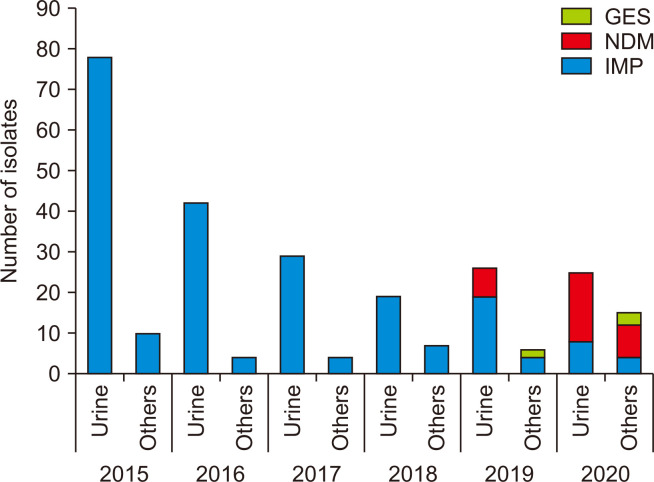
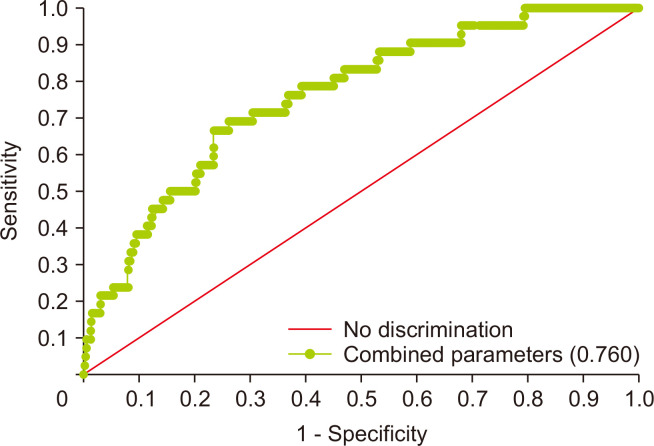
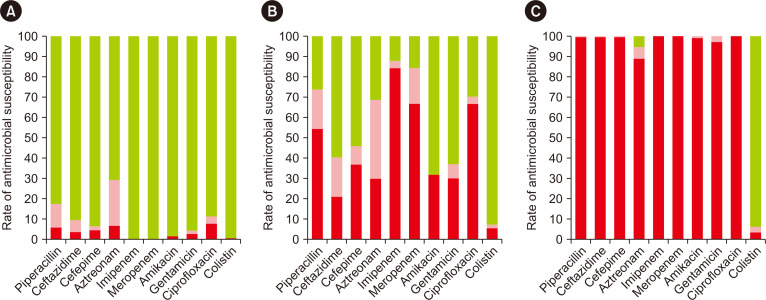
The prevalence of carbapenem-non-susceptible isolates showed a decreasing trend from 2015 to 2018 and then increased in the background of the emergence of New Delhi metallo-β-lactamase (NDM)-type isolates since 2019. The CPPA strains showed 100.0% non-susceptibility to all tested antibiotics, except aztreonam (94.5%) and colistin (5.9%). Carbapenems were identified as a risk and common predisposing factor for UTI (odds ratio [OR]=1.943) and mortality (OR=2.766). Intensive care unit (ICU) stay (OR=2.677) and white blood cell (WBC) count (OR=1.070) were independently associated with mortality.
The changing trend and genetic distribution of CPPA isolates emphasize the need for relentless monitoring to control further dissemination. The use of carbapenems, ICU stay, and WBC count should be considered risk factors, and aggressive antibiotic stewardship programs and monitoring may serve to prevent worse outcomes.
耐碳青霉烯肠杆菌科细菌(CrPA)是导致医疗相关性尿路感染(UTI)的主要原因。碳青霉烯酶的产生是一种重要机制,可显著改变常用抗假单胞菌药物的疗效。报告产碳青霉烯酶的(CPPA)分离株的当前基因分型分布与抗微生物药物敏感性、UTI 危险因素和死亡率之间的关系,对于提高对这些菌株的认识和控制至关重要。
共从 2015 年至 2020 年住院患者中分离出 1652 个非重复菌株。分析了抗微生物药物敏感性、碳青霉烯酶基因型、UTI 危险因素和相关死亡率。
2015 年至 2018 年,耐碳青霉烯非敏感分离株的流行率呈下降趋势,而自 2019 年以来,新德里金属β-内酰胺酶(NDM)型分离株的出现则增加了耐碳青霉烯非敏感分离株的流行率。CPPA 菌株对所有测试的抗生素均表现出 100.0%的不敏感性,除了氨曲南(94.5%)和黏菌素(5.9%)。碳青霉烯类药物被确定为 UTI(比值比 [OR]=1.943)和死亡率(OR=2.766)的风险和常见诱发因素。重症监护病房(ICU)停留(OR=2.677)和白细胞(WBC)计数(OR=1.070)与死亡率独立相关。
CPPA 分离株的变化趋势和遗传分布强调需要不断监测以控制进一步传播。碳青霉烯类药物的使用、入住 ICU 和白细胞计数应被视为危险因素,积极的抗生素管理方案和监测可能有助于预防更差的结局。