Cochlear Technology Centre Belgium, Mechelen, Belgium.
Department of Otorhinolaryngology, Donders Institute for Brain, Cognition and Behaviour, Radboud University Medical Center Nijmegen, Nijmegen, The Netherlands.
Eur Arch Otorhinolaryngol. 2024 Mar;281(3):1163-1173. doi: 10.1007/s00405-023-08195-3. Epub 2023 Sep 4.
Programming a cochlear implant (fitting) is an essential part of a user's post-implantation journey, defining how sound will be translated into electrical stimulation and aiming to provide optimal speech perception outcomes. Currently, there are no established, evidence-based guidelines for fitting cochlear implant users, leading to a high degree of variability in fitting practices, users' parameters, and probably outcomes. In this study a data-driven approach is used to retrospectively investigate the relation between cochlear implant fitting parameters and speech perception outcomes in post-lingually deafened adults.
298 data points corresponding to fitting parameters and speech audiometry test results for the same number of adult, post-lingually deafened, experienced CI users were analyzed. Correlation analysis was performed, after which parameters from the top-scoring and bottom-scoring tertiles were compared via the Mann-Whitney-Wilcoxon u test.
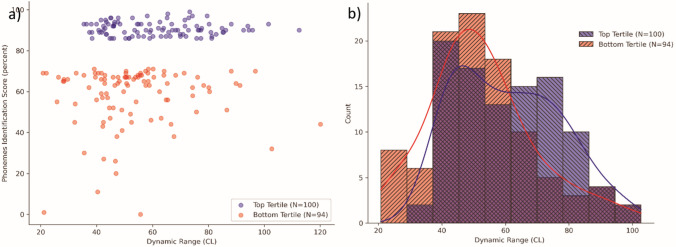
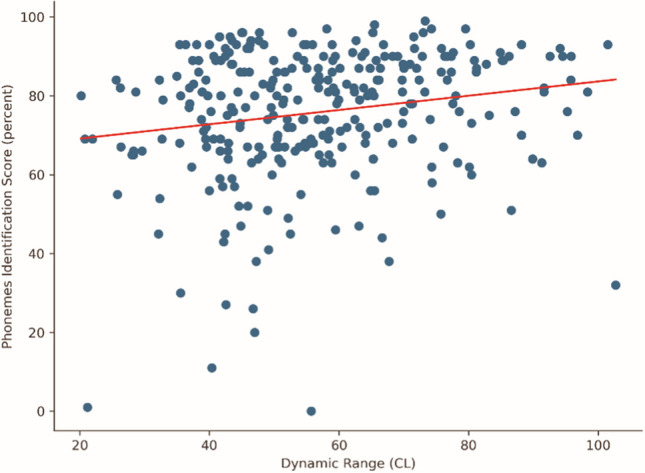
Weak correlations between dynamic range and speech audiometry outcomes were identified, having p values lower than (albeit close to) 0.05. A significant (p < 0.05) difference in electrical dynamic range (the difference between the minimum and maximum amount of current which may be delivered by each electrode) was found, with top-scoring subjects having on average a wider dynamic range.
The association between dynamic range and speech perception outcomes shown in this retrospective study highlights the need for deeper investigation into evidence-driven fitting. It might be a first step in the direction of evidence-based fitting, minimizing variability in outcomes for cochlear implant users and helping mitigate the issue of unexplained low performance.
人工耳蜗编程是使用者植入后的重要环节,它将声音转换为电刺激,并旨在提供最佳的言语感知效果。目前,人工耳蜗使用者的编程尚无既定的循证指南,导致编程实践、使用者参数存在高度差异,可能会对结果产生影响。在这项研究中,我们采用数据驱动的方法来回顾性研究成年后天聋患者人工耳蜗编程参数与言语感知结果之间的关系。
分析了 298 个数据点,这些数据点与相同数量的成年后天聋、有经验的人工耳蜗使用者的编程参数和言语测听测试结果相对应。进行了相关性分析,然后通过曼-惠特尼-威尔科克森 U 检验比较了得分最高和最低三分位的参数。
确定了动态范围与言语测听结果之间的弱相关性,其 p 值低于(尽管接近)0.05。发现电动态范围(每个电极可输送的最小和最大电流量之间的差异)存在显著差异(p < 0.05),得分最高的受试者的动态范围平均更宽。
本回顾性研究中动态范围与言语感知结果之间的关联强调了需要更深入地研究循证编程。这可能是循证编程的第一步,可以最小化人工耳蜗使用者结果的变异性,并有助于解决未解释的低性能问题。