Plant Protection College, Shenyang Agricultural University, Shenyang, 110866, China.
Institute of Plant Protection, Liaoning Academy of Agricultural Sciences, Shenyang, 110161, P.R. China.
BMC Plant Biol. 2023 Sep 4;23(1):410. doi: 10.1186/s12870-023-04423-4.
Early leaf spot disease, caused by Cercospora arachidicola, is a devastating peanut disease that has severely impacted peanut production and quality. Chemical fungicides pollute the environment; however, Bacillus bacteria can be used as an environmentally friendly alternative to chemical fungicides. To understand the novel bacterial strain and unravel its molecular mechanism, De novo whole-genome sequencing emerges as a rapid and efficient omics approach.
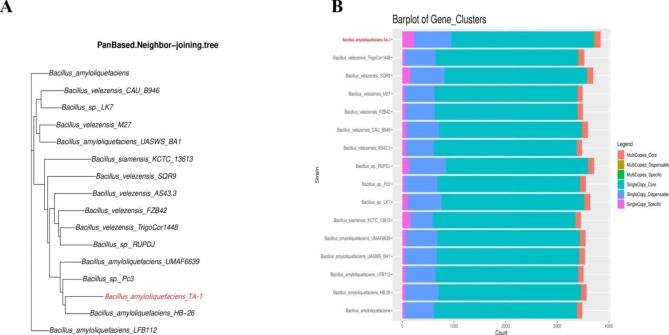
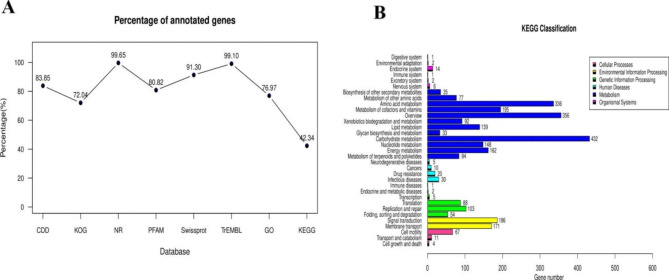
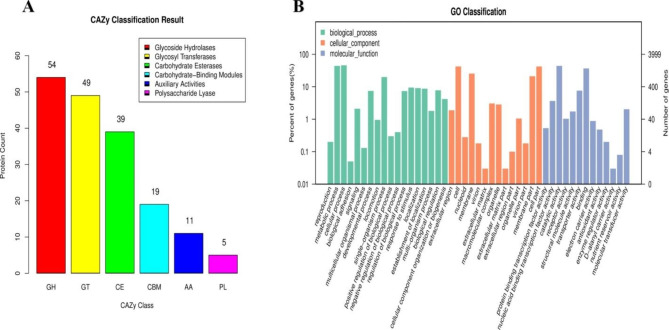
In the current study, we identified an antagonistic strain, Bacillus amyloliquefaciens TA-1. In-vitro assay showed that the TA-1 strain was a strong antagonist against C. arachidicola, with an inhibition zone of 88.9 mm. In a greenhouse assay, results showed that the TA-1 strain had a significant biocontrol effect of 95% on peanut early leaf spot disease. De novo whole-genome sequencing analysis, shows that strain TA-1 has a single circular chromosome with 4172 protein-coding genes and a 45.91% guanine and cytosine (GC) content. Gene function was annotated using non-redundant proteins from the National Center for Biotechnology Information (NCBI), Swiss-Prot, the Kyoto Encyclopedia of Genes and Genomes (KEGG), clusters of orthologous groups of proteins, gene ontology, pathogen-host interactions, and carbohydrate-active enZYmes. antiSMASH analysis predicted that strain TA-1 can produce the secondary metabolites siderophore, tailcyclized peptide, myxochelin, bacillibactin, paenibactin, myxochelin, griseobactin, benarthin, tailcyclized, and samylocyclicin.
The strain TA-1 had a significant biological control effect against peanut early leaf spot disease in-vitro and in greenhouse assays. Whole genome analysis revealed that, TA-1 strain belongs to B. amyloliquefaciens and could produce the antifungal secondary metabolites.
早疫病是一种由 Cercospora arachidicola 引起的毁灭性花生病害,严重影响了花生的产量和质量。化学杀菌剂会污染环境;然而,芽孢杆菌可以作为化学杀菌剂的环保替代品。为了了解新型细菌菌株并揭示其分子机制,从头全基因组测序成为一种快速有效的组学方法。
在本研究中,我们鉴定了一种拮抗菌株,解淀粉芽孢杆菌 TA-1。体外试验表明,TA-1 菌株对 C. arachidicola 具有很强的拮抗作用,抑菌圈为 88.9mm。温室试验结果表明,TA-1 菌株对花生早疫病的生物防治效果显著,达 95%。从头全基因组测序分析表明,菌株 TA-1 有一个单一的圆形染色体,包含 4172 个编码蛋白的基因和 45.91%的鸟嘌呤和胞嘧啶(GC)含量。使用非冗余蛋白从国家生物技术信息中心(NCBI)、Swiss-Prot、京都基因与基因组百科全书(KEGG)、直系同源群、基因本体论、病原体-宿主相互作用和碳水化合物活性酶对基因功能进行注释。antiSMASH 分析预测,菌株 TA-1 可以产生铁载体、尾环肽、粘菌素、杆菌肽、巴宾菌素、粘菌素、灰黄霉素、贝那西丁、尾环肽和 samylocyclicin 等次生代谢物。
TA-1 菌株在体外和温室试验中对花生早疫病具有显著的生物防治效果。全基因组分析表明,TA-1 菌株属于解淀粉芽孢杆菌,能产生抗真菌次生代谢物。