• 文献检索
  • 文档翻译
  • 深度研究
  • 学术资讯
  • Suppr Zotero 插件Zotero 插件
  • 邀请有礼
  • 套餐&价格
  • 历史记录
应用&插件
Suppr Zotero 插件Zotero 插件浏览器插件Mac 客户端Windows 客户端微信小程序
定价
高级版会员购买积分包购买API积分包
服务
文献检索文档翻译深度研究API 文档MCP 服务
关于我们
关于 Suppr公司介绍联系我们用户协议隐私条款
关注我们

Suppr 超能文献

核心技术专利:CN118964589B侵权必究
粤ICP备2023148730 号-1Suppr @ 2026

文献检索

告别复杂PubMed语法,用中文像聊天一样搜索,搜遍4000万医学文献。AI智能推荐,让科研检索更轻松。

立即免费搜索

文件翻译

保留排版,准确专业,支持PDF/Word/PPT等文件格式,支持 12+语言互译。

免费翻译文档

深度研究

AI帮你快速写综述,25分钟生成高质量综述,智能提取关键信息,辅助科研写作。

立即免费体验

医生对疫苗犹豫家长的知识、态度和看法:一项横断面研究。

Physicians' knowledge, attitude and perceptions towards vaccine-hesitant parents: a cross-sectional study.

机构信息

Department of Paediatrics, College of Medicine, King Saud University, Riyadh, Saudi Arabia.

College of Medicine, Department of Medical Education, King Saud University, P O Box 2925, 11461, Riyadh, Saudi Arabia.

出版信息

BMC Med Educ. 2023 Sep 4;23(1):637. doi: 10.1186/s12909-023-04590-w.

DOI:10.1186/s12909-023-04590-w
PMID:37667302
原文链接:https://pmc.ncbi.nlm.nih.gov/articles/PMC10478439/
Abstract

OBJECTIVES

Research has shown that physicians are encountering an increase in vaccine-hesitant parents (VHPs) numbers. This study examined physicians' vaccination knowledge, vaccine-related discussions with VHPs, beliefs about and responses to vaccine hesitancy, and challenges faced while discussing immunization with VHPs.

METHODS

This cross-sectional, descriptive study was performed at King Saud University Medical City (KSUMC), Riyadh, Saudi Arabia, in September 2020. The data were collected through a questionnaire distributed via email. The sample comprised 90 physicians who routinely treat children and reported they frequently have appropriate vaccine discussions when encountering VHPs.

RESULTS

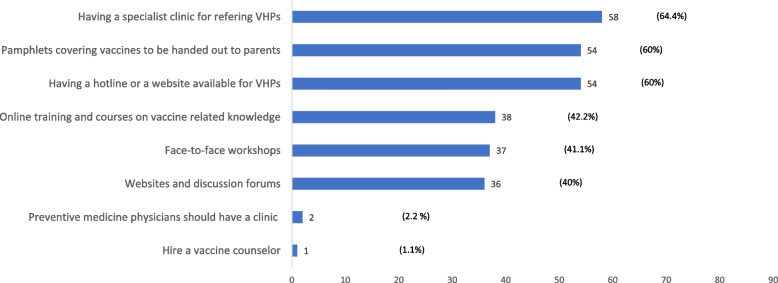
Ninety participants (59% were females) completed the questionnaire. Of these, 37.8% were from family medicine, 7.8% from primary care, and 54.4% from paediatrics. The most discussed topics were vaccine necessity, reasons for vaccine refusal, and vaccine safety. Seventeen participants (18.8%) reported being extremely confident, and (42.2%) were confident in their vaccine-specific knowledge. Regarding confidence in communication skills, 22.2% reported being extremely confident and (45.6%) were confident. Determinants of higher confidence in the knowledge and communication skills were physician age (p = 0.001 and p = 0.0001, respectively), years of practice (p = 0.002 and (p = 0.005), and patients seen per workday (p = 0.0001 and p = 0.024). Other factors such as physician sex (p = 0.062), the field of practice (p = 0.329), and hours of work per week (p = 0.061) were not significantly different. Forty-six (51%) physicians sometimes find it challenging to conduct appropriate vaccine-related discussions because of having too many other issues to discuss during the consultation. Furthermore, 53 (59%) participants agreed/strongly agreed that parental refusal to vaccinate would raise suspicions of negligence. On the other hand, 59 (65%) disagreed/strongly disagreed that parental refusal of vaccines is a parental right. Participants expressed the need to refer VHPs to a specialised advisory clinic with excellent experience and negotiation skills to overcome the challenges.

CONCLUSION

Vaccine safety and necessity are the topics of most concern to VHPs, and a knowledgeable physician with competent communication skills is critical in responding to such situations. This study highlights the most reported barriers to successful vaccine-related discussions. It raises underlying ethical principles such as parental autonomy and the need to train physicians in VHPs. To train physians for succucful vaccine counceling of VHPs.

摘要

目的

研究表明,医生遇到的疫苗犹豫家长(VHP)数量不断增加。本研究调查了医生的疫苗知识、与 VHP 进行疫苗相关讨论、对疫苗犹豫的信念和反应,以及在与 VHP 讨论免疫接种时面临的挑战。

方法

本横断面描述性研究于 2020 年 9 月在沙特阿拉伯利雅得的沙特国王大学医学城(KSUMC)进行。通过电子邮件分发问卷收集数据。样本包括 90 名经常治疗儿童的医生,他们报告说在遇到 VHP 时经常进行适当的疫苗讨论。

结果

90 名参与者(59%为女性)完成了问卷。其中,37.8%来自家庭医学,7.8%来自初级保健,54.4%来自儿科。讨论最多的话题是疫苗的必要性、疫苗拒绝的原因和疫苗的安全性。17 名参与者(18.8%)表示非常自信,而(42.2%)对他们的疫苗特定知识有信心。关于沟通技巧的信心,22.2%表示非常自信,而(45.6%)有信心。对知识和沟通技巧更有信心的决定因素是医生的年龄(p=0.001 和 p=0.0001),实践年限(p=0.002 和 p=0.005),以及每个工作日看诊的患者数量(p=0.0001 和 p=0.024)。其他因素,如医生性别(p=0.062)、实践领域(p=0.329)和每周工作时间(p=0.061)没有显著差异。46 名(51%)医生有时发现,由于在咨询期间有太多其他问题要讨论,因此很难进行适当的疫苗相关讨论。此外,53 名(59%)参与者同意/强烈同意,父母拒绝接种疫苗会引起疏忽的怀疑。另一方面,59 名(65%)参与者不同意/强烈不同意父母拒绝疫苗是父母的权利。参与者表示需要将 VHP 转介给经验丰富且谈判技巧高超的专门咨询诊所,以克服这些挑战。

结论

疫苗安全性和必要性是 VHP 最关心的问题,知识渊博且沟通能力强的医生在应对此类情况时至关重要。本研究强调了成功进行疫苗相关讨论最常报告的障碍。它提出了潜在的伦理原则,如父母自主权和培训医生识别 VHP 的必要性。
https://cdn.ncbi.nlm.nih.gov/pmc/blobs/8c7a/10478439/41cb39805d48/12909_2023_4590_Fig1_HTML.jpg

相似文献

1
Physicians' knowledge, attitude and perceptions towards vaccine-hesitant parents: a cross-sectional study.医生对疫苗犹豫家长的知识、态度和看法:一项横断面研究。
BMC Med Educ. 2023 Sep 4;23(1):637. doi: 10.1186/s12909-023-04590-w.
2
Parents' and caregivers' role toward childhood vaccination in Albania: assessment of predictors of vaccine hesitancy.阿尔巴尼亚父母及照料者在儿童疫苗接种中的角色:疫苗犹豫的预测因素评估
Ann Ig. 2023 Jan-Feb;35(1):75-83. doi: 10.7416/ai.2022.2521. Epub 2022 May 6.
3
The causes of parental vaccine refusal: results of a survey from Giresun, Turkey.父母拒绝疫苗接种的原因:来自土耳其吉雷松的调查结果。
Turk J Pediatr. 2021;63(4):618-625. doi: 10.24953/turkjped.2021.04.009.
4
Parental vaccine hesitancy in Italy - Results from a national survey.意大利的父母对疫苗的犹豫态度 - 一项全国性调查的结果。
Vaccine. 2018 Feb 1;36(6):779-787. doi: 10.1016/j.vaccine.2017.12.074. Epub 2018 Jan 8.
5
Levels of Parental Human Papillomavirus Vaccine Hesitancy and Their Reasons for Not Intending to Vaccinate: Insights From the 2019 National Immunization Survey-Teen.父母对接种人乳头瘤病毒疫苗的犹豫程度及其不打算接种疫苗的原因:2019 年全国免疫调查-青少年的见解。
J Adolesc Health. 2022 Jul;71(1):39-46. doi: 10.1016/j.jadohealth.2022.01.223. Epub 2022 Mar 9.
6
Prevalence of influenza vaccine hesitancy at a tertiary care hospital in Riyadh, Saudi Arabia.沙特阿拉伯利雅得一家三级保健医院中流感疫苗犹豫的流行率。
J Infect Public Health. 2018 Jul-Aug;11(4):491-499. doi: 10.1016/j.jiph.2017.09.002. Epub 2017 Oct 5.
7
Parent perspectives on childhood vaccination: How to deal with vaccine hesitancy and refusal?家长对儿童疫苗接种的看法:如何应对疫苗犹豫和拒绝?
Vaccine. 2019 Feb 8;37(7):984-990. doi: 10.1016/j.vaccine.2018.12.062. Epub 2019 Jan 14.
8
Does the relative importance of MMR vaccine concerns differ by degree of parental vaccine hesitancy?: An exploratory study.家长对接种疫苗犹豫不决的程度是否会影响他们对接种麻腮风三联疫苗(MMR 疫苗)相关担忧的重视程度?一项探索性研究。
Hum Vaccin Immunother. 2013 Feb;9(2):430-6. doi: 10.4161/hv.22065. Epub 2012 Oct 2.
9
Knowledge, attitudes, and beliefs of school nurses and personnel and associations with nonmedical immunization exemptions.学校护士及工作人员的知识、态度和信念以及与非医疗免疫豁免的关联。
Pediatrics. 2004 Jun;113(6):e552-9. doi: 10.1542/peds.113.6.e552.
10
Beliefs about causes of autism and vaccine hesitancy among parents of children with autism spectrum disorder.自闭症谱系障碍儿童家长对自闭症病因的看法和对接种疫苗的犹豫。
Vaccine. 2020 Sep 11;38(40):6327-6333. doi: 10.1016/j.vaccine.2020.07.034. Epub 2020 Jul 27.

引用本文的文献

1
Factors influencing healthcare workers' vaccine recommendations: A cross-sectional study in Zhejiang Province, China.影响医护人员疫苗推荐的因素:一项在中国浙江省开展的横断面研究。
Hum Vaccin Immunother. 2025 Dec;21(1):2543166. doi: 10.1080/21645515.2025.2543166. Epub 2025 Aug 18.
2
Knowledge, attitude, practice, and barriers among physicians in the Middle East and North Africa region toward influenza vaccination for the high-risk group of patients: a cross-sectional study.中东和北非地区医生对高危患者群体流感疫苗接种的知识、态度、实践及障碍:一项横断面研究。
Trop Dis Travel Med Vaccines. 2025 Apr 1;11(1):6. doi: 10.1186/s40794-024-00241-0.
3
Assessing the Knowledge, Attitude, and Practice of Healthcare Workers on the Herpes Zoster Vaccine in Saudi Arabia: A Cross-Sectional Study.
评估沙特阿拉伯医护人员对带状疱疹疫苗的知识、态度和实践:一项横断面研究。
Cureus. 2025 Jan 11;17(1):e77302. doi: 10.7759/cureus.77302. eCollection 2025 Jan.
4
Childhood vaccination hesitancy in Saudi Arabia: are we still facing a problem? A narrative review.沙特阿拉伯的儿童疫苗接种犹豫:我们是否仍面临问题?叙述性综述。
Saudi Med J. 2024 Jun;45(6):551-559. doi: 10.15537/smj.2024.45.6.20240116.