Department of Obstetrics and Gynecology, The Fifth People's Hospital of Shanghai, Fudan University, Shanghai, 200240, China.
School of Pharmacy, Shanghai Jiao Tong University, Shanghai, 200240, China.
J Transl Med. 2023 Sep 5;21(1):596. doi: 10.1186/s12967-023-04271-8.
Ovarian cancer (OC) is a highly aggressive gynecological malignancy prevalent worldwide. Most OC cases are typically diagnosed at advanced stages, which has led to a 5-year overall survival rate of less than 35% following conventional treatment. Furthermore, immune checkpoint inhibitor therapy has shown limited efficacy in the treatment of patients with OC, and CAR-T therapy has also demonstrated modest results owing to inadequate T cell infiltration. Therefore, novel strategies must be developed to enhance T cell persistence and trafficking within the OC tumor microenvironment.
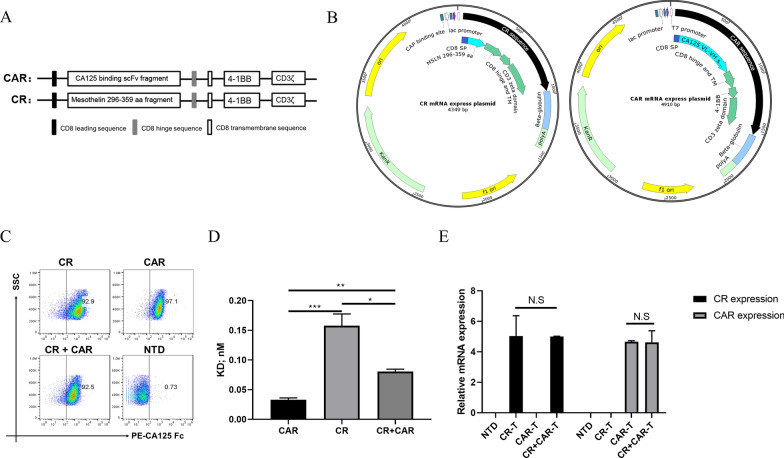
In this study, we developed a novel adoptive T-cell therapy for ovarian cancer based on a chimeric antigen receptor structure. We used a ligand-receptor binding motif to enhance the therapeutic effect of targeting CA125. Since mesothelin can naturally bind to CA125 with high affinity, we concatenated the core-binding fragment of mesothelin with the 4-1BB and CD3ζ signal fragments to assemble a novel CA125-targeting chimeric receptor (CR). The CAR structure targeting CA125 derived from the 4H11 antibody was also constructed. CR- and CAR-encoding RNA were electroporated into T cells to evaluate their antitumor activity both in vitro and in vivo.
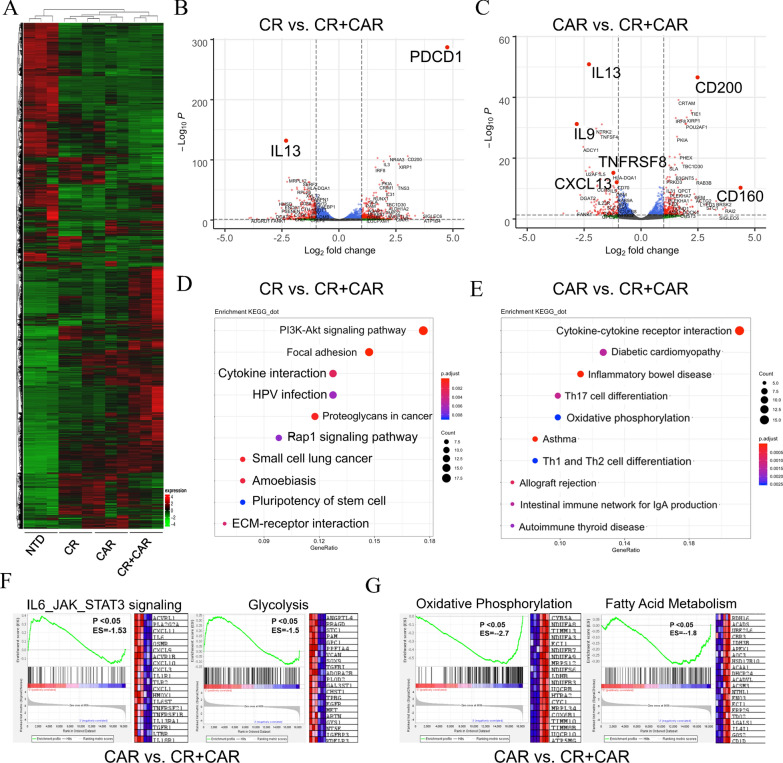
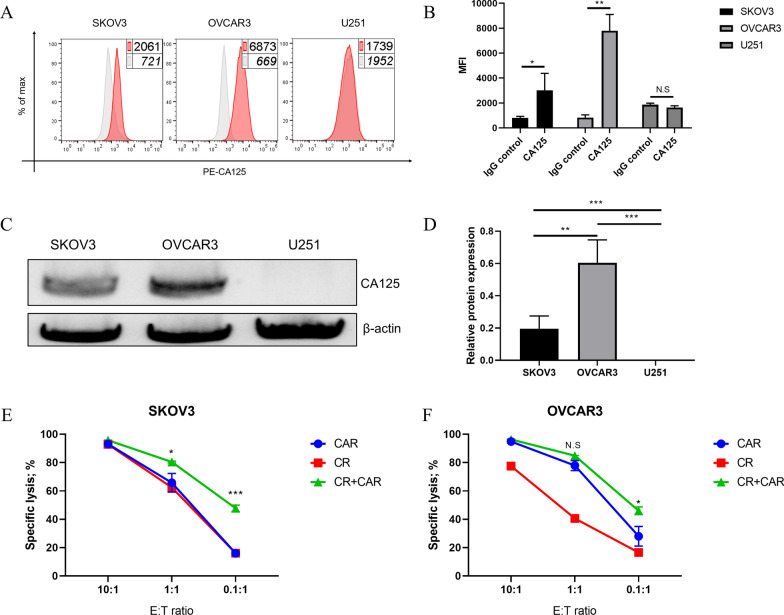
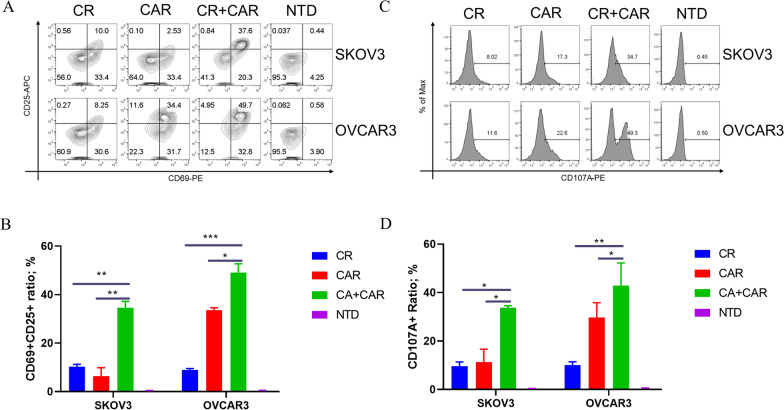
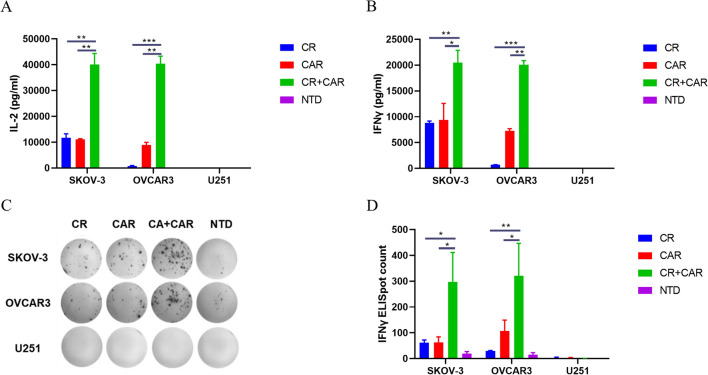
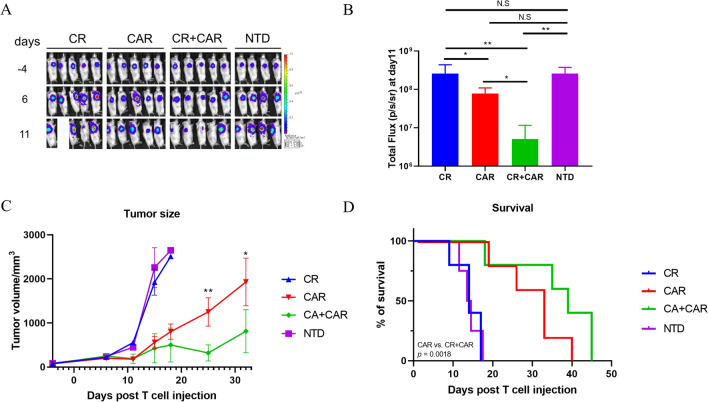
While CR-T or CAR-T cells exhibited moderate activity against two ovarian cancer cell lines, T cells co-expressing CR and CAR exhibited a superior killing effect compared to T cells expressing either CR or CAR alone. Furthermore, upon interaction with ovarian tumors, the ability of CR and CAR T cells to release activation markers and functional cytokines increased significantly. Similarly, CR and CAR co-expressing T cells persistently controlled the growth of transplanted ovarian cancer tumors in NSG mice and significantly prolonged the overall survival of tumor-challenged mice. Transcriptome sequencing revealed that the survival and cytotoxicity of T cells co-expressing CR and CAR were significantly altered compared with those of T cells expressing either CR or CAR.
Our findings demonstrate that CA125 targeting CR and CAR can synergistically kill ovarian cancer cells, indicating that CA125 targeting by the two binding motifs simultaneously in tumors may improve the therapeutic outcomes of ovarian cancer treatment.
卵巢癌(OC)是一种在全球范围内普遍存在的高度侵袭性妇科恶性肿瘤。大多数 OC 病例通常在晚期诊断,这导致接受常规治疗后 5 年总生存率低于 35%。此外,免疫检查点抑制剂疗法在 OC 患者的治疗中显示出有限的疗效,而 CAR-T 疗法也由于 T 细胞浸润不足而显示出中等疗效。因此,必须开发新的策略来增强 T 细胞在 OC 肿瘤微环境中的持久性和迁移。
在这项研究中,我们开发了一种基于嵌合抗原受体结构的新型卵巢癌过继性 T 细胞疗法。我们使用配体-受体结合基序来增强针对 CA125 的治疗效果。由于间皮素可以与 CA125 天然高亲和力结合,我们将间皮素的核心结合片段与 4-1BB 和 CD3ζ 信号片段串联起来,组装成一种新型的 CA125 靶向嵌合受体(CR)。还构建了源自 4H11 抗体的靶向 CA125 的 CAR 结构。将 CR 和 CAR 编码 RNA 电穿孔到 T 细胞中,以评估它们在体外和体内的抗肿瘤活性。
虽然 CR-T 或 CAR-T 细胞对两种卵巢癌细胞系表现出中等活性,但共表达 CR 和 CAR 的 T 细胞与单独表达 CR 或 CAR 的 T 细胞相比表现出优越的杀伤效果。此外,与卵巢肿瘤相互作用时,CR 和 CAR T 细胞释放激活标志物和功能细胞因子的能力显著增加。同样,CR 和 CAR 共表达的 T 细胞持续控制 NSG 小鼠移植的卵巢癌肿瘤的生长,并显著延长了受挑战的肿瘤小鼠的总生存时间。转录组测序显示,与单独表达 CR 或 CAR 的 T 细胞相比,共表达 CR 和 CAR 的 T 细胞的存活和细胞毒性发生了显著改变。
我们的研究结果表明,CA125 靶向 CR 和 CAR 可以协同杀伤卵巢癌细胞,这表明同时在肿瘤中使用两种结合基序靶向 CA125 可能改善卵巢癌治疗的治疗效果。