Department of International Health, Johns Hopkins Bloomberg School of Public Health, Baltimore, Maryland, USA.
Department of Epidemiology, Johns Hopkins Bloomberg School of Public Health, Baltimore, Maryland, USA.
J Trauma Stress. 2023 Oct;36(5):980-992. doi: 10.1002/jts.22967. Epub 2023 Sep 6.
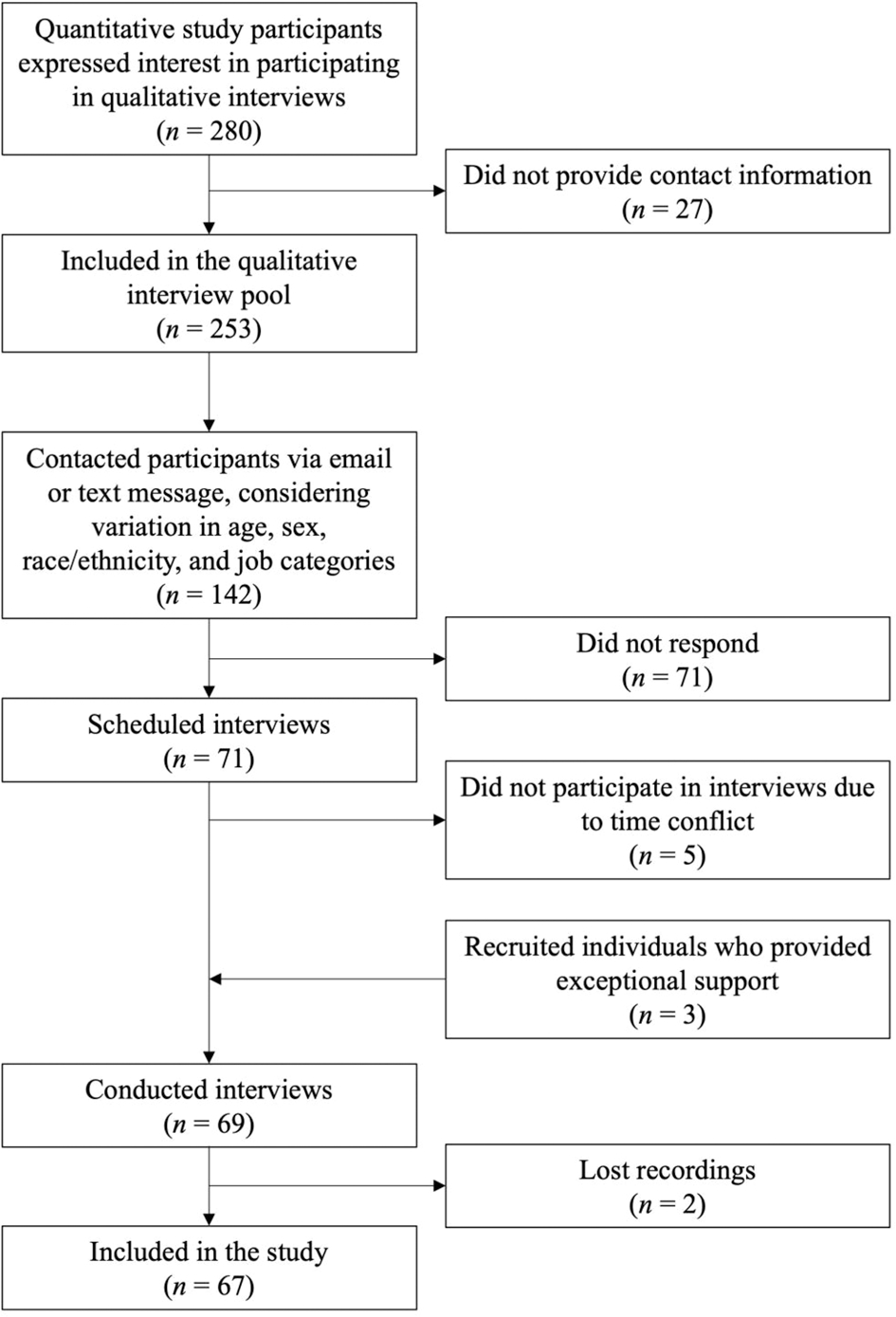
The COVID-19 pandemic has exacted a physical and mental health toll on health care and hospital workers (HHWs). To provide COVID-19 care, HHWs expected health care institutions to support equipment and resources, ensure safety for patients and providers, and advocate for employees' needs. Failure to do these acts has been defined as institutional betrayal. Using a mixed-methods approach, this study aimed to explore the experience of institutional betrayal in HHWs serving COVID-19 patients and the associations between self-reported institutional betrayal and both burnout and career choice regret. Between July 2020 and January 2021, HHWs working in an urban U.S. health care system participated in an online survey (n = 1,189) and semistructured interview (n = 67). Among 1,075 quantitative participants, 57.8% endorsed institutional betrayal. Qualitative participants described frustration when the institution did not prioritize their safety while reporting they perceived receiving inadequate compensation from the system and felt that leadership did not sufficiently respond to their needs. Participants who endorsed prolonged breaches of trust reported more burnout and stronger intent to quit their job. Quantitatively, institutional betrayal endorsement was associated with 3-fold higher odds of burnout, aOR = 2.94, 95% CI [2.22, 3.89], and 4-fold higher odds of career choice regret, aOR = 4.31, 95% CI [3.15, 5.89], compared to no endorsement. Developing strategies to prevent, address, and repair institutional betrayal in HHWs may be critical to prevent and reduce burnout and increase motivation to work during and after public health emergencies.
COVID-19 大流行给医疗保健和医院工作人员(HHWs)的身心健康带来了沉重打击。为了提供 COVID-19 护理,HHWs 期望医疗机构提供设备和资源支持,确保患者和提供者的安全,并倡导员工的需求。未能做到这些被定义为机构背叛。本研究采用混合方法,旨在探讨为 COVID-19 患者服务的 HHWs 经历机构背叛的体验,以及自我报告的机构背叛与倦怠和职业选择后悔之间的关联。2020 年 7 月至 2021 年 1 月期间,在美国一家城市医疗保健系统工作的 HHWs 参与了一项在线调查(n=1189)和半结构化访谈(n=67)。在 1075 名定量参与者中,有 57.8%的人表示经历过机构背叛。定性参与者描述了机构在报告时不优先考虑他们的安全,而他们认为自己从系统中获得的补偿不足,并感到领导层没有充分回应他们的需求时的沮丧。报告经历长期信任破裂的参与者表示倦怠程度更高,辞职意愿更强。从定量上看,与不支持机构背叛的参与者相比,支持机构背叛的参与者倦怠的可能性增加了两倍多,OR=2.94,95%CI[2.22,3.89],职业选择后悔的可能性增加了四倍多,OR=4.31,95%CI[3.15,5.89]。在大流行期间和之后,制定预防、解决和修复 HHWs 中机构背叛的策略可能对于预防和减少倦怠以及提高工作动力至关重要。