Abd-Dada Hassane, Bouda Said, Khachtib Youssef, Bella Youssef Ait, Haddioui Abdelmajid
Laboratory of Agro-Industrial and Medical Biotechnologies, Faculty of Sciences and Techniques, Sultan Moulay Slimane University, Beni Mellal, Morocco.
J Genet Eng Biotechnol. 2023 Sep 6;21(1):91. doi: 10.1186/s43141-023-00543-4.
Euphorbia resinifera is a melliferous, medicinal, and endemic plant to Morocco. Nevertheless, its ecological and genetic diversity still unknown. The objective of this study is to analyze the diversity and genetic structure of Moroccan wild populations of E. resinifera using ISSR markers. Twelve natural populations collected from its geographical range in Morocco were analyzed using 14 ISSR primers.
A total of 125 bands were obtained, with polymorphism of 74.81%. The polymorphic information content (PIC), resolving power (Rp), Shannon's information index (I), and total genetic diversity (Ht) were 0.33, 2.8, 0.35, and 0.21, respectively. The analysis of molecular variance showed that 75.56% of the total variability is present within populations and that 24.44% exists among populations. Also, the analysis showed a very low genetic differentiation between groups of mountain range type (FCT = 0.066), mountain versant type groups (FCT = -0.024), and altitude groups (FCT = -0.022). Moreover, the geographical distances between populations are correlated with their corresponding genetic distances according to the Mantel test (r = 0.507; P < 0.0001).
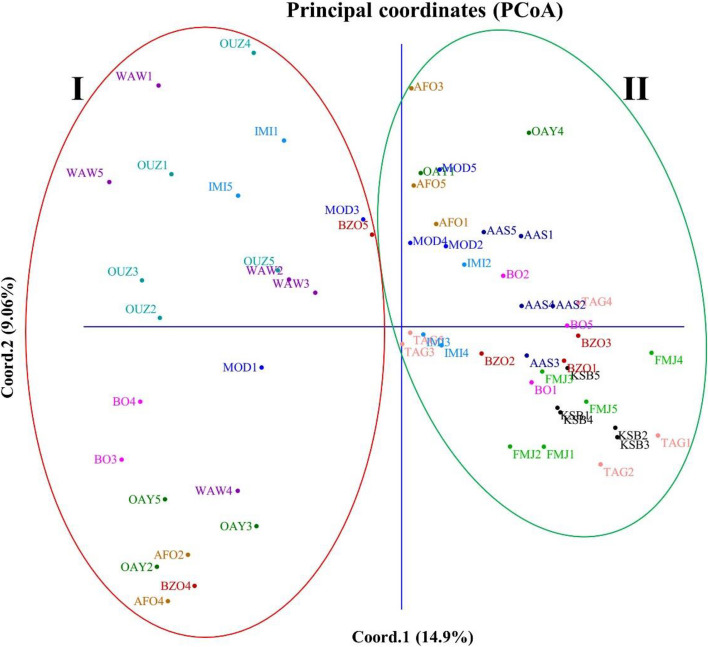
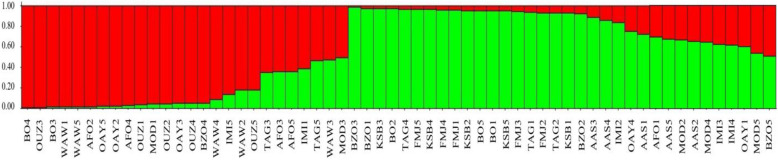
These results suggest that the population structuring follows a model of isolation by geographical distance. Indeed, the genetic structuring of populations into two groups obtained from PCoA and structure analysis revealed a dependence on the geographical origin of the populations. By contrast, the genetic distances are not correlated with the altitude.
树脂大戟是一种产蜜、具有药用价值的摩洛哥特有植物。然而,其生态和遗传多样性仍然未知。本研究的目的是使用ISSR标记分析摩洛哥野生树脂大戟种群的多样性和遗传结构。使用14个ISSR引物对从摩洛哥地理范围内收集的12个自然种群进行了分析。
共获得125条带,多态性为74.81%。多态信息含量(PIC)、分辨力(Rp)、香农信息指数(I)和总遗传多样性(Ht)分别为0.33、2.8、0.35和0.21。分子方差分析表明,总变异的75.56%存在于种群内,24.44%存在于种群间。此外,分析显示山脉类型组(FCT = 0.066)、山坡类型组(FCT = -0.024)和海拔组(FCT = -0.022)之间的遗传分化非常低。此外,根据Mantel检验,种群之间的地理距离与其相应的遗传距离相关(r = 0.507;P < 0.0001)。
这些结果表明,种群结构遵循地理距离隔离模型。确实,从主坐标分析(PCoA)和结构分析得出的种群遗传结构分为两组,这揭示了对种群地理起源的依赖性。相比之下,遗传距离与海拔无关。