Tang Wuli, Xie Gang, Li Junlin, Tan Wei, Yi Rongqi, Yang Ling, Zhang Lingqin, Deng Jiaxing, Zhang Yue, Li Kang
Chongqing Medical University, Chongqing, China.
Chongqing Institute of Green and Intelligent Technology, Chinese Academy of Sciences, Chongqing, China.
Front Nutr. 2023 Aug 21;10:1251448. doi: 10.3389/fnut.2023.1251448. eCollection 2023.
The disease activity status and behavior of Crohn's disease (CD) can reflect the severity of the disease, and changes in body composition are common in CD patients.
The aim of this study was to investigate the relationship between body composition parameters and disease severity in CD patients treated with infliximab (IFX).
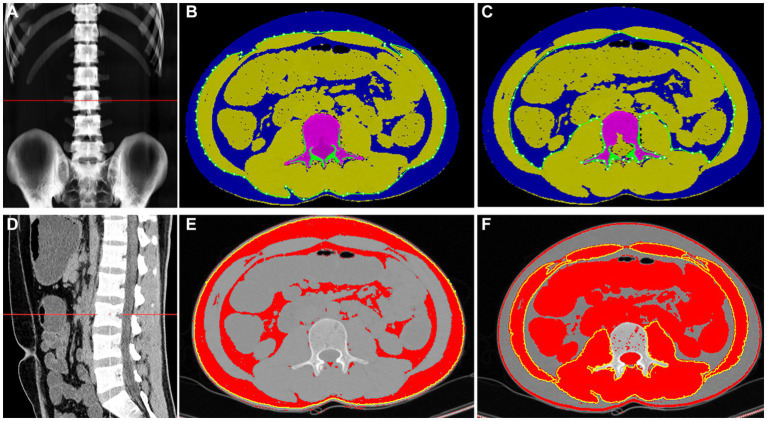
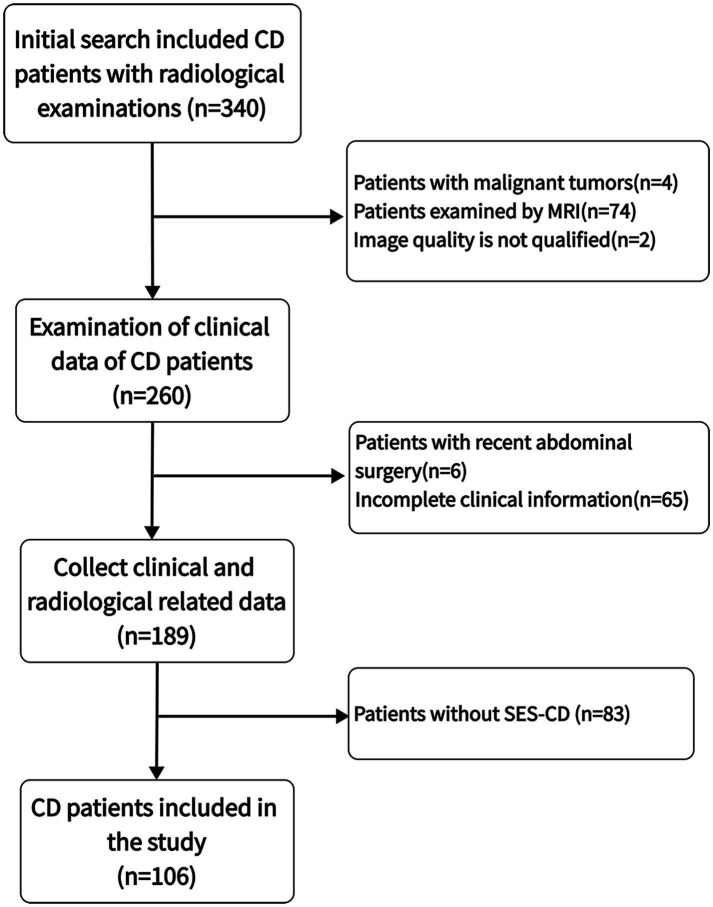
Patients with CD assessed with the simple endoscopic score (SES-CD) and were treated with IFX were retrospectively collected, and body composition parameters at the level of the 3rd lumbar vertebrae were calculated from computed tomography (CT) scans of the patients. The correlation of patients' body composition parameters with disease activity status and disease behavior was analyzed, and the diagnostic value of the relevant parameters was assessed using receiver operating characteristic (ROC) curves.
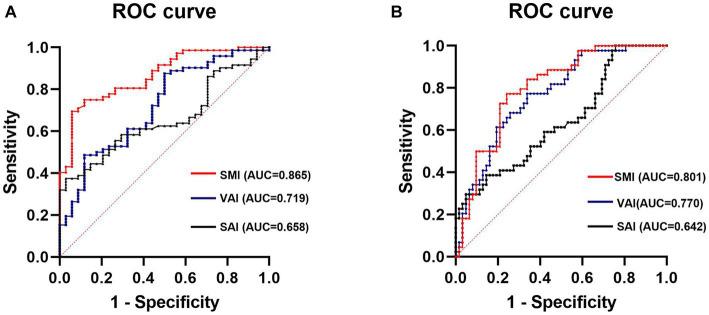
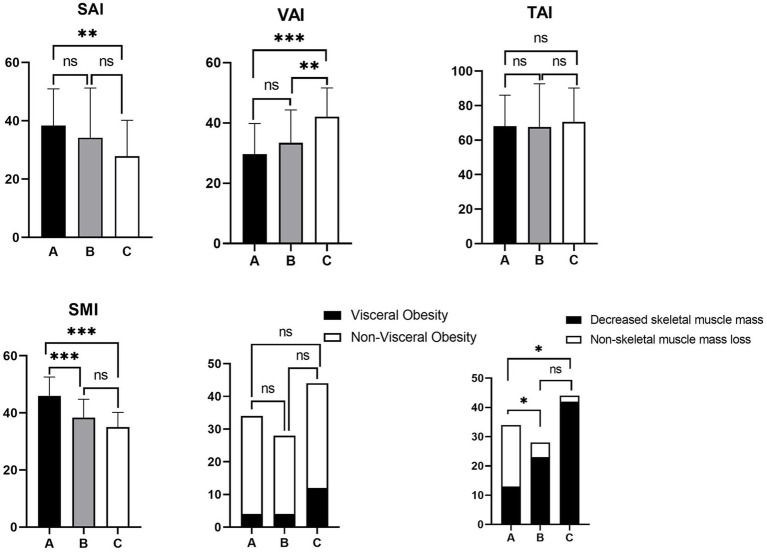
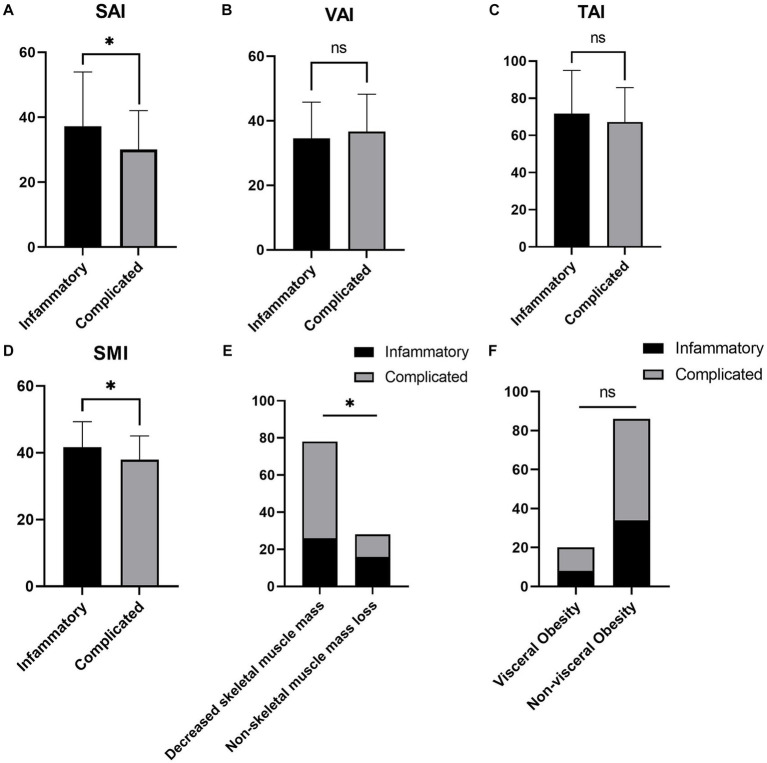
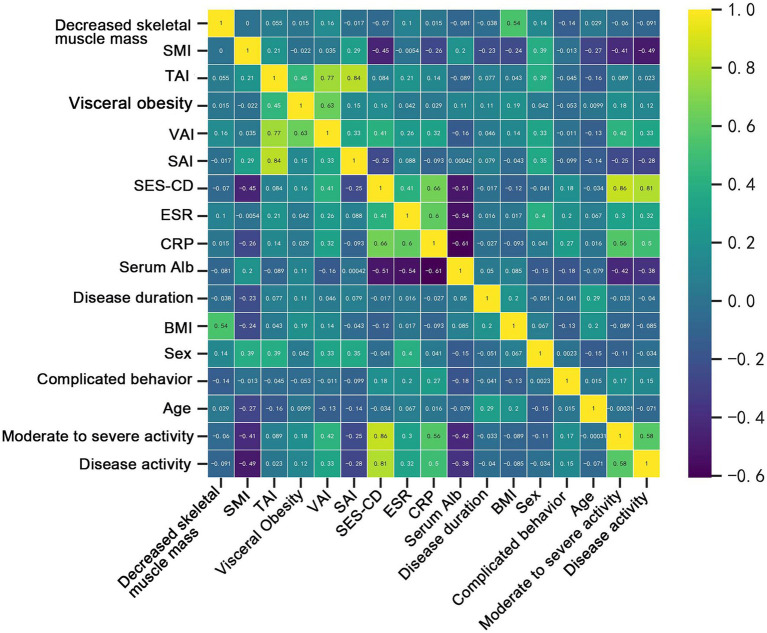
A total of 106 patients were included in this study. There were significant differences in the subcutaneous adiposity index (SAI) ( = 0.010), the visceral adiposity index (VAI) ( < 0.001), the skeletal muscle mass index (SMI) ( < 0.001), and decreased skeletal muscle mass ( < 0.001) among patients with different activity status. After Spearman and multivariate regression analysis, SAI ( = 0.006 and = 0.001), VAI ( < 0.001 and < 0.001), and SMI ( < 0.001and = 0.007) were identified as independent correlates of disease activity status (both disease activity and moderate-to-severe activity), with disease activity status independently positively correlated with SAI and SMI and independently negatively correlated with VAI. In determining the disease activity and moderate-to-severe activity status, SMI performed best relative to SAI and VAI, with areas under the ROC curve of 0.865 and 0.801, respectively. SAI ( = 0.015), SMI ( = 0.011) and decreased skeletal muscle mass ( = 0.027) were significantly different between different disease behavior groups (inflammatory disease behavior group, complex disease behavior group) but were not independent correlates ( > 0.05).
Body composition parameters of CD patients treated with IFX correlate with the endoscopic disease severity, and SMI can be used as a reliable indicator of disease activity status.
克罗恩病(CD)的疾病活动状态和行为可反映疾病的严重程度,且CD患者身体成分会发生常见变化。
本研究旨在探讨接受英夫利昔单抗(IFX)治疗的CD患者身体成分参数与疾病严重程度之间的关系。
回顾性收集经简单内镜评分(SES-CD)评估且接受IFX治疗的CD患者,通过患者的计算机断层扫描(CT)图像计算第三腰椎水平的身体成分参数。分析患者身体成分参数与疾病活动状态及疾病行为的相关性,并使用受试者工作特征(ROC)曲线评估相关参数的诊断价值。
本研究共纳入106例患者。不同活动状态患者的皮下脂肪指数(SAI)(P = 0.010)、内脏脂肪指数(VAI)(P < 0.001)、骨骼肌质量指数(SMI)(P < 0.001)及骨骼肌质量降低(P < 0.001)存在显著差异。经Spearman和多因素回归分析,SAI(P = 0.006和P = 0.001)、VAI(P < 0.001和P < 0.001)及SMI(P < 0.001和P = 0.007)被确定为疾病活动状态(包括疾病活动和中重度活动)的独立相关因素,疾病活动状态与SAI和SMI独立正相关,与VAI独立负相关。在判断疾病活动和中重度活动状态时,相对于SAI和VAI,SMI表现最佳,其ROC曲线下面积分别为0.865和0.801。不同疾病行为组(炎症性疾病行为组、复杂性疾病行为组)之间SAI(P = 0.015)、SMI(P = 0.011)及骨骼肌质量降低(P = 0.027)存在显著差异,但并非独立相关因素(P > 0.05)。
接受IFX治疗的CD患者的身体成分参数与内镜下疾病严重程度相关,且SMI可作为疾病活动状态的可靠指标。