de Morais David Gomes, Sanches Talita Rojas Cunha, Santinho Mirela Aparecida Rodrigues, Yada Eduardo Yuki, Segura Gabriela Cardoso, Lowe Diogo, Navarro Guilherme, Seabra Victor Faria, Taniguchi Leandro Utino, Malbouisson Luiz Marcelo Sá, de André Carmen Diva Saldiva, Andrade Lúcia, Rodrigues Camila Eleuterio
Hospital das Clínicas da Faculdade de Medicina da Universidade de São Paulo (HCFMUSP), Disciplina de Nefrologia, Faculdade de Medicina, Universidade de São Paulo, São Paulo, Brazil.
Centro de Estatística Aplicada, Instituto de Matemática e Estatística, Universidade de São Paulo, São Paulo, Brazil.
Front Nephrol. 2022 Sep 30;2:929743. doi: 10.3389/fneph.2022.929743. eCollection 2022.
The incidence of acute kidney injury (AKI) is high in intensive care units (ICUs), and a better understanding of AKI is needed. Early chronic kidney disease is associated with urinary concentration inability and AKI recovery with increased urinary solutes in humans. Whether the inability of the kidneys to concentrate urine and excrete solutes at appropriate levels could occur prior to the diagnosis of AKI is still uncertain, and the associated mechanisms have not been studied.
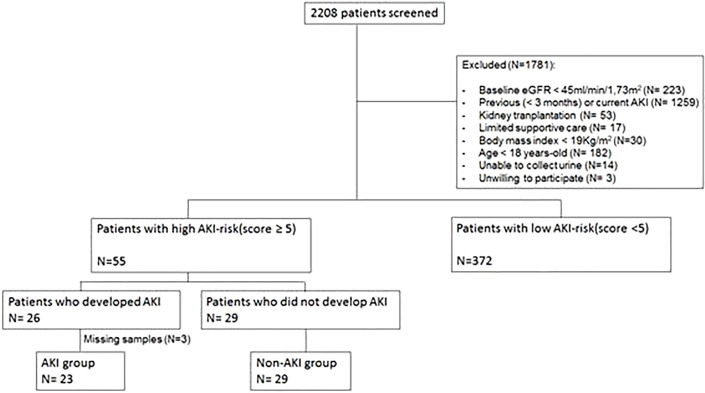
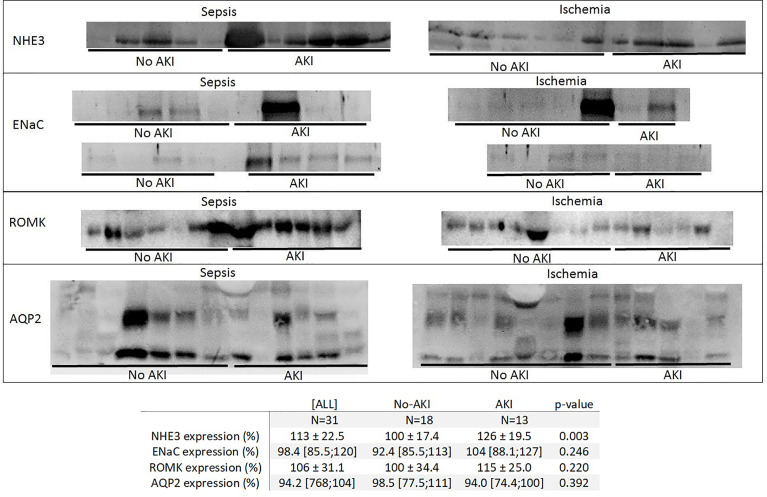
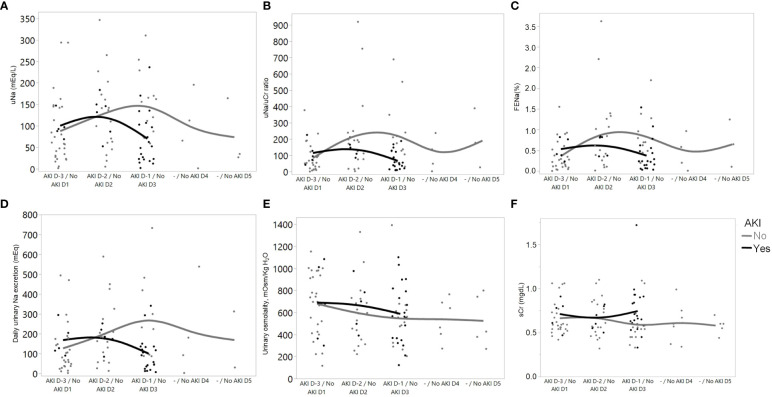
In this single-center prospective observational study, high AKI risk in ICU patients was followed up for 7 days or until ICU discharge. They were grouped as "AKI" or "No AKI" according to their AKI status throughout admission. We collected daily urine samples to measure solute concentrations and osmolality. Data were analyzed 1 day before AKI, or from the first to the fifth day of admission in the "No AKI" group. We used logistic regression models to evaluate the influence of the variables on future AKI diagnosis. The expression of kidney transporters in urine was evaluated by Western blotting.
We identified 29 patients as "No AKI" and 23 patients as "AKI," the latter being mostly low severity AKI. Urinary sodium excretion was lower in "AKI" patients prior to AKI diagnosis, particularly in septic patients. The expression of Na+/H+ exchanger (NHE3), a urinary sodium transporter, was higher in "AKI" patients.
Urinary sodium excretion is low before an AKI episode in ICU patients, and high expressions of proximal tubule sodium transporters might contribute to this.
急性肾损伤(AKI)在重症监护病房(ICU)的发病率很高,因此需要更好地了解AKI。早期慢性肾病与尿液浓缩功能障碍以及人类AKI恢复时尿溶质增加有关。在AKI诊断之前,肾脏是否无法以适当水平浓缩尿液和排泄溶质仍不确定,相关机制也尚未得到研究。
在这项单中心前瞻性观察研究中,对ICU患者的高AKI风险进行了7天的随访或直至ICU出院。根据他们在整个住院期间的AKI状态,将他们分为“AKI”组或“无AKI”组。我们每天收集尿液样本以测量溶质浓度和渗透压。在AKI前1天或“无AKI”组入院的第1天至第5天对数据进行分析。我们使用逻辑回归模型来评估变量对未来AKI诊断的影响。通过蛋白质印迹法评估尿液中肾转运蛋白的表达。
我们将29例患者确定为“无AKI”,23例患者确定为“AKI”,后者大多为低严重程度的AKI。在AKI诊断前,“AKI”患者的尿钠排泄较低,尤其是脓毒症患者。尿钠转运蛋白钠/氢交换体(NHE3)在“AKI”患者中的表达较高。
ICU患者在发生AKI之前尿钠排泄较低,近端小管钠转运蛋白的高表达可能是其原因。