Yokokawa Takashi, Suzuki Kenichi, Tsuji Daiki, Hosonaga Mari, Kobayashi Kazuo, Kawakami Kazuyoshi, Kawazoe Hitoshi, Nakamura Tomonori, Suzuki Wataru, Sugisaki Takahito, Aoyama Takeshi, Hashimoto Koki, Hatori Masahiro, Tomomatsu Takuya, Inoue Ayaka, Azuma Keiichi, Asano Maimi, Takano Toshimi, Ohno Shinji, Yamaguchi Masakazu
Department of Pharmacy, Cancer Institute Hospital of Japanese Foundation for Cancer Research, Tokyo, Japan.
Department of Clinical Pharmacology, School of Pharmacy, Tokyo University of Pharmacy and Life Sciences, Tokyo, Japan.
Cancer Med. 2023 Sep;12(18):18745-18754. doi: 10.1002/cam4.6494. Epub 2023 Sep 7.
Female sex and younger age are reported risk factors for chemotherapy-induced nausea and vomiting (CINV) in highly emetogenic chemotherapy, but the underlying mechanism has not been elucidated. The purpose of this study was to clarify the impact of menopause on CINV.
This retrospective observational study analyzed data from consecutive patients who received their first cycle of perioperative anthracycline-based chemotherapy for breast cancer between January 2018 and June 2020. The endpoints were association between CINV (vomiting, ≥Grade 2 nausea, complete response [CR] failure) and menopause as well as the association between CINV and follicle-stimulating hormone [FSH]/estradiol [E2].
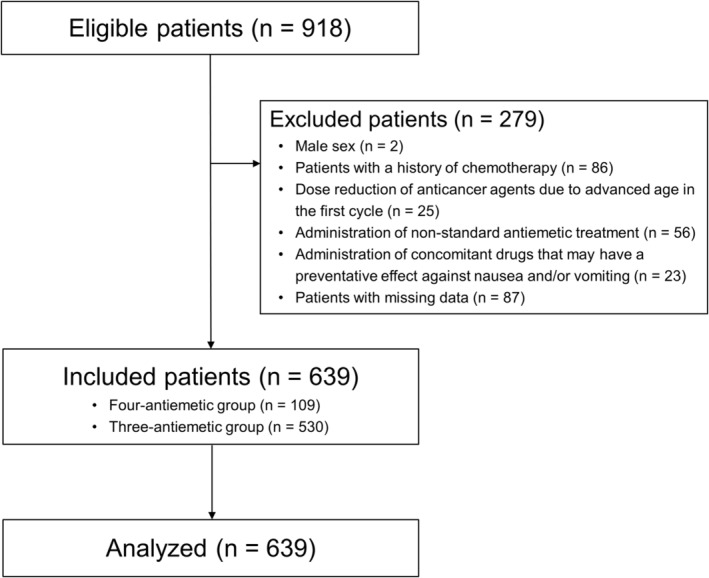
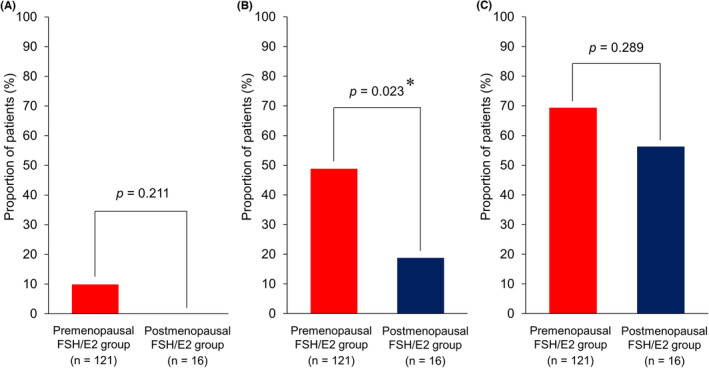
Data for 639 patients were analyzed. Among these patients, 109 (17.1%) received olanzapine (four antiemetic combinations) and 530 (82.9%) did not (three antiemetic combinations). Premenopausal state (amenorrhea lasting ≥12 months) was significantly associated with ≥Grade 2 nausea and CR failure in univariate analysis but not in multivariate analysis. The premenopausal FSH/E2 group (defined by serum levels; FSH <40 mIU/mL and E2 ≥20 pg/mL) had a significantly higher rate of ≥Grade 2 nausea than the postmenopausal FSH/E2 group (FSH ≥40 mIU/mL and E2 <20 pg/mL) (48.8% vs. 18.8%, p = 0.023).
Our results suggest that changes in FSH and E2 due to menopause may affect the severity of nausea and that FSH and E2 (especially FSH) levels might be useful indicators for CINV risk assessment.
在高致吐性化疗中,女性性别和较年轻年龄被报道为化疗引起的恶心和呕吐(CINV)的风险因素,但潜在机制尚未阐明。本研究的目的是阐明绝经对CINV的影响。
这项回顾性观察性研究分析了2018年1月至2020年6月期间接受乳腺癌围手术期蒽环类化疗首个周期的连续患者的数据。终点是CINV(呕吐、≥2级恶心、完全缓解[CR]失败)与绝经之间的关联以及CINV与促卵泡生成素[FSH]/雌二醇[E2]之间的关联。
分析了639例患者的数据。在这些患者中,109例(17.1%)接受了奥氮平(四种止吐联合用药),530例(82.9%)未接受(三种止吐联合用药)。在单因素分析中,绝经前状态(闭经持续≥12个月)与≥2级恶心和CR失败显著相关,但在多因素分析中并非如此。绝经前FSH/E2组(根据血清水平定义;FSH<40 mIU/mL且E2≥20 pg/mL)的≥2级恶心发生率显著高于绝经后FSH/E2组(FSH≥40 mIU/mL且E2<20 pg/mL)(48.8%对18.8%,p = 0.023)。
我们的结果表明,绝经引起的FSH和E2变化可能影响恶心的严重程度,并且FSH和E2(尤其是FSH)水平可能是CINV风险评估的有用指标。